Accreditation and Certification Fraud in IT

December 27, 2024

Many people in the academic integrity world are already familiar with contract cheating websites, those that deal in the business of buying and selling exams, bespoke term papers, theses, and exam questions and answers.

But this business isn’t limited to the millions of K-12, high school and post-secondary students. The exam fraud business is alive and well for professional accreditation exams for folks who either want to bypass a formal university degree or to supplement existing credentials.

For example, in the IT industry credentials are often the golden key to new opportunities. Certifications and accreditations (allegedly) validate technical skills, offering (so-called) proof that a candidate has the expertise needed for a professional role. 

Taking into account supply and demand, with job candidates being in high supply and well-paying jobs being in high demand, certification and accreditation fraud is alive and well in the IT industry, as well as other industries. This is a trend employers cannot afford to ignore.

Exposing the Fraud: How Buying and Selling of Certification Exam Questions Works

Certification fraud occurs when individuals falsify credentials, purchase counterfeit certifications, or misuse legitimate certifications obtained by others. But there’s this sneaky grey area that exists when a person actually sits a professional exam themselves, but they’ve prepared by buying the exam questions and/or the answers from an online vendor.

I won’t name specific companies that do this in this post, because I’m not in the habit of advertising for these fraudsters, but I want to show you how they work, so here are some screenshots:

Screenshot #1: Home page

A website screenshot. Black background, with text in white and blue. Some of the text is quoted in the narrative that follows.

At the top of this website, the company claims that 94% of the exam questions that they sold were “almost the same” and that 97% of customers passed the exam using their materials. (Who knows what happened to the other 3%…?) Finally, 98% of customers found the “study guides” effective and helpful.

There’s that phrase that we commonly see on contract cheating websites, “study guide”. For the uninitiated, this is a euphemism for “exam questions”. 

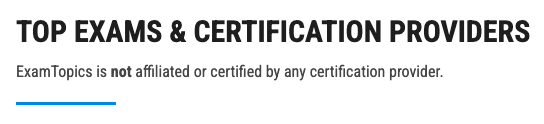
Screenshot #2: Saying it like it is: Not affiliated with any certification provider

A website screenshot. White background with black text.

In this screenshot the company states plainly that they are not affiliated or certified by any certification provider. Reading between the lines, the message is ‘caveat emptor’ or ‘buyer beware’. They are telling you upfront that they are in the business of selling exam questions and make no guarantees about their products.

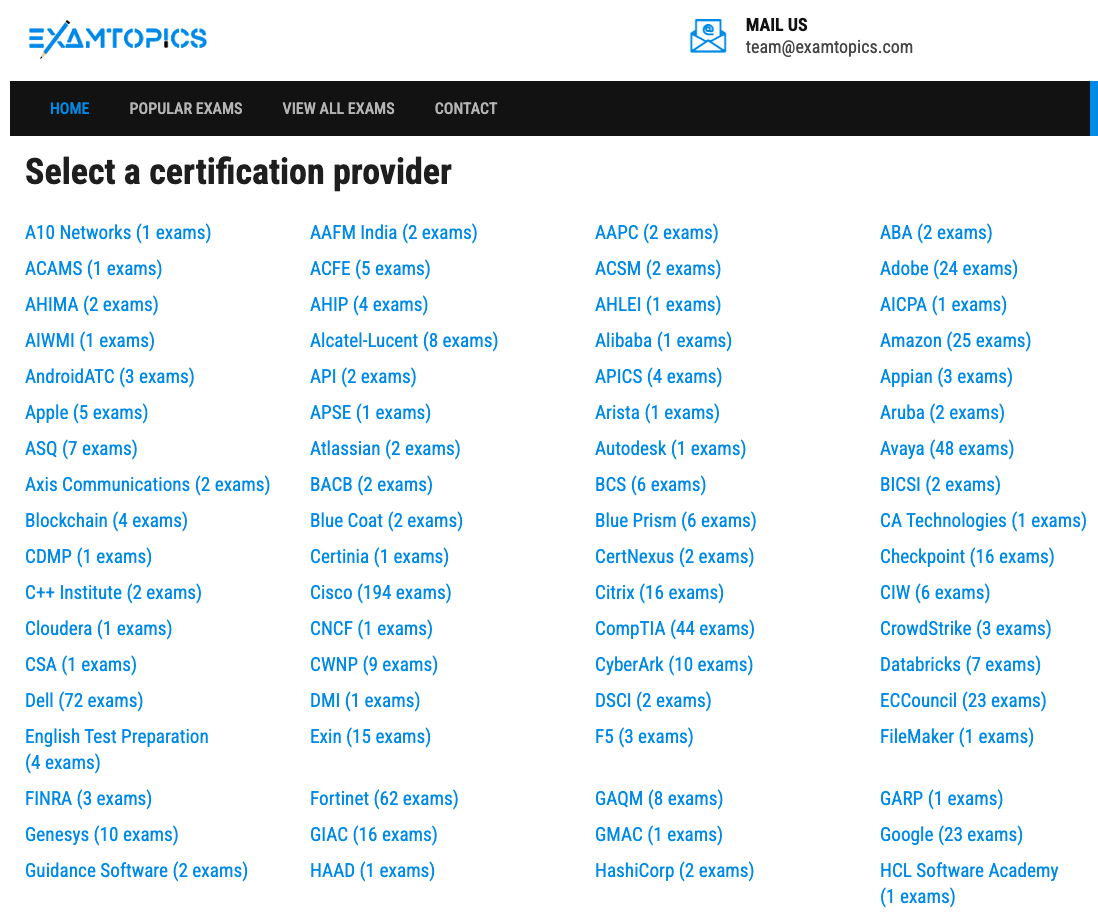
Screenshot #3: Samples of accreditation exam questions for sale

A website screenshot. White background. Black task bar with light grey text. There are lists of texts written in blue.

Look at all the options: You can buy exam questions for certifications offered by DELL, English language proficiency exams, Citrix, Adobe, and Amazon, and Google just to name a few. 

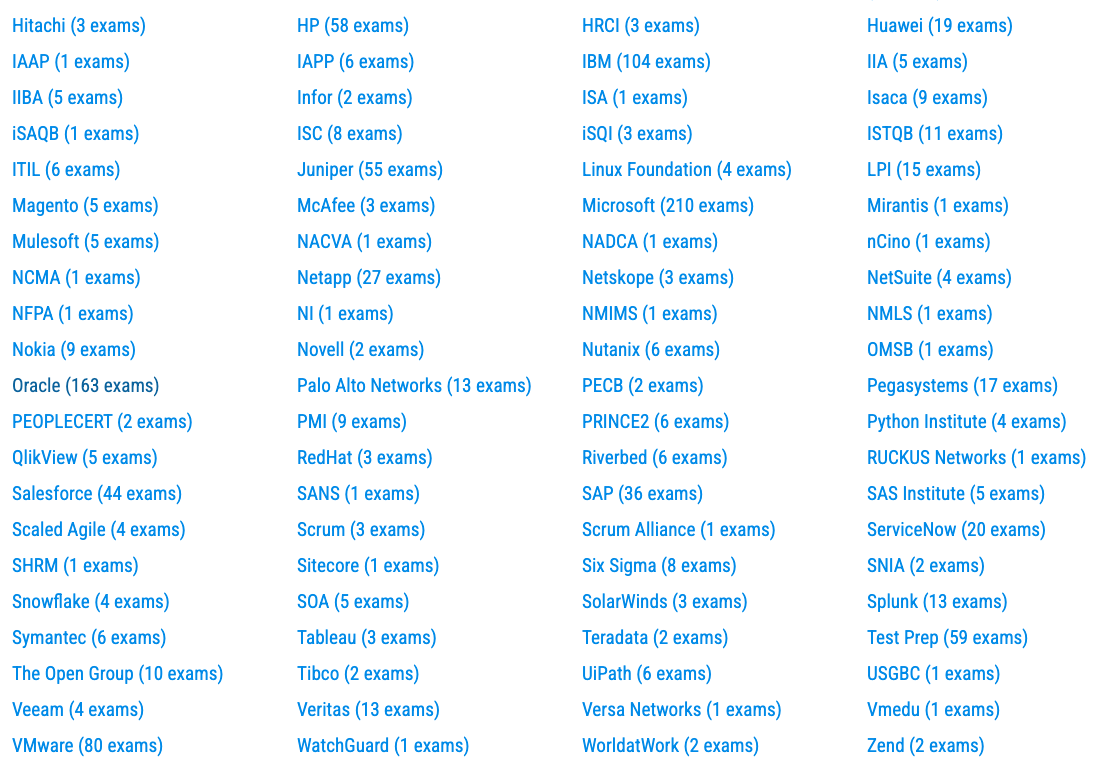
Screenshot #4: More samples of certification provider exam questions for sale.

A website screenshot. White background. Black task bar with light grey text. There are lists of texts written in blue.

But wait! There’s more! You can buy exam questions for certifications offers by Oracle, IBM, SAP, and others.

Assessment Security

Sites like compromise the assessment security of certification exams that are meant to qualify individuals to do a particular job. If this term is new to you, I recommend Professor Phill Dawson’s book, Defending Assessment Security in a Digital World. For a quick (and free) overview, of Phill’s work, this slide deck from one of his presentations is worth checking out.

Businesses that buy and sell exam certification questions engage in fraudulent practices undermine trust in the certification system and create significant risks for employers.

Consequences for Employers

Hiring someone with counterfeit credentials can have dire consequences. Unqualified employees may lack the technical skills to handle complex tasks, leading to project delays, costly errors, or even security breaches. Beyond the financial impact, fraudulent certifications can erode team morale, as employees with genuine qualifications may feel undervalued when working alongside those who faked their way in.

What Employers and Hiring Managers can Do

Employers, and especially hiring managers and those working in HR, must take proactive steps to safeguard their hiring processes. Some of you may be asking if this kind of practice is actually illegal. I’m not a lawyer, but what I can say is that although contact cheating for students is illegal in countries like Australia, the UK, and Ireland, if you’re not a student, then you might get to live a proverbial grey zone. To the best of my knowledge, it is not actually illegal to buy and sell questions for professional certification exams in most countries of the world.

So, what can employers do? First, trust but verify! Verifying certifications directly with issuing organizations is one step. Many certification bodies offer easy online verification tools to confirm a candidate’s credentials. Additionally, employers should stay informed about recognized accreditation standards and avoid unverified institutions. 

Having said this, verification of credentials and certification won’t help if someone has bought exam questions online and then taken the test themselves. Their results could be ‘verifiable’ in a sense, because there’s an assumption that a person who has passed an exam had the knowledge to do so. But when someone buys their exam questions before sitting the test, it means that they have prepared for an exam and may not necessarily have internalized the knowledge or skills that should match the certification they receive from passing an exam. An exam is one measure of knowledge, but it isn’t the only one. 

Having prospective employees demonstrate their skills and respond to technical questions that could only be answered if the person has the knowledge to back up their documentation can also help. One possibility is to give an interviewee a real-world scenario that could happen at your organization. Ask them how they would go about problem-solving it. If they struggle or stumble, it could be a sign that they lack the necessary skills for the job. (It could also be a sign that they’re just nervous or that interviewing isn’t their strength. So let me also make a plug here for having an inclusive and equitable interviewing process.)

Investing in robust, inclusive, and equitable hiring practices not only protects an organization from the pitfalls of fraud but also helps to create a culture of accountability and excellence. By placing a premium on authentic certifications combined with demonstrable knowledge and skills and inclusive hiring practices, employers signal their commitment to integrity and ensure they are building a team of qualified professionals.

Bottom line: If you’re hiring someone who says they have an IT certification based on taking exams, it’s worth it to find out if they actually have the knowledge and skills to do the job. 

And this is just one example of one site. Rest assured that it is not the only one out there. Exam cheating companies like this one don’t exist in isolation. They’re in the game to make money, and lots of it. 

In an industry where skills and knowledge drive success, vigilance against certification and accreditation fraud is not optional—it is a driver of success.

Future Outlook

Fraud and corruption are alive and well education and industry. There is a growing community of sleuths, scholars, and activists who are ready to sniff out fraud and expose it and naïveté about these matters is quickly going out of fashion. 

There may have been a time when it was acceptable—or even fashionable—to clutch your pearls, proclaim moral outrage, or just refuse to accept that educational and professional fraud are more commonplace than you might have previously thought. GenAI is here to stay, and so are companies whose business is educational, accreditation, scientific, and professional fraud. These companies are profitable because they have customers willing to pay for their goods and services.

Vigilance, sleuthing, and exposing fraud are very much on trend as we move ahead into the new year. And if you’re a hiring manager, taking steps to protect the integrity of your operations is definitely part of the job in 2025 and beyond.

References and Further Reading

Carmichael, J. (2023, June 7). Understanding Fake Degrees and Credential Fraud in Higher Ed. The Evollution: A Modern Campus Illumination. https://evolllution.com/programming/credentials/understanding-fake-degrees-and-credential-fraud-in-higher-ed/

Eaton, S. E., & Carmichael, J. (2022). The Ecosystem of Commercial Academic Fraud. In. Calgary, Canada: University of Calgary. https://dx.doi.org/10.11575/PRISM/40330

Eaton, S. E., Carmichael, J., & Pethrick, H. (Eds.). (2023). Fake degrees and credential fraud in higher education. Springer. https://doi.org/10.1007/978-3-031-21796-8

Related posts

________________________

Share this post: Accreditation and Certification Fraud in IT – https://drsaraheaton.com/2024/12/27/accreditation-and-certification-fraud-in-the-it-world/

This blog has had over 3 million views thanks to readers like you. If you enjoyed this post, please “like” it or share it on social media. Thanks!

Sarah Elaine Eaton, PhD, is a Professor and Research Chair in the Werklund School of Education at the University of Calgary, Canada. Opinions are my own and do not represent those of my employer. 


Embracing Open Access: My Scholarly Commitment to Shared Knowledge

December 8, 2024

As I prepare for the 2024-2025 Werklund Distinguished Research Lecture, I’ve been reflecting about how important it is to make scholarly work accessible to all. Open access (OA) is more than just a publishing model—it is a philosophy that challenges traditional barriers to knowledge dissemination and embodies the true spirit of academic scholarship.

Breaking Down Barriers to Knowledge

Historically (at least in my lived historical experience in higher education), academic research has been locked behind expensive paywalls, creating a significant divide that extends far beyond academic institutions. This exclusionary model particularly impacts researchers and knowledge seekers who find themselves on the margins of academic privilege. Researchers in middle and low-income countries (LMICs) often struggle to access scholarly and scientific literature and independent scholars and community practitioners face substantial financial barriers to staying current in their fields. Students and educators with limited institutional resources find themselves cut off from the latest scholarly insights, and curious members of the public are shut out from understanding complex academic work that could potentially transform their understanding of the world.

The Ethical Imperative of Sharing

Research is fundamentally about advancing human understanding, and restricting access undermines this core mission. Open access is commitment to knowledge as a public good, enabling a more dynamic and inclusive approach to scholarly communication. By removing economic and institutional barriers, we create opportunities for faster dissemination of critical findings, increased global collaboration, and unprecedented transparency in research methodologies. This approach allows for more rapid scientific and social progress, breaking down the traditional silos that have long constrained academic discourse.

Amplifying Research Impact

Contrary to traditional concerns, open access actually enhances the visibility and influence of scholarly work. Publications that are freely available receive more citations and reach broader audiences. This expanded reach afforded through OA creates opportunities for interdisciplinary and transdisciplinary connections that might otherwise remain unexplored, allowing research to transcend the narrow confines of specialized academic journals and engage with a more diverse intellectual ecosystem.

Personal Commitment and Broader Vision

As I prepare for this lecture, I am reflecting deeply about my commitment to open access (OA). One of my goals is to create a more equitable, informed, and connected world. This isn’t only about making documents freely downloadable, but also about cultivating a more inclusive intellectual landscape where knowledge can flow freely, unencumbered by economic or institutional constraints.

Practical Pathways to Open Access

For researchers considering this path, the journey involves strategic choices and institutional engagement. I am grateful for the privilege of working at the University of Calgary where researchers can self-archive their works into our institutional digital repository, PRISM. 

Our university supports infrastructures that recognize and reward open access scholarship. Not everyone has this privilege.

Navigating Copyright and Publisher Agreements

Having said all this, I also recognize that it is important to abide by existing copyright agreements with publishers. Academic publishing involves complex legal and contractual relationships. Each publication typically comes with specific copyright terms that must be honoured (both ethically and legally), which may limit immediate or unrestricted sharing. 

Because of this, I won’t be able to share all my work with a Creative Commons licence— not if a publisher holds the copyright. It does mean that I will look for creative and ethical ways to maximize access while maintaining professional integrity and contractual obligations.

Concluding reflections

Open access is not just about free downloads—it’s about free thinking, free exploration, and our commitment to knowledge being a universal right, not a privileged access. The longer I work in higher education, the more I am thinking about the future of knowledge, teaching, learning, and creating opportunities for others to thrive. This is really what is driving me right now — creating opportunities for others to thrive. Making as much of my work freely available as open access resources is one way I can do this.

Here are some places you can find my work:

Google Scholar

Research Gate

University of Calgary PRISM digital repository

As we get closer to the lecture, I’ll be making more and more of my work available as free open access downloads. I’ll keep you updated as we get closer to the lecture.

Related posts

Re-released as a Free Open Access Resource: 101 Ways to Market Your Language Program (2002)

________________________

Share this post: Embracing Open Access: My Scholarly Commitment to Shared Knowledge – https://drsaraheaton.com/2024/12/08/embracing-open-access-my-scholarly-commitment-to-shared-knowledge/

This blog has had over 3 million views thanks to readers like you. If you enjoyed this post, please “like” it or share it on social media. Thanks!

Sarah Elaine Eaton, PhD, is a Professor and Research Chair in the Werklund School of Education at the University of Calgary, Canada. Opinions are my own and do not represent those of my employer.


Future-proofing integrity in the age of artificial intelligence and neurotechnology: Prioritizing human rights, dignity, and equity

November 13, 2024

Once a year I write an editorial for the International Journal for Educational Integrity. I take a big idea, ground it in literature written by some of the best in the world and then call for ways to improve our field even more. In 2023 I wrote about Postplagiarism and in 2022, I focused on equity, diversity, inclusion, accessibility and decolonization as new priorities for academic integrity. Here is this year’s editorial:

Future-proofing integrity in the age of artificial intelligence and neurotechnology: prioritizing human rights, dignity, and equity

A screenshot of an article title page. There is black text on a white background with a green banner at the top.
Here is a link to the original: https://edintegrity.biomedcentral.com/articles/10.1007/s40979-024-00175-2

Abstract

In this article I argue for the prioritisation of human rights when developing and implementing misconduct policies. Existing approaches may be perpetuate inequities, particularly for individuals from marginalised groups. A human-rights-by-design approach, which centres human rights in policy development, revision, and implementation, ensuring that every individual is treated with dignity and respect.

Recommendations for implementing a human-rights approach to misconduct investigations and case management are offered, covering areas such as procedural fairness, privacy, equity, and the right to education. Additional topics covered are the need to limit surveillance technologies, and the need to recognize that not all use of artificial intelligence tools automatically constitutes misconduct. I disentangle

the differences between equity and equality and explain how both are important when considering ethics and integrity. A central argument of this paper is that a human-rights-by-design approach to integrity does not diminish standards but rather strengthens educational systems by cultivating ethical awareness and respect for personhood. I conclude with a call to action with a seven-point plan for institutions to adopt a human-rights-based approach to ethics and integrity. In the age of artificial intelligence and neurotechnology, insisting on human rights and dignity when we investigate and address misconduct allegations is an ethical imperative that has never been more important.

Keywords Academic misconduct, Academic dishonesty, Plagiarism, Policy, Human rights, Restorative justice, Artificial intelligence, Neurotechnology, Higher education, Education

Commentary

As I reflect on the current state of academic and research integrity, I am struck by a glaring omission in our discussions: the connection between misconduct and human rights. We often treat these as separate entities, failing to recognize the profound impact that misconduct investigations and policies can have on the fundamental rights of individuals. This oversight is particularly concerning in the age of artificial intelligence (AI) and neurotechnology, where the potential for harm is magnified.

Take, for example, the case of a professor in Canada who physically assaulted international students accused of plagiarism. This horrifying example demonstrates how the pursuit of academic integrity can be twisted into a justification for degrading and inhumane treatment, violating the very principles of dignity and respect that should guide our actions. While this is an extreme case, it highlights the need for a fundamental shift in our approach.

In this editorial, I offer a call to action to move beyond simply adhering to legal requirements and embrace a ‘human-rights-by-design’ approach that embeds human rights principles into our policies and practices. This means ensuring procedural fairness throughout investigations, safeguarding the privacy of individuals, and recognizing the right to be presumed innocent until there is proof to the contrary. It also requires us to acknowledge the diverse backgrounds and circumstances of our students and staff, striving for equitable treatment that addresses systemic inequalities and provides the support needed for everyone to succeed.

In the face of rapidly evolving technologies like AI, we must be especially vigilant in upholding human rights. The temptation to rely on unproven AI detection tools or to rush to judgement based on suspicion rather than evidence is strong, but it is a path that leads us away from justice and fairness. We cannot allow fear or expediency to erode our commitment to human dignity.

By centring human rights in our approach to integrity, we can create educational and research environments that are not only ethically sound but also truly just and equitable. This is not about lowering standards; it is about building a culture of integrity that upholds the inherent worth of every individual.

________________________

Share this post: Future-proofing integrity in the age of artificial intelligence and neurotechnology: Prioritizing human rights, dignity, and equity – https://drsaraheaton.com/2024/11/13/future-proofing-integrity-in-the-age-of-artificial-intelligence-and-neurotechnology-prioritizing-human-rights-dignity-and-equity/
This blog has had over 3 million views thanks to readers like you. If you enjoyed this post, please “like” it or share it on social media. Thanks!

Sarah Elaine Eaton, PhD, is a Professor and Research Chair in the Werklund School of Education at the University of Calgary, Canada. Opinions are my own and do not represent those of my employer.


UNESCO Women for Ethical AI: outlook study on artificial intelligence and gender

October 30, 2024

Over the past few months I have had the tremendous opportunity to work with an incredible group of women under the direction of Assistant Director-General (ADG) for Social and Human Sciences of UNESCO. Our collective produced this report that was launched today at a special conference in Paris:

UNESCO Women for Ethical AI: outlook study on artificial intelligence and gender

https://unesdoc.unesco.org/ark:/48223/pf0000391719

Here is our agenda from today’s conference:

I joined today’s conference online. Here are a few pics that I snapped during the presentations:

________________________

Share this post:
UNESCO Women for Ethical AI: outlook study on artificial intelligence and gender – https://drsaraheaton.com/2024/10/30/unesco-women-for-ethical-ai-outlook-study-on-artificial-intelligence-and-gender/

This blog has had over 3 million views thanks to readers like you. If you enjoyed this post, please “like” it or share it on social media. Thanks!

Sarah Elaine Eaton, PhD, is a Professor and Research Chair in the Werklund School of Education at the University of Calgary, Canada. Opinions are my own and do not represent those of my employer.


Exploring Postplagiarism with Google NotebookLM

September 23, 2024

This weekend I have been playing around with Google’s NotebookLM. This is a brand new, completely free service that can help users learn content in a variety of ways. It is powered by Gemini 1.5 Pro and it’s worth checking out. 

To test it out, I uploaded a copy of “Postplagiarism: Transdisciplinary ethics and integrity in the age of artificial intelligence and neurotechnology” in .pdf format.

Here is what NotebookLM came up with:

Audio Conversation

Perhaps the most impressive of the outputs is a podcast-style audio conversation that is completely AI-generated. You can listen to the Postplagiarism conversation here.

Postplagiarism: Navigating Ethics and Integrity in the Age of AI: Study Guide

Screenshot from Google’s NotebookLM, taken 22-SEP-2024

Summary

This article introduces the concept of “postplagiarism,” an era defined by the seamless integration of artificial intelligence (AI) and neurotechnology into everyday life, including education. Eaton explores the implications of this integration for academic integrity, arguing that traditional definitions of plagiarism may become obsolete as AI blurs the lines of authorship.

The author posits six key tenets of postplagiarism:

  1. Hybrid human-AI writing will become the norm: Co-created content will make distinguishing human and AI input increasingly difficult.
  2. Human creativity is enhanced: AI serves as a tool to augment human creativity, not replace it.
  3. Language barriers disappear: AI translation tools have the potential to facilitate cross-cultural communication.
  4. Humans can relinquish control, but not responsibility: While AI can assist in content creation, individuals remain accountable for accuracy and ethical use.
  5. Attribution remains important: Acknowledging sources and intellectual contributions remains crucial, with evolving considerations for Indigenous knowledge systems.
  6. Historical definitions of plagiarism no longer apply: Shifting technological landscapes necessitate new frameworks for ethical engagement with information and knowledge creation.

Eaton challenges Chomsky’s view of AI as “high-tech plagiarism,” arguing instead that it demands a reevaluation of existing definitions of plagiarism within the context of rapidly evolving technological capabilities. She advocates for pre-emptive research into the ethical implications of AI and neurotechnology, particularly commercially available brain-computer interfaces (BCIs), highlighting the need for transdisciplinary collaboration to address these complex issues.

The article concludes with a call to action, urging educators to prepare students for a future characterized by ubiquitous AI and neurotechnology, emphasizing ethical considerations and societal impact.

Quiz

Instructions: Answer the following questions in 2-3 sentences.

  1. What does Eaton mean by “postplagiarism”?
  2. Why does Eaton believe that AI will make traditional definitions of plagiarism obsolete?
  3. What is Eaton’s stance on Chomsky’s characterization of AI as “high-tech plagiarism”?
  4. Explain the concept of “hybrid human-AI writing” and its implications.
  5. According to Eaton, how does the emergence of AI impact human creativity?
  6. Why does Eaton believe that attribution remains important in the age of AI?
  7. What ethical concerns does Eaton raise regarding the use of neurotechnology in education?
  8. Why does Eaton believe that educators were caught off guard by both the COVID-19 pandemic and the emergence of AI like ChatGPT?
  9. What type of research does Eaton advocate for in relation to AI and neurotechnology in education?
  10. What is Eaton’s primary call to action for educators in light of the emerging postplagiarism era?

Quiz Answer Key

  1. “Postplagiarism” refers to an era where advanced technologies like AI and neurotechnology are fully integrated into everyday life, including education. This integration significantly impacts how we teach, learn, communicate, and engage with knowledge.
  2. Eaton argues that traditional definitions of plagiarism, often focused on verbatim copying, become inadequate in the face of AI. This is because AI tools enable the creation of sophisticated, original content, blurring the lines between human and machine authorship and challenging the notion of plagiarism as we know it.
  3. Eaton disagrees with Chomsky’s view, arguing that AI should not be simply dismissed as “high-tech plagiarism.” Instead, she calls for a nuanced understanding of AI’s capabilities and a re-evaluation of existing plagiarism definitions within the context of evolving technology.
  4. “Hybrid human-AI writing” refers to the collaborative process where humans and AI tools work together to create content. This collaboration makes it difficult to discern human input from AI-generated content, challenging traditional authorship and plagiarism detection methods.
  5. Eaton argues that AI enhances, rather than threatens, human creativity. She sees AI tools as resources that can augment human imagination and inspire new forms of creative expression, rather than replacing human ingenuity.
  6. Eaton stresses the continued importance of attribution in acknowledging intellectual debts and recognizing the contributions of others. In the age of AI, this includes responsibly crediting both human and AI sources, acknowledging the collaborative nature of knowledge creation.
  7. Eaton raises ethical concerns related to privacy, consent, and equitable access when it comes to neurotechnology in education. She particularly highlights concerns regarding commercially available brain-computer interfaces (BCIs) and their potential for misuse or exacerbating existing inequalities.
  8. Eaton suggests that educators were caught off guard by both the rapid shift to online learning during the COVID-19 pandemic and the sudden rise of AI tools like ChatGPT. She attributes this to a lack of preparedness for large-scale disruptions and the exponential pace of technological advancement.
  9. Eaton advocates for pre-emptive, transdisciplinary research on the ethical implications of AI and neurotechnology in education. This research would involve collaboration between academics, policymakers, and industry experts to address complex questions surrounding equitable access, privacy, and the impact on learning and teaching practices.
  10. Eaton calls on educators to proactively prepare students for a future deeply integrated with AI and neurotechnology. This preparation involves fostering critical thinking skills, ethical awareness regarding technology use, and adaptability in the face of evolving technological landscapes.

Essay Questions

  1. Analyse Eaton’s argument that traditional definitions of plagiarism are no longer applicable in the age of AI. How does AI challenge existing notions of authorship and originality?
  2. Discuss the ethical implications of commercially available neurotechnology in education. What are the potential benefits and risks associated with using such technologies in learning environments?
  3. How should educational institutions adapt their policies and practices to address the challenges and opportunities presented by postplagiarism?
  4. In what ways can AI be used to enhance, rather than replace, human creativity and critical thinking skills in educational settings? Provide specific examples to support your arguments.
  5. Discuss the potential impact of AI-driven translation tools on language learning and cross-cultural communication in education. How can we ensure equitable access to these tools and address concerns related to language diversity and cultural representation?

Glossary of Key Terms

  • Postplagiarism: An era characterized by the seamless integration of advanced technologies like AI and neurotechnology into everyday life, impacting how we learn, communicate, and create knowledge.
  • Artificial Intelligence (AI): The ability of a computer or a robot controlled by a computer to perform tasks that are usually done by humans because they require human intelligence and discernment.
  • Neurotechnology: Technology that interacts directly with the brain or nervous system, encompassing tools for monitoring, recording, or modulating neural activity.
  • Brain-Computer Interface (BCI): A device that establishes a direct communication pathway between the brain and an external device, often a computer, enabling the control of the device using brain signals.
  • Hybrid Human-AI Writing: Collaborative content creation involving both human input and AI-generated text, blurring the lines of authorship.
  • Large Language Model (LLM): A type of AI trained on a massive dataset of text and code to generate human-quality text, translate languages, write different kinds of creative content, and answer your questions in an informative way.
  • Decolonization: The process of undoing the harmful effects of colonialism, particularly in educational contexts, challenging Eurocentric perspectives and promoting Indigenous knowledge systems.
  • Knowledge Caretaker: An individual or community responsible for preserving, transmitting, and respectfully engaging with knowledge, particularly within Indigenous cultures.

This study guide provides a comprehensive overview of the article, aiding in your understanding of the key concepts and arguments presented. Remember to utilize the quiz and essay questions to test your knowledge and delve deeper into the complexities of postplagiarism.

Postplagiarism FAQ

1. What is postplagiarism?

Postplagiarism refers to an era where advanced technologies, such as artificial intelligence (AI) and neurotechnology like brain-computer interfaces (BCIs), are deeply integrated into our daily lives, including education. This integration will significantly impact how we teach, learn, and interact.

2. How will AI impact academic writing?

AI writing tools are becoming increasingly sophisticated, making it difficult to distinguish between human and AI-generated text. This rise of hybrid human-AI writing presents challenges to traditional notions of plagiarism. While AI can enhance creativity by assisting with writing tasks, it also raises concerns about authenticity and the need to uphold ethical writing practices.

3. Will AI make learning languages irrelevant?

While AI translation tools are becoming more powerful, they won’t render language learning obsolete. Although AI can facilitate communication across language barriers, it cannot replace the cultural understanding and nuanced communication that comes with learning a language.

4. Can I use AI to complete my assignments?

Even with AI assistance, students are ultimately responsible for their academic work. Using AI to complete assignments without proper attribution or understanding can be considered a form of academic misconduct. Educators have a responsibility to adapt assessment methods to ensure students demonstrate genuine learning.

5. How does postplagiarism affect attribution practices?

While traditional citation methods remain important, postplagiarism challenges us to rethink how we acknowledge and value knowledge sources, particularly Indigenous knowledge systems often overlooked in standard academic practices. Respectful attribution in the postplagiarism era requires moving beyond technical citations to engage deeply with the works and ideas of others.

6. Are current academic integrity policies equipped to handle AI?

Existing definitions and policies related to plagiarism may need to be reevaluated in the age of postplagiarism. The lines are becoming blurred, demanding a more nuanced understanding of academic integrity that goes beyond simply detecting copied text.

7. What about neurotechnology? How will it impact education?

The emergence of neurotechnology, particularly BCIs, brings both opportunities and challenges. While it has the potential to revolutionize learning and assist individuals with disabilities, it also raises ethical concerns regarding privacy, autonomy, and potential misuse for academic cheating.

8. What can educators do to prepare for the postplagiarism era?

Educators should actively engage in discussions surrounding AI and neurotechnology in education. This includes researching ethical implications, promoting responsible AI use, adapting teaching practices, and fostering critical thinking skills in students to navigate this evolving landscape. Collaboration between educators, policymakers, and researchers is crucial to address these challenges proactively.

Sarah’s Reflections on NotebookLM

Notebook LM is a game-changer for teaching and learning. Students can upload any material to the app and generate content in plain language in both text and audio format.

NotebookLM is a game-changer for teaching and learning. Students can upload any material to the app and generate content in plain language in both text and audio format. There are benefits and drawbacks to any technology and here are some that come to mind for NotebookLM:

Benefits

  • Personalized Learning: NotebookLM can tailor learning experiences to individual students’ needs, pace, and preferences. It can provide personalized explanations, examples, and practice test questions. I like this aspect of NotebookLM because it allows learners to personalize their own learning experience, rather than having a teacher do it for them.
  • Enhanced Engagement: By offering interactive and engaging content, NotebookLM can increase student interest and motivation by situating the locus of control for the learning with the student. I like this because the app can help to promote learner autonomy and agency. It can also facilitate collaborative learning through features like group discussions and shared notes.
  • Accessibility and UDL: The tool can make learning more accessible to students with disabilities, learning difficulties or really, just any learner. It does this by providing the content in a variety of formats such as text-based summaries or the audio pod-cast style conversation.
  • 24/7 Support: NotebookLM can be available to students at any time, providing a resource for independent learning and practice. No matter when a student prefers to do their learning,”just-in-time” tools like this meet learners where they are at, on their timeline, not the teacher’s timeline.

Drawbacks

  • Lack of Human Interaction: Although NotebookLM can provide valuable support, it cannot fully replace the human connection and guidance that educators offer. The affective aspects of teaching and learning and the social connections, remain important.
  • Dependency on Technology: Overreliance on NotebookLM could lead to technological issues and disruptions in learning.  For example, students who are overly dependent on technology may struggle to adapt to situations where the tool is not available or appropriate. Tools like this may — or may not — help students to develop metacognitve skills and evaluative judgement. (For more info on assessment in the age of generative AI, check out this article by Margaret Bearman and Rosemary Luckin.)
  • Perpetuation of Inequities: Students from disadvantaged backgrounds may have limited access to technology or to Internet connectivity, creating a digital divide and exacerbating educational inequalities. So, just as tools like this can enhance accessibility, they may simultaneously erode equity in different ways.
  • Data Privacy Concerns: The collection and use of student data raise privacy concerns and require careful consideration of data protection measures. There are also questions about copyright and what happens when students upload work to which others hold the copyright.
  • Potential for Misuse: NotebookLM could be misused by students to cheat or generate inaccurate content, requiring educators to implement appropriate safeguards. So, like any other technology, it can be used ethically, or unethically. Students may or may not know what is allowed or expected and so having conversations with students about expectations remains important.

Thank you to my friend and colleague, Dr. Soroush Sabbaghan, Associate Professor (Teaching) at the University of Calgary, for introducing me to NotebookLM a few days ago. I am keen to hear what learners and educators think of this tool.

References

Eaton, S. E. (2023). Postplagiarism: Transdisciplinary ethics and integrity in the age of artificial intelligence and neurotechnology. International Journal for Educational Integrity, 19(1), 1-10. https://doi.org/10.1007/s40979-023-00144-1 

Related posts:

_________________________________

Share this post: Exploring Postplagiarism Using Google’s Notebook LM – https://drsaraheaton.com/2024/09/23/exploring-postplagiarism-with-google-notebooklm/

This blog has had over 3 million views thanks to readers like you. If you enjoyed this post, please “like” it or share it on social media. Thanks!

Sarah Elaine Eaton, PhD, is a faculty member in the Werklund School of Education, and the Educational Leader in Residence, Academic Integrity, University of Calgary, Canada. Opinions are my own and do not represent those of the University of Calgary.