Inclusive Academic Integrity: A Holistic Approach to Ethical Learning for Everyone

November 15, 2024

Earlier this semester, I accepted a new leadership role in the Werklund School of Education as the Academic Coordinator of the Master of Education (MEd) graduate topic in Inclusive Education. (We are accepting applications the 2025-2026 academic year, in case you’ve been thinking about doing an MEd. It is a fully online four-course topic.)

This got me thinking about academic integrity through an inclusive lens. My interest in the connection between social justice, equity, inclusion, and accessibility goes back a few years. In 2022, I partnered with a Werklund graduate student in educational psychology, Rachel Pagaling, and Dr. Brenda McDermott, Senior Manager, Student Accessibility Services to write up a brief open access report on Academic Integrity Considerations for Accessibility, Equity and Inclusion.

A lot more work has been done in this area since we wrote that report. Professor Mary Davis has been a particular champion of this topic. Her 2022 open access article, Examining and improving inclusive practice in institutional academic integrity policies, procedures, teaching and support, is worth checking out. There is also an entire section of the Second Handbook of Academic Integrity (2024) dedicated to equity, diversity, inclusion, accessibility, and decolonization. 

We know that academic integrity is a cornerstone of both K-12 and higher education. We want to ensure that learning, assessment, and credentials uphold the highest ethical standards. However, as educators, we can — and should — consider how the principles of inclusive education can strengthen and complement our approach to academic integrity.

Inclusive education means ensuring that all students, regardless of their background, abilities, or learning needs, have equitable access to educational opportunities and can meaningfully participate. Thomas and May sum it up nicely when they say that being inclusive means “proactively making higher education accessible, relevant and engaging to all students” (p. 5).  Of course, the same thinking could be extended to K-12 education, too. Applying these inclusive principles to academic integrity means recognizing that diverse learners may express and demonstrate their knowledge in different ways. 

Inclusion is not only about students with physical disabilities, developmental disabilities, or neurodivergence, but rather it is about creating conditions where all students can thrive. Associate Professor Joanna Tai and colleagues have a great article on Assessment for Inclusion that helps us think about how to design equitable and rigorous.

In addition, Dr. Eliana Elkhoury has a great chapter on how to create, An Equitable Approach to Academic Integrity Through Alternative Assessment.

The point here is that by fostering an inclusive academic culture, we empower all students to bring their best selves to school and learn with integrity.

Beyond accessibility and cultural responsiveness, inclusive academic integrity also means actively addressing systemic barriers and implicit biases. If certain groups of students consistently struggle with academic integrity issues, it may reveal deeper inequities that need to be examined and addressed. In other words, we can look at the barriers to success, rather than the limitations of our students, as being the problem. As Juuso Nieminen and I have pointed out, even accommodations policies have an underlying assumption that students who need accommodations are out to cheat the system. 

If you’re interested in reading more about disability justice to inform your thinking, I highly recommend Doron Dorfman’s article on the fear of the disability con and Jay Dolman’s work on academic ableism.

The benefits of this holistic, inclusive approach to academic integrity are numerous. When students feel respected, supported, and able to succeed, they are more engaged and motivated. This, in turn, leads to better learning outcomes. Moreover, graduates who have internalized inclusive academic integrity will be better equipped to uphold ethical standards in their future careers and communities.

As educators, we have a responsibility to nurture academic integrity in ways that are inclusive, accessible, culturally responsive, and empowering for diverse learners. By applying the principles of inclusive education, we can transform academic integrity from a rigid set of rules into a collaborative, values-driven endeavor that brings out the best in our students and ourselves.

References

Davis, M. (2022). Examining and improving inclusive practice in institutional academic integrity policies, procedures, teaching and support. International Journal for Educational Integrity, 18(1), 14. https://doi.org/10.1007/s40979-022-00108-x 

Dolmage, J. T. (2017). Academic Ableism: Disability and Higher Education. University of Michigan Press. 

Dorfman, D. (2019). Fear of the disability con: Perceptions of fraud and special rights discourse. Law & society review, 53(4), 1051-1091. https://doi.org/10.1111/lasr.12437 

Elkhoury, E. (2024). An Equitable Approach to Academic Integrity Through Alternative Assessment. In S. E. Eaton (Ed.), Second Handbook of Academic Integrity (pp. 1261-1272). Springer Nature Switzerland. https://doi.org/10.1007/978-3-031-54144-5_135 

Nieminen, J. H., & Eaton, S. E. (2023). Are assessment accommodations cheating? A critical policy analysis. Assessment & Evaluation in Higher Education, 1-16. https://doi.org/10.1080/02602938.2023.2259632 

Pagaling, R., Eaton, S. E., & McDermott, B. (2022, April 4). Academic Integrity: Considerations for Accessibility, Equity, and Inclusion. http://hdl.handle.net/1880/114519

Thomas, L., & May, H. (2010). Inclusive learning and teaching in Higher Education. Higher Education Academy. https://www.advance-he.ac.uk/knowledge-hub/inclusive-learning-and-teaching-higher-education

Tai, J., Ajjawi, R., Bearman, M., Boud, D., Dawson, P., & Jorre de St Jorre, T. (Eds.). (2022). Assessment for inclusion: rethinking contemporary strategies in assessment design. Routledge. https://doi.org/10.1080/07294360.2022.2057451 

________________________

Share this post: Inclusive Academic Integrity: A Holistic Approach to Ethical Learning for Everyone – https://drsaraheaton.com/2024/11/12/inclusive-academic-integrity-a-holistic-approach-to-ethical-learning-for-everyone/

This blog has had over 3 million views thanks to readers like you. If you enjoyed this post, please “like” it or share it on social media. Thanks!

Sarah Elaine Eaton, PhD, is a Professor and Research Chair in the Werklund School of Education at the University of Calgary, Canada. Opinions are my own and do not represent those of my employer.


Future-proofing integrity in the age of artificial intelligence and neurotechnology: Prioritizing human rights, dignity, and equity

November 13, 2024

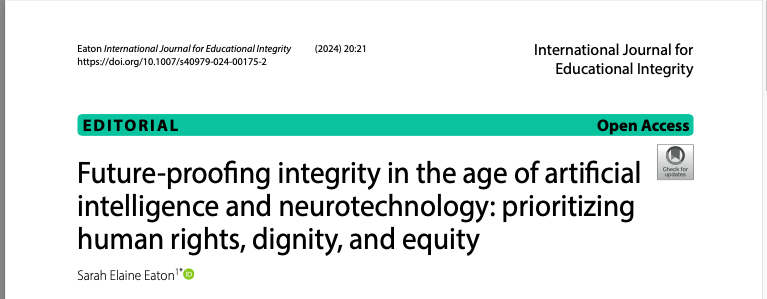
Once a year I write an editorial for the International Journal for Educational Integrity. I take a big idea, ground it in literature written by some of the best in the world and then call for ways to improve our field even more. In 2023 I wrote about Postplagiarism and in 2022, I focused on equity, diversity, inclusion, accessibility and decolonization as new priorities for academic integrity. Here is this year’s editorial:

Future-proofing integrity in the age of artificial intelligence and neurotechnology: prioritizing human rights, dignity, and equity

A screenshot of an article title page. There is black text on a white background with a green banner at the top.
Here is a link to the original: https://edintegrity.biomedcentral.com/articles/10.1007/s40979-024-00175-2

Abstract

In this article I argue for the prioritisation of human rights when developing and implementing misconduct policies. Existing approaches may be perpetuate inequities, particularly for individuals from marginalised groups. A human-rights-by-design approach, which centres human rights in policy development, revision, and implementation, ensuring that every individual is treated with dignity and respect.

Recommendations for implementing a human-rights approach to misconduct investigations and case management are offered, covering areas such as procedural fairness, privacy, equity, and the right to education. Additional topics covered are the need to limit surveillance technologies, and the need to recognize that not all use of artificial intelligence tools automatically constitutes misconduct. I disentangle

the differences between equity and equality and explain how both are important when considering ethics and integrity. A central argument of this paper is that a human-rights-by-design approach to integrity does not diminish standards but rather strengthens educational systems by cultivating ethical awareness and respect for personhood. I conclude with a call to action with a seven-point plan for institutions to adopt a human-rights-based approach to ethics and integrity. In the age of artificial intelligence and neurotechnology, insisting on human rights and dignity when we investigate and address misconduct allegations is an ethical imperative that has never been more important.

Keywords Academic misconduct, Academic dishonesty, Plagiarism, Policy, Human rights, Restorative justice, Artificial intelligence, Neurotechnology, Higher education, Education

Commentary

As I reflect on the current state of academic and research integrity, I am struck by a glaring omission in our discussions: the connection between misconduct and human rights. We often treat these as separate entities, failing to recognize the profound impact that misconduct investigations and policies can have on the fundamental rights of individuals. This oversight is particularly concerning in the age of artificial intelligence (AI) and neurotechnology, where the potential for harm is magnified.

Take, for example, the case of a professor in Canada who physically assaulted international students accused of plagiarism. This horrifying example demonstrates how the pursuit of academic integrity can be twisted into a justification for degrading and inhumane treatment, violating the very principles of dignity and respect that should guide our actions. While this is an extreme case, it highlights the need for a fundamental shift in our approach.

In this editorial, I offer a call to action to move beyond simply adhering to legal requirements and embrace a ‘human-rights-by-design’ approach that embeds human rights principles into our policies and practices. This means ensuring procedural fairness throughout investigations, safeguarding the privacy of individuals, and recognizing the right to be presumed innocent until there is proof to the contrary. It also requires us to acknowledge the diverse backgrounds and circumstances of our students and staff, striving for equitable treatment that addresses systemic inequalities and provides the support needed for everyone to succeed.

In the face of rapidly evolving technologies like AI, we must be especially vigilant in upholding human rights. The temptation to rely on unproven AI detection tools or to rush to judgement based on suspicion rather than evidence is strong, but it is a path that leads us away from justice and fairness. We cannot allow fear or expediency to erode our commitment to human dignity.

By centring human rights in our approach to integrity, we can create educational and research environments that are not only ethically sound but also truly just and equitable. This is not about lowering standards; it is about building a culture of integrity that upholds the inherent worth of every individual.

________________________

Share this post: Future-proofing integrity in the age of artificial intelligence and neurotechnology: Prioritizing human rights, dignity, and equity – https://drsaraheaton.com/2024/11/13/future-proofing-integrity-in-the-age-of-artificial-intelligence-and-neurotechnology-prioritizing-human-rights-dignity-and-equity/
This blog has had over 3 million views thanks to readers like you. If you enjoyed this post, please “like” it or share it on social media. Thanks!

Sarah Elaine Eaton, PhD, is a Professor and Research Chair in the Werklund School of Education at the University of Calgary, Canada. Opinions are my own and do not represent those of my employer.


Event: The Intersection of Academic Integrity and Inclusion: A Fireside Chat

October 10, 2024

Next week is Academic Integrity Week at the Univeristy of Calgary. This year, I have the honour of moderating a fireside chat with one of my very own Werklund School of Education Doctor of Education (EdD) students, Colleen Fleming. 

Join us for a thought-provoking discussion during Academic Integrity Week 2024!

A poster with text in black, red, and orange. The University of Calgary logo appears at the top. On the right-hand side there is art featuring a woman wearing a headset.

Discover the crucial link between academic integrity and inclusion in higher education with our distinguished speaker, Colleen Fleming, EdD student, Werklund School of Education.

Moderated by Dr. Sarah Elaine Eaton, this conversation will explore:

  • Defining academic integrity in an inclusive context
  • Challenges in maintaining integrity across diverse student populations
  • Practical strategies for educators to promote both integrity and inclusion

Don’t miss this opportunity to gain insights from Colleen’s extensive experience as a K-12 practitioner and her cutting-edge doctoral research. Engage in a live Q&A session and contribute to this important conversation.

A bit about Colleen…

A photograph of a woman with chin-length blonde hair. She is wearing a white top. The background is blue.

Colleen Fleming (she/her/hers) is a K-12 practitioner at a designated special education school in Calgary. She has a keen interest in developing a culture of integrity among learners through the promotion of equity, diversity, and inclusion. As a Doctor of Education student at Werklund, her research involves proactively educating students about academic integrity in preparation for higher education.

Event details

Date: October 16, 2024

Time: 12:00 – 1:00 p.m.

Location: University of Calgary, Taylor Family Digital Library, Gallery Hall

https://events.ucalgary.ca/library/event/481166-academic-integrity-and-inclusion-with-colleen-fleming

This event is free and open to the public. Everyone is welcome!

________________________

Share this post: The Intersection of Academic Integrity and Inclusion: A Fireside Chat – https://drsaraheaton.com/2024/10/10/event-the-intersection-of-academic-integrity-and-inclusion-a-fireside-chat/

This blog has had over 3 million views thanks to readers like you. If you enjoyed this post, please “like” it or share it on social media. Thanks!

Sarah Elaine Eaton, PhD, is a Professor and Research Chair in the Werklund School of Education at the University of Calgary, Canada. Opinions are my own and do not represent those of my employer.


Ethical Reasons to Avoid Using AI Apps for Student Assessment

September 10, 2024

It’s the start of a new school year here in North America. We are into the second week of classes and already I am hearing from administrators in both K-12 and higher education institutions who are frustrated with educators who have turned to ChatGPT and other publicly-available Gen AI apps to help them assess student learning.

Although customized AI apps designed specifically to assist with the assessment of student learning already exist, many educators do not yet have access to such tools. Instead, I am hearing about educators turning to large language models (LLMs) like ChatGPT to help them provide formative or summative assessment of students’ work. There are some good reasons not to avoid using ChatGPT or other LLMs to assess student learning.

I expect that not everyone will agree with these points, please take them with the spirit in which they are intended, which to provide guidance on ethical ways to teach, learn, and assess students’ work.

8 Tips on Why Educators Should Avoid Using AI Apps to Help with Assessment of Student Learning

Intellectual Property

In Canada at least, a student’s work is their intellectual property. Unless you have permission to use it outside of class, then avoid doing so. The bottom line here is that student’s intellectual work is not yours to share to a large-language model (LLM) or any other third party application, with out their knowledge and consent.

Privacy

A student’s personal data, including their name, ID number and other details should never be uploaded to an external app without consent. One reason for this blog post is to respond to stories I am hearing about educators uploading entire student essays or assignments, including the cover page with all the identifying information, to a third-party GenAI app.

Data security

Content uploaded to an AI tool may be added to its database and used to train the tool. Uploading student assignments to GenAI apps for feedback poses several data security risks. These include potential breaches of data storage systems, privacy violations through sharing sensitive student information, and intellectual property concerns. Inadequate access controls or encryption could allow unauthorized access to student work. 

AI model vulnerabilities might enable data extraction, while unintended leakage could occur through the AI app’s responses. If the educator’s account is compromised, it could expose all of the uploaded assignments. The app’s policies may permit third-party data sharing, and long-term data persistence in backups or training sets could extend the risk timeline. Also, there may be legal and regulatory issues around sharing student data, especially for minors, without proper consent.

Bias

AI apps are known to be biased. Feedback generated by an AI app can be biased, unfair, and even racist. To learn more check out this article published in Nature. AI models can perpetuate existing biases present in their training data, which may not represent diverse student populations adequately. Apps might favour certain writing styles (e.g., standard American English), cultural references, or modes of expression, disadvantaging students from different backgrounds. 

Furthermore, the AI’s feedback could be inconsistent across similar submissions or fail to account for individual student progress and needs. Additionally, the app may not fully grasp nuanced or creative approaches, leading to standardized feedback that discourages unique thinking.

Lack of context

An AI app does not know your student like you do. Although GenAI tools can offer quick assessments and feedback, they often lack the nuanced understanding of a student’s unique context, learning style, and emotional or physical well-being. Overreliance on AI-generated feedback might lead to generic responses, diminishing the personal connection and meaningful interaction that educators provide, which are vital for effective learning.

Impersonal

AI apps can provide generic feedback, but as an educator, you can personalize feedback to help the student grow. AI apps can provide generic feedback but may not help to scaffold a student’s learning. Personalized feedback is crucial, as it fosters individual student growth, enhances understanding, and encourages engagement with the material. Tailoring feedback to specific strengths and weaknesses helps students recognize their progress and areas needing improvement. In turn, this helps to build their confidence and motivation. 

Academic Integrity

Educators model ethical behaviour, this includes transparent and fair assessment. If you are using tech tools to assess student learning, it is important to be transparent about it. In this post, I write more about how and why deceptive and covert assessment tactics are unacceptable.

Your Employee Responsibilities

If your job description includes assessing student work , you may be violating your employment contract if you offload assessment to an AI app.

Concluding Thoughts

Unless your employer has explicitly given you permission to use AI apps for assessing student work then, at least for now, consider providing feedback and assessment in the ways expected by your employer. If we do not want students to use AI apps to take shortcuts, then it is up to us as educators to model the behavior we expect from students.

I understand that educators have excessive and exhausting workloads. I appreciate that we have more items on our To Do Lists than is reasonable. I totally get it that we may look for shortcuts and ways to reduce our workload. The reality is that although Gen AI may have the capability to help with certain tasks, not all employers have endorsed their use in same way.

Not all institutions or schools have artificial intelligence policies or guideline, so when in doubt, ask your supervisor if you are not sure about the expectations. Again, there is a parallel here with student conduct. If we expect students to avoid using AI apps unless we make it explicit that it is OK, then the same goes for educators. Avoid using unauthorized tech tools for assessment without the boss knowing about it.

I am not suggesting that Gen AI apps don’t have the capability to assist with AI, but I am suggesting that many educational institutions have not yet approved the use of such apps for use in the workplace. Trust me, when there are Gen AI apps to help with the heaviest aspects of our workload as educators, I’ll be at the front of the line to use them. In the meantime, there’s a balance to be struck between what AI can do and what one’s employer may permit us to use AI for. It’s important to know the difference — and to protect your livelihood.

Related post:

The Use of AI-Detection Tools in the Assessment of Student Work https://drsaraheaton.wordpress.com/2023/05/06/the-use-of-ai-detection-tools-in-the-assessment-of-student-work/

____________________________

Share this post:
Ethical Reasons to Avoid Using AI Apps for Student Assessment – https://drsaraheaton.com/2024/09/10/ethical-reasons-to-avoid-using-ai-apps-for-student-assessment/

This blog has had over 3.6 million views thanks to readers like you. If you enjoyed this post, please “like” it or share it on social media. Thanks!

Sarah Elaine Eaton, PhD, is a faculty member in the Werklund School of Education at the University of Calgary, Canada. Opinions are my own and do not represent those of my employer.

Sarah Elaine Eaton, PhD, Editor-in-Chief, International Journal for Educational Integrity


Self-Plagiarism: Publishing Works Based on a Thesis or Dissertation

January 28, 2024

A question I am often asked is: Is it considered self-plagiarism to publish an article or some other output from one’s thesis?

I will start with a disclaimer: The contents of this post may not represent the views of my employer, an editor, or a publisher. There is no singular or universally accepted definition of self-plagiarism (or even plagiarism, for that matter). This post is based on my expertise as a scholar of plagiarism and academic misconduct. I have written about self-plagiarism in this peer-reviewed article and I dedicate an entire chapter to the topic my book, Plagiarism in Higher Education: Tackling Tough Topics in Academic Integrity.

In this post, I use the word ‘thesis’ to include any kind of student final summative written work including dissertations or other forms of final projects. A thesis can refer to undergraduate (often honours) work or graduate work, which is also called post-graduate work in some countries. In this post, I am talking specifically about student academic work that is supervised by a professor and receives approval and validation through formal evaluation such as a written appraisal of the work, an examination, and/or an oral defence.

In this post I am talking more about a thesis with a traditional format (e.g., five or six chapters) than about a manuscript-based thesis (also called ‘thesis by publication’ or ‘PhD by publication’). The queries I get about self-plagiarism are almost always about theses that follow a historically dominant structure with chapters, which is the kind of thesis that remains prevalent in the humanities and social sciences.

With these details covered, let’s get to the good stuff. Firstly, it is both expected and encouraged that students will publish from their thesis. After the oral defence or final thesis evaluation, a student’s work can be further refined and developed in order for it to be ready for publication. In many cases, student work may require substantive revisions (or even a complete overhaul) before it is suitable for publication in a journal or a book. It is foolhardy to assume that just because a student thesis has passed that it is automatically suitable for publication elsewhere. In some cases, there is still a lot of work to be done.

Here are the few things to think about after the thesis has been approved by the university authorities:

Archiving the Thesis in a Digital Repository

Our friendly institutional librarians at the University of Calgary have clarified for me on a previous occasion that theses are considered ‘unpublished’. Adding a thesis to a digital repository means it is archived, but not published. Learning that distinction was helpful for me.

Request an embargo on the release of the thesis into the public domain

Students can ask for an embargo on the release of the thesis until the results are published (e.g., journal article, book chapter or any other format). There seems to be a distressing but growing predatory practice around graduate student theses (or the data therein) being misappropriated, repackaged, and published under someone else’s name. I have heard of two such instances recently and, anecdotally, it seems this practice is growing internationally, though I have no data to substantiate this assertion.

This recommendation stems not from protecting oneself from self-plagiarism, but rather from predatory bad actors who have the intention of harvesting your work before you yourself have published it.

An embargo on a thesis should be requested for a reasonable and finite period of time, with the goal of making the research publicly accessible at some point within a couple of years of graduation, unless there is a compelling reason to extend the embargo longer than that.

Advice About How to Avoid Allegations of Self-plagiarism 

To avoid questions about academic or research misconduct, and specifically self-plagiarism, that can emerge when a student publish works derived from their thesis, there are two points to consider: communication and transparency. Both points should be taken into consideration.

An infographic. There is blue border surrounding a white background. Text is written in black. There is one oval and 8 rectangles, connected by lines. Each shape contains text. The content of this infographic is explained in the blog post.

Communication: Correspond with the Editor Prior to Submission

I recommend that students/graduates correspond with the journal editors prior to, or at the time of manuscript submission, in writing, to ensure full transparency. State clearly that the manuscript is drawn from the thesis and parts of it may be replicated exactly (e.g., methods section). Other parts of the manuscript may be derived (and/or significantly revised) from the thesis and if that is the case, offer some details, but avoid going overboard. Ask directly if such a submission would be considered by the journal / publisher. There is no harm is being clear and transparent with journal editors in this regard.

If the journal editor says no, then consider withdrawing the manuscript and trying a different publication. It is important to recognize that editors have the authority to make such judgements, so don’t be rude or try to convince the editor that their decision is wrong. Maintain a polite and professional tone at all times. Thank them for considering your request and move on.

If the editor says yes, then you are ready to proceed. Ensure you are attending to the matter of transparency during the preparation of your manuscript.

If you communicate with an editor orally (e.g., a face-to-face conversation or a video call), follow up in writing to document the conversation. Ask for confirmation that you have understood the agreement correctly. 

I recommend keeping a record of your written correspondence in case you ever need it again in the future.

Transparency: Declare the re-use of previous content in the manuscript itself

As you prepare your manuscript for submission, ensure you are being transparent about the re-use of content derived from your thesis. This can be done in a couple of ways:

Explicit transparency statement: Add a declaration to the article/chapter/knowledge output stating that it is derived from your thesis. This way, you are declaring there may be some duplication helps to mitigate concerns about self-plagiarizing. You do not need be excessive with your statement. You can keep it short and simple. Here is some sample text that you are welcome to use, re-use, or adapt (as in, I am openly giving anyone permission to use or adapt this statement):

“This work is derived from my doctoral dissertation. Portions of the text resemble or may replicate the original text from my unpublished PhD thesis and have been reproduced as such with the permission of the editors”.

Note that if you use this statement verbatim, it may (ironically) be picked up by text-matching software used by publishers (i.e., flagged for possible plagiarism). I won’t take responsibility for that, so use some judgement in how you prepare your transparency statement.

Attribution: Self-citation is a contested issue in academic publication and it is prudent to avoid over-citing oneself. There are some circumstances in which self-citation is appropriate and this is one of them. When you are deriving work from your thesis, it is appropriate to cite your thesis in the list of references of your publication.

Be careful and attentive when it comes to attribution in publications derived from your thesis. You still need to cite any original works that your thesis drew from. I once saw a manuscript derived from a student thesis and the only work listed in the references was the student thesis! This is disrespectful to the authors of any original works the student thesis was drawn from, so be sure to give credit where it is due. Ensure you give attribution to the authors whose work informed your thesis and any subsequent publications.

This does not mean that you need to replicate the entire bibliography from your thesis in subsequent publications, unless, of course, you are specifically citing every single source in the publication. Instead, be meticulous and mindful to ensure that the specific sources that inform subsequent publications are cited appropriately. Details matter, and if you are going to publish from your thesis, it is worth it to focus on producing the highest quality publication possible.

Finally, assuming that you have a good relationship with your supervisor, I recommend that you keep them informed. In some cases, co-publication with the supervisor may be appropriate, but not in all cases. Co-publishing with one’s supervisor is a topic for another blog post, so I won’t delve deep into those complexities here. Suffice to say that staying in touch with your supervisor about the publication of your work may be beneficial to you, depending on the circumstances.

The bottom line is that concerns about self-plagiarism might be solved with open communication and transparency.

Bibliography and Further Reading

  • Eaton, S. E., & Crossman, K. (2018). Self-plagiarism research literature in the social sciences: A scoping review. Interchange: A Quarterly Review of Education, 49(3), 285-311. https://rdcu.be/YR5u 
  • Roig, M. (2005). Re-using text from one’s own previously published papers: An exploratory study of potential self-plagiarism. Psychological Reports, 2005(97), 43-49. https://doi.org/10.2466/pr0.97.1.43-49
  • Roig, M. (2008). The debate on self-plagiarism: Inquisitional science or high standards of scholarship? Journal of Cognitive & Behavioral Psychotherapies, 8(2), 245-258.
  • Roig, M. (2010). Plagiarism and self-plagiarism: What every author should know. Biochemia Medica, 20(3), 295-300. https://www.biochemia-medica.com/en/journal/20/3/10.11613/BM.2010.037
  • Roig, M. (2024). On Recycling Our Own Work in the Digital Age. In S. E. Eaton (Ed.), Second Handbook of Academic Integrity (pp. 361-380). Springer Nature Switzerland. https://doi.org/10.1007/978-3-031-54144-5_15

Related posts

How to Get Your Academic Article Published in a High Quality Journal  https://drsaraheaton.wordpress.com/2024/01/02/how-to-get-your-academic-article-published-in-a-high-quality-journal/

What is the difference between a thesis, a dissertation and a capstone project? https://drsaraheaton.wordpress.com/2018/02/06/what-is-the-difference-between-a-dissertation-a-thesis-and-a-capstone-project/

What’s the difference between a citation and a reference?  https://drsaraheaton.wordpress.com/2013/10/18/whats-the-difference-between-a-citation-and-a-reference/ 

What’s the difference between a manuscript and an article?https://drsaraheaton.wordpress.com/2017/05/08/whats-the-difference-between-a-manuscript-and-an-article

____________________________

Share this post: Self-Plagiarism: Publishing Works Based on a Thesis or Dissertation – https://drsaraheaton.wordpress.com/2024/01/28/self-plagiarism-publishing-works-based-on-a-thesis-or-dissertation/

This blog has had over 3.7 million views thanks to readers like you. If you enjoyed this post, please “like” it or share it on social media. Thanks!

Sarah Elaine Eaton, PhD, is a faculty member in the Werklund School of Education at the University of Calgary, Canada. Opinions are my own and do not represent those of my employer.

Sarah Elaine Eaton, PhD, Editor-in-Chief, International Journal for Educational Integrity