Fake Degrees, Fraudulent Credentials and the Ecosystem of Commercial Academic Fraud

April 10, 2025

Since 2020 I’ve been working with a number of collaborators on projects related to fake degrees, diploma mills, and credential fraud. One of the people I have had the privilege of working with is FBI Special Agent (ret.), Allen Ezell, who is one of the world’s leading experts on  fake degrees and accreditation fraud. 

I’ve spent countless hours on the phone with Allen and have exchanged dozens, if not hundreds, of e-mails with him, over the years. Now in his 80s, Allen is one of the world’s finest experts on the topic. He contributed a fascinating chapter called “Yesterday, today, and tomorrow: A tour of Axact, the ‘World’s Largest Diploma Mill’” to our book, Fake Degrees and Fraudulent Credentials in Higher Education

We also learned from other contributors to the book that the companies who sell fake credentials don’t stop there. They can also provide contact cheating services (often under the guise of ‘research services’), fake admission letters, fake transcripts, fraud in standardized testing (e.g., sending impersonators to write English language proficiency tests), and much more. 

In the introduction for the book, we connect the dots to show how admissions fraud, contract cheating (e.g., term paper mills), scientific and scholarly paper mills, and fake degrees and fraudulent credentials are all connected. We synthesize the key ideas in this infographic:

Diagram titled "The Ecosystem of Commercial Academic Fraud" by Eaton & Carmichael (2022), showing four overlapping colored circles, each representing a type of academic fraud, with "Fraud" in the center where all circles overlap. The categories are: Degree Mills (red): Fake and fraudulent diplomas, transcripts, reference letters, and other academic and professional documents. Contract Cheating (orange): Outsourced student academic work including term paper mills, assignment completion services, thesis writing services, and student proxy services. Admissions Fraud (green): Impersonation and fraud services for standardized admissions testing (e.g., SATs), language proficiency testing, and unethical educational agents. Paper Mills (blue): Manufactured scholarly and scientific publications, authorship for sale. Each category overlaps in the center to show they are part of a broader ecosystem of fraud. The image includes a citation and Creative Commons license at the bottom.

It is difficult to get a handle on the exact size and scope of the industry, but based on what we know, we estimated that the industry is worth at least $21 Billion USD, and we figure that is a low estimate.

Throughout the past half-decade, we’ve developed a number of resources related to these topics. I’ve posted about them previously, but I figured it might be helpful if I gathered some of them into a single blog post. They are all freely available as open access resources.

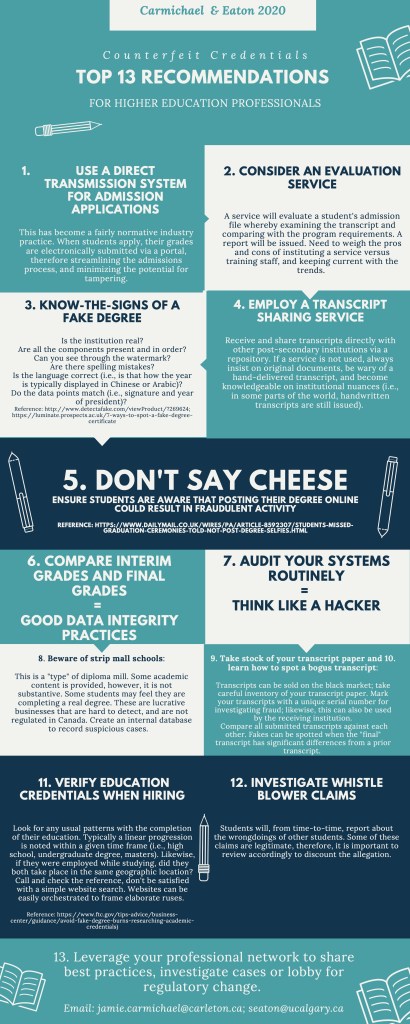
Counterfeit Credentials: 13 Recommendations for Higher Education Professionals

Infographic titled "Counterfeit Credentials: Top 13 Recommendations for Higher Education Professionals" by Carmichael & Eaton (2020). It offers guidance to help institutions detect and prevent the use of fake degrees and fraudulent documents in admissions and hiring. The recommendations are:
1.	Use a direct transmission system for admission applications – Electronic grade submissions reduce tampering.
2.	Consider an evaluation service – Evaluate transcripts against program requirements.
3.	Know the signs of a fake degree – Check for authenticity, spelling, watermarks, correct language, matching data points.
4.	Employ a transcript sharing service – Use secure repositories or verify hand-delivered transcripts.
5.	Don't say cheese – Warn students not to post degrees online due to risk of fraud.
6.	Compare interim and final grades – Ensures data integrity.
7.	Audit your systems routinely – Think like a hacker to uncover weaknesses.
8.	Beware of strip mall schools – Diploma mills that mimic real institutions; create internal databases for tracking.
9.	Take stock of your transcript paper – Use serial numbers and compare for inconsistencies.
10.	Learn how to spot a bogus transcript – Identify fakes by comparing submitted transcripts.
11.	Verify education credentials when hiring – Check for linear academic progression and verify references beyond website searches.
12.	Investigate whistleblower claims – Some student reports may be legitimate and need proper review.
13.	Leverage your professional network – Share practices, investigate cases, or lobby for change.
References and contact emails (jamie.carmichael@carleton.ca; seaton@ucalgary.ca) are included for further information.

This infographic is intended mainly for registrars, admissions staff, admissions committees and others whose work involves assessing the credentials of applicants for university and college programs. 

Scholarships Without Scruples

In this infographic, Jamie Carmichael and I share signs of scholarship scams, which is one from of educational fraud:

Infographic titled “Scholarships Without Scruples – 3 Signs of Scholarship Scams.” Credit Card Required: Don’t give out your credit card number. Legitimate scholarship applications never ask for this information. Discount in Disguise: You should not have to buy anything to receive a scholarship. Legit scholarships never require payment for goods or services. Tax Trickery: Legit scholarships are taxed differently than earned income. If proper tax documentation isn’t provided, it may not be a real scholarship. At the bottom: “Find out more” – Contact information for Sarah Elaine Eaton (University of Calgary, seaton@ucalgary.ca) and Jamie Carmichael (Carleton University, Jamie.Carmichael@Carleton.ca). Footer text: “Scholarship scams are real. Learn how to protect yourself!”

When it comes to education fraud, there are many angles to consider. There is certainly a need for more research, awareness, and advocacy on these topics, especially as GenAI can make these types of fraud easier.

Below are some related posts and further resources that I hope you find helpful.

Related posts

References and Resources

  • Carmichael, J. (2023, June 7). Understanding Fake Degrees and Credential Fraud in Higher Ed. The Evollution: A Modern Campus Illumination. https://evolllution.com/programming/credentials/understanding-fake-degrees-and-credential-fraud-in-higher-ed/
  • Carmichael, J. J. (2024). Reframing and Broadening Adversarial Stylometry for Academic Integrity. In S. E. Eaton (Ed.), Second Handbook of Academic Integrity (pp. 1467-1485). Springer Nature Switzerland. https://doi.org/10.1007/978-3-031-54144-5_148 
  • Carmichael, J., & Eaton, S. E. (2020). Counterfeit Credentials: Top 13 Recommendations for Higher Education Professionals (Infographic). University of Calgary. http://hdl.handle.net/1880/113042 
  • Clark, A. (2023). Examining the problem of fraudulent English test scores: What can Canadian higher education institutions learn? In S. E. Eaton, J. J. Carmichael, & H. Pethrick (Eds.), Fake Degrees and Fraudulent Credentials in Higher Education (pp. 187-207). Springer International Publishing. https://doi.org/10.1007/978-3-031-21796-8_9 
  • Çelik, Ö., & Razı, S. (2023). Avoiding favouritism in the recruitment practice of Turkish higher education institutions. In S. E. Eaton, J. J. Carmichael, & H. Pethrick (Eds.), Fake Degrees and Fraudulent Credentials in Higher Education (pp. 153-167). Springer International Publishing. https://doi.org/10.1007/978-3-031-21796-8_7 
  • DeCoster, B. (2023). There is no culture? A framework for addressing admissions fraud. In S. E. Eaton, J. J. Carmichael, & H. Pethrick (Eds.), Fake Degrees and Fraudulent Credentials in Higher Education (pp. 209-226). Springer International Publishing. https://doi.org/10.1007/978-3-031-21796-8_10 
  • Duklas, J. (2023). Bridging to tomorrow: A historical and technological review of credential exchange in higher education within Canada. In S. E. Eaton, J. J. Carmichael, & H. Pethrick (Eds.), Fake Degrees and Fraudulent Credentials in Higher Education (pp. 95-113). Springer International Publishing. https://doi.org/10.1007/978-3-031-21796-8_4
  • Eaton, S. E., & Carmichael, J. (2020). Scholarships without scruples (Infographic). University of Calgary: http://hdl.handle.net/1880/113044
  • Eaton, S. E., & Carmichael, J. (2022). The Ecosystem of Commercial Academic Fraud. University of Calgary. https://dx.doi.org/10.11575/PRISM/40330
  • Eaton, S. E., Carmichael, J., & Pethrick, H. (Eds.). (2023). Fake degrees and credential fraud in higher education. Springer. https://doi.org/10.1007/978-3-031-21796-8
  • Ezell, A. (2023). Yesterday, today, and tomorrow: A tour of Axact, the “World’s Largest Diploma Mill”. In S. E. Eaton, J. J. Carmichael, & H. Pethrick (Eds.), Fake Degrees and Fraudulent Credentials in Higher Education (pp. 49-94). Springer International Publishing. https://doi.org/10.1007/978-3-031-21796-8_3 
  • Hextrum, K. (2023). Fair play, fraud, or fixed? Athletic credentials in U.S. higher education. In S. E. Eaton, J. J. Carmichael, & H. Pethrick (Eds.), Fake Degrees and Fraudulent Credentials in Higher Education (pp. 115-132). Springer International Publishing. https://doi.org/10.1007/978-3-031-21796-8_5
  • Orim, S.-M., & Glendinning, I. (2023). Corruption in admissions, recruitment, qualifications and credentials: From research into quality assurance. In S. E. Eaton, J. J. Carmichael, & H. Pethrick (Eds.), Fake Degrees and Fraudulent Credentials in Higher Education (pp. 133-151). Springer International Publishing. https://doi.org/10.1007/978-3-031-21796-8_6
  • Sabbaghan, S., & Fazel, I. (2023). None of the above: Integrity concerns of standardized English proficiency tests. In S. E. Eaton, J. J. Carmichael, & H. Pethrick (Eds.), Fake Degrees and Fraudulent Credentials in Higher Education (pp. 169-185). Springer International Publishing. https://doi.org/10.1007/978-3-031-21796-8_8

–——–-

Share this post: Fake Degrees, Fraudulent Credentials and the Ecosystem of Commercial Academic Fraud – https://drsaraheaton.com/2025/04/10/fake-degrees-fraudulent-credentials-and-the-ecosystem-of-commercial-academic-fraud/

This blog has had over 3.7 million views thanks to readers like you. If you enjoyed this post, please ‘Like’ it using the button below or share it on social media. Thanks!

Sarah Elaine Eaton, PhD, is a Professor and Research Chair in the Werklund School of Education at the University of Calgary, Canada. Opinions are my own and do not represent those of my employer. 


Academic Integrity on Trial: Mark Carney’s Case and the Politics of Plagiarism

March 29, 2025

Gosh, we humans love a good scandal, don’t we? The recent allegations against Liberal leader Mark Carney regarding plagiarism in his 1995 Oxford doctoral thesis raise important questions about how we define, detect, and respond to plagiarism in academic and public life.

Drawing from both the specifics of Carney’s case and broader discussions about academic integrity, several important themes emerge:

The Pattern of Plagiarism Witch Hunts

In my January 2024 blog post, “Plagiarism Witch Hunts Cause Harm,” about the case of former Harvard University President, Dr. Claudine Gay, I pointed out that we appear to be in an era where plagiarism is increasingly weaponized against public figures. Following the resignation of Dr. Gay amid plagiarism allegations, we have seen a troubling pattern of using academic integrity as a political weapon rather than an educational concern. 

This weaponization is particularly concerning when we consider the broader landscape of academic integrity issues. 

In my 2020 investigation “Is the Hon. Demetrios Nicolaides, Alberta Minister of Advanced Education involved with contract cheating?”, I showed how careful we must be in assessing evidence before making accusations. That investigation highlighted the need for rigorous verification when claiming someone has violated academic integrity, especially when political motivations might be involved. For the record, the analysis that I conducted for that blog post took me several days to complete.

The National Post’s investigation of Carney’s thesis identified several instances of alleged plagiarism, including unattributed quotes and paraphrasing from authors such as Michael Porter and Jeremy Stein. This follows a pattern seen in previous high-profile cases where decades-old academic work is scrutinized through modern lenses of academic integrity.

The Complexities of Defining Plagiarism

One critical aspect highlighted across these cases is the lack of universal agreement on what constitutes plagiarism. There is no singular or universally accepted definition of plagiarism. Oxford University defines it as “presenting work or ideas from another source as your own.” However, interpretations of definitions, as well as the definitions themselves can vary from one university to the next, as I have pointed out elsewhere.

In Carney’s case, his doctoral supervisor defended his work, stating she saw “no evidence of plagiarism in the thesis,” whereas academics consulted by the National Post disagreed. One professor, Dr. Geoffrey Sigalet, a political science professor at the University of British Columbia Okanagan (UBCO) stated that the unattributed quotes are “what we call plagiarism.” According to the National Post article, Dr. Sigalet is a member of the UBCO’s institutional president’s advisory committee on student discipline, “which handles cases of plagiarism for the university”. This disagreement underscores the subjectivity in evaluating academic integrity.

If you are curious about the UBCO Rules for President’s Advisory Committee on Student Discipline, they are publicly available here. Of note is that in allegations of academic misconduct, section 9.c of the regulations state that the committee must “provide the student with a copy of the Statement of Case and any documentary evidence and list of any witnesses”, and it is expected that the individual alleged to have engaged in misconduct has a right to know the case being brought against them before the matter is decided. This is a basic principle of procedural fairness in academic misconduct investigations and case management.

Upon reading the National Post article, one question that I had was: was Mr. Carney informed of the allegations before they were investigated?

Post-Facto Investigations and Their Consequences

The timing of these allegations is noteworthy. Investigating work completed nearly 30 years ago raises questions about motives and impact. As I have pointed out previously when I commented on the Dr. Claudine Gay case, “a retroactive investigation into a person’s academic work while they were a student is often an exercise in discrediting someone in their current professional role.”

For Carney, these allegations emerge as he serves as Liberal Leader and campaigns in a federal election—timing that raises questions about political motivations rather than genuine concerns about academic integrity.

The Role of Academic Supervision

An often-overlooked aspect of these cases is the responsibility of academic supervisors. I asked this question with respect to the Dr. Claudine Gay case, and it bears repeating: Where are all the graduate supervisors? In Carney’s case, his supervisor, Dr. Margaret Meyer, Oxford University has defended his work, noting it was “evaluated and approved by a faculty committee.” 

This comment is not insignificant because highlights the collective responsibility of the academic community in ensuring academic integrity. As in other high-profile cases of student PhD theses being scrutinized for plagiarism post-graduation, a big question — and I mean, a really big question —is, how could the academic supervisors, faculty committee members, and academic examiners, allow a student to pass their PhD thesis if it was rife with plagiarism? We may never be able to answer this question in this case, or in the cases of countless other allegations of academic misconduct that arise after a student has graduated.

If we take a wraparound approach to student success, then everyone in the educational ecosystem plays a role in supporting to students to write and research ethically. This is, quite literally, our job as professors.

So, Did Mark Carney Plagiarize or Not?

The answer is, I don’t know. When I conduct an analysis of text for possible plagiarism, it is a meticulously in-depth and detailed process. I start with the allegedly plagiarized text and I go through it line-by-line comparing it to the original sources from which text has been allegedly lifted without attribution. That can show whether or not there is a potential ‘text match’. There are examples of possible text matches in the National Post article, but they are selective. I cannot make a call on whether or not there was plagiarism based on excerpts. I would want to see the full texts (original and allegedly plagiarized), not bits and pieces.

If we can identify a possible text match, then we need to look for additional evidence. Was this sloppy scholarship or poor academic literacy? For example, were the original sources perhaps listed in the bibliography, but the direct quotations were not attributed in the main body of the text? In the context of the entire thesis, would it appear as though the student was deliberately trying to deceive their supervisor or academic advisory committee. (Intent to deceive is difficult, if not impossible to prove in many cases.) 

Were there drafts of the work that were reviewed by the supervisor or committee that commented on the content, as well as as technical aspects of citing and referencing? If not, how was the student supported to ensure that their research was done properly?

When I conduct an analysis of text for plagiarism, it can take me days or weeks, depending on the length of the text and the complexity of the case. When an individual’s reputation is on the line, I take even greater care, knowing that my findings might have an impact on their career or their future. There can be a great deal at stake in high-profile cases of plagiarism. A thorough investigation takes time and expertise and quite frankly, any plagiarism expert worth their reputation would insist on taking the time they need before drawing conclusions in such matters.

So, dear readers, if you are looking for me to weigh in with a definitive stance on this case, you are going to be disappointed. I simply have too many questions to draw a reasonable conclusion on the matter. 

Human Rights and Due Process

What I can say is this: due process, procedural fairness, and human rights matter. When we allege, investigate, and manage cases of plagiarism or misconduct, the accused, regardless of whether they are a student, a professor, a politician, or anyone else, deserves at the very least to have their human rights upheld. 

Even though Article 11 of the United Nations Universal Declaration of Human Rights states everyone is “entitled to a fair and public hearing by an independent and impartial tribunal” in case after case of public allegations of plagiarism, we can observe that there is due process is often bypassed, with accused individuals presumed to be guilty and forced to prove their own innocence.

The topic of how basic human rights and dignity are dismissed in academic cheating cases is something I have written about in some detail. No matter who you are, if you are accused of misconduct, you have the right to be treated with basic human dignity while the matter is under investigation and being decided. Whether you are a member of the United Conservative Party of Alberta alleged to have engaged in contract cheating, a Black woman who is president of Harvard University accused of plagiarism, or the liberal prime minister of Canada, human beings are entitled to dignity and due process.

Moving Forward: Balance in Academic Integrity

The Carney case, like those before it, shows a need for a balanced approach to academic integrity that:

  1. Distinguishes between technical citation errors (i.e., sloppiness) and an outright intention to deceive (even if intent is difficult to prove).
  2. Considers the standards and practices of the time when work was produced.
  3. Respects due process and presumes innocence until proven guilty.
  4. Acknowledges the shared responsibility of academic communities, and in particular, the responsibilities of graduate supervisors and academic advisors.
  5. Recognizes when allegations may be politically motivated.
  6. Prioritizes educational responses over punitive approaches (i.e., providing students with an opportunity to learn how to cite and reference properly).

Rather than using plagiarism as a weapon to discredit public figures, we could focus on strengthening current academic integrity practices and supporting students and researchers to write and research well, which includes proper attribution. Academic integrity is a foundation for ethical decision-making in everyday life and in one’s career.

As we evaluate these allegations against Mark Carney, we should consider not just the specific instances cited but also the context, timing, and potential consequences of how we frame and respond to questions of academic and professional integrity in public life. 

Final note

For what it is worth, if this case had been against Pierre Poilievre instead of Mark Carney, my position would be exactly the same, because integrity matters no matter which side of the political bench you sit on.

________________________

Share this post: Academic Integrity on Trial: Mark Carney’s Case and the Politics of Plagiarism – https://drsaraheaton.com/2025/03/29/academic-integrity-on-trial-mark-carneys-case-and-the-politics-of-plagiarism/

This blog has had over 3.7 million views thanks to readers like you. If you enjoyed this post, please ‘Like’ it using the button below or share it on social media. Thanks!

Sarah Elaine Eaton, PhD, is a Professor and Research Chair in the Werklund School of Education at the University of Calgary, Canada. Opinions are my own and do not represent those of my employer. 


Three tips for future-proofing academic and research integrity this year

January 2, 2025

In my 2024 annual editorial for the International Journal for Educational Integrity, was entitled, ’Future-proofing integrity in the age of artificial intelligence and neurotechnology: prioritizing human rights, dignity, and equity

Here are three things you can do to prioritize human rights and dignity when it comes to policies and procedures to address allegations of academic or research misconduct:

Use a human-rights-by-design approach to developing, revising, and implementing policies by conducting a comprehensive review of existing academic integrity policies. Update policies to explicitly incorporate human rights principles, ensuring they address fair process, privacy, equitable treatment, and respect for human dignity. It is essential to involve individuals from representative groups in this process.

Provide ongoing training, education, and support to faculty, staff, and students about human rights principles and how they apply to misconduct investigations and case management. Create orientation programs that explain expectations for ethical conduct while respecting diverse cultural perspectives. Offer workshops and resources, peer mentoring programs, and support services.

Focus on continuous improvement and quality assurance of ethics and integrity practices by gathering feedback from students, faculty, staff and relevant stakeholders. Regularly review misconduct case management processes and data to ensure equitable treatment across different demographics.

Implementing human rights principles into misconduct investigations and case management helps to create more effective and sustainable learning environments. This approach prioritizes people over punishment, dignity over draconianism, and compassion over callousness.

Read the full article here: https://edintegrity.biomedcentral.com/articles/10.1007/s40979-024-00175-2 

Related post:

Future-proofing integrity in the age of artificial intelligence and neurotechnology: Prioritizing human rights, dignity, and equity

________________________

Share this post: Three tips for future-proofing academic and research integrity this year – https://drsaraheaton.com/2025/01/02/three-tips-for-future-proofing-academic-and-research-integrity-this-year/

This blog has had over 3 million views thanks to readers like you. If you enjoyed this post, please “like” it or share it on social media. Thanks!

Sarah Elaine Eaton, PhD, is a Professor and Research Chair in the Werklund School of Education at the University of Calgary, Canada. Opinions are my own and do not represent those of my employer. 


Inclusive Academic Integrity: A Holistic Approach to Ethical Learning for Everyone

November 15, 2024

Earlier this semester, I accepted a new leadership role in the Werklund School of Education as the Academic Coordinator of the Master of Education (MEd) graduate topic in Inclusive Education. (We are accepting applications the 2025-2026 academic year, in case you’ve been thinking about doing an MEd. It is a fully online four-course topic.)

This got me thinking about academic integrity through an inclusive lens. My interest in the connection between social justice, equity, inclusion, and accessibility goes back a few years. In 2022, I partnered with a Werklund graduate student in educational psychology, Rachel Pagaling, and Dr. Brenda McDermott, Senior Manager, Student Accessibility Services to write up a brief open access report on Academic Integrity Considerations for Accessibility, Equity and Inclusion.

A lot more work has been done in this area since we wrote that report. Professor Mary Davis has been a particular champion of this topic. Her 2022 open access article, Examining and improving inclusive practice in institutional academic integrity policies, procedures, teaching and support, is worth checking out. There is also an entire section of the Second Handbook of Academic Integrity (2024) dedicated to equity, diversity, inclusion, accessibility, and decolonization. 

We know that academic integrity is a cornerstone of both K-12 and higher education. We want to ensure that learning, assessment, and credentials uphold the highest ethical standards. However, as educators, we can — and should — consider how the principles of inclusive education can strengthen and complement our approach to academic integrity.

Inclusive education means ensuring that all students, regardless of their background, abilities, or learning needs, have equitable access to educational opportunities and can meaningfully participate. Thomas and May sum it up nicely when they say that being inclusive means “proactively making higher education accessible, relevant and engaging to all students” (p. 5).  Of course, the same thinking could be extended to K-12 education, too. Applying these inclusive principles to academic integrity means recognizing that diverse learners may express and demonstrate their knowledge in different ways. 

Inclusion is not only about students with physical disabilities, developmental disabilities, or neurodivergence, but rather it is about creating conditions where all students can thrive. Associate Professor Joanna Tai and colleagues have a great article on Assessment for Inclusion that helps us think about how to design equitable and rigorous.

In addition, Dr. Eliana Elkhoury has a great chapter on how to create, An Equitable Approach to Academic Integrity Through Alternative Assessment.

The point here is that by fostering an inclusive academic culture, we empower all students to bring their best selves to school and learn with integrity.

Beyond accessibility and cultural responsiveness, inclusive academic integrity also means actively addressing systemic barriers and implicit biases. If certain groups of students consistently struggle with academic integrity issues, it may reveal deeper inequities that need to be examined and addressed. In other words, we can look at the barriers to success, rather than the limitations of our students, as being the problem. As Juuso Nieminen and I have pointed out, even accommodations policies have an underlying assumption that students who need accommodations are out to cheat the system. 

If you’re interested in reading more about disability justice to inform your thinking, I highly recommend Doron Dorfman’s article on the fear of the disability con and Jay Dolman’s work on academic ableism.

The benefits of this holistic, inclusive approach to academic integrity are numerous. When students feel respected, supported, and able to succeed, they are more engaged and motivated. This, in turn, leads to better learning outcomes. Moreover, graduates who have internalized inclusive academic integrity will be better equipped to uphold ethical standards in their future careers and communities.

As educators, we have a responsibility to nurture academic integrity in ways that are inclusive, accessible, culturally responsive, and empowering for diverse learners. By applying the principles of inclusive education, we can transform academic integrity from a rigid set of rules into a collaborative, values-driven endeavor that brings out the best in our students and ourselves.

References

Davis, M. (2022). Examining and improving inclusive practice in institutional academic integrity policies, procedures, teaching and support. International Journal for Educational Integrity, 18(1), 14. https://doi.org/10.1007/s40979-022-00108-x 

Dolmage, J. T. (2017). Academic Ableism: Disability and Higher Education. University of Michigan Press. 

Dorfman, D. (2019). Fear of the disability con: Perceptions of fraud and special rights discourse. Law & society review, 53(4), 1051-1091. https://doi.org/10.1111/lasr.12437 

Elkhoury, E. (2024). An Equitable Approach to Academic Integrity Through Alternative Assessment. In S. E. Eaton (Ed.), Second Handbook of Academic Integrity (pp. 1261-1272). Springer Nature Switzerland. https://doi.org/10.1007/978-3-031-54144-5_135 

Nieminen, J. H., & Eaton, S. E. (2023). Are assessment accommodations cheating? A critical policy analysis. Assessment & Evaluation in Higher Education, 1-16. https://doi.org/10.1080/02602938.2023.2259632 

Pagaling, R., Eaton, S. E., & McDermott, B. (2022, April 4). Academic Integrity: Considerations for Accessibility, Equity, and Inclusion. http://hdl.handle.net/1880/114519

Thomas, L., & May, H. (2010). Inclusive learning and teaching in Higher Education. Higher Education Academy. https://www.advance-he.ac.uk/knowledge-hub/inclusive-learning-and-teaching-higher-education

Tai, J., Ajjawi, R., Bearman, M., Boud, D., Dawson, P., & Jorre de St Jorre, T. (Eds.). (2022). Assessment for inclusion: rethinking contemporary strategies in assessment design. Routledge. https://doi.org/10.1080/07294360.2022.2057451 

________________________

Share this post: Inclusive Academic Integrity: A Holistic Approach to Ethical Learning for Everyone – https://drsaraheaton.com/2024/11/12/inclusive-academic-integrity-a-holistic-approach-to-ethical-learning-for-everyone/

This blog has had over 3 million views thanks to readers like you. If you enjoyed this post, please “like” it or share it on social media. Thanks!

Sarah Elaine Eaton, PhD, is a Professor and Research Chair in the Werklund School of Education at the University of Calgary, Canada. Opinions are my own and do not represent those of my employer.

The Use of AI-Detection Tools in the Assessment of Student Work

May 6, 2023

People have been asking if they should be using detection tools to identify text written by ChatGPT or other artificial intelligence writing apps. Just this week I was a panelist in a session on “AI and You: Ethics, Equity, and Accessibility”, part of ETMOOC 2.0. Alec Couros asked what I was seeing across Canada in terms of universities using artificial intelligence detection in misconduct cases.

The first thing I shared was the University of British Columbia web page stating that the university was not enabling Turnitin’s AI-detection feature. UBC is one of the few universities in Canada that subscribes to Turnitin.

The Univeristy of British Columbia declares the university is not enabling Turnitin’s AI-detection feature.

Turnitin’s rollout of AI detection earlier this year was widely contested and I won’t go into that here. What I will say is that whether AI detection is a new feature embedded into existing product lines or a standalone product, there is little actual scientific evidence to show that AI-generated text can be effectively detected (see Sadasivan et al., 2023). In a TechCrunch article, Open AI, the company that developed ChatGPT, talked about its own detection tool, noting that its success rate was around 26%

Key message: Tools to detect text written by artificial intelligence aren’t really reliable or effective. It would be wise to be skeptical of any marketing claims to the contrary.

There are news reports about students being falsely accused of misconduct when the results of AI writing detection tools were used as evidence. See news stories here and here, for example. 

There have been few studies done on the impact of a false accusation of student academic misconduct, but if we turn to the literature on false accusations in criminal offences, there is evidence showing that false accusations can result in reputation damage, self-stigma, depression, anxiety, PTSD, sleep problems, social isolation, and strained relationships, among other outcomes. Falsely accusing students of academic misconduct can be devastating, including dying by suicide as a result. You can read some stories about students dying by suicide after false allegations of academic cheating in the United States and in India. Of course, stories about student suicide are rarely discussed in the media, for a variety of reasons. The point here is that false accusations of students for academic cheating can have a negative impact on their mental and physical health.

Key message: False accusations of academic misconduct can be devastating for students.

Although reporting allegations of misconduct remains a responsibility of educators, having fully developed (and mandatory) case management and investigation systems is imperative. Decisions about whether misconduct has occurred should be made carefully and thoughtfully, using due process that follows established policies.

It is worth noting that AI-generated text can be revised and edited such that the end product is neither fully written by AI, nor fully written by a human. At our university, the use of technology to detect possible misconduct may not be used deceptively or covertly. For example, we do not have an institutional license to any text-matching software. Individual professors can get a subscription if they wish, but the use of detection tools should be declared in the course syllabus. If detection tools are used post facto, it can be considered a deception on the part of the professor because the students were not made aware of the technology prior to handing in their assessment. 

Key message: Students can appeal any misconduct case brought forward with the use of deceptive or undisclosed assessment tools or technology (and quite frankly, they would probably win the appeal).

If we expect students to be transparent about their use of tools, then it is up to educators and administrators also to be transparent about their use of technology prior to assessment and not afterwards. A technology arms race in the name of integrity is antithetical to teaching and learning ethically and can perpetuate antagonistic and adversarial relationships between educators and students.

Ethical Principles for Detecting AI-Generated Text in Student Work

Let me be perfectly clear: I am not at all a fan of using detection tools to identify possible cases of academic misconduct. But, if you insist on using detection tools, for heaven’s sake, be transparent and open about your use of them.

Here is an infographic you are welcome to use and share: Infographic: “Ethical Principles for Detecting AI-Generated Text in Student Work” (Creative Commons License: Attribution-NonCommercial-ShareAlike 4.0 International). The text inside the infographic is written out in full with some additional details below.

Here is some basic guidance:

Check your Institutional Policies First

Before you use any detection tools on student work, ensure that the use of such tools is permitted according to your school’s academic integrity policy. If your school does not have such a policy or if the use of detection tools is not mentioned in the policy, that does not automatically mean that you have the right to use such tools covertly. Checking the institutional policies and regulations is a first step, but it is not the only step in applying the use of technology ethically in assessment of student work.

Check with Your Department Head

Whether the person’s title is department head, chair, headmaster/headmistress, principal, or something else, there is likely someone in your department, faculty or school whose job it is to oversee the curriculum and/or matters relating to student conduct. Before you go rogue using detection tools to catch students cheating, ask the person to whom you report if they object to the use of such tools. If they object, then do not go behind their back and use detection tools anyway. Even if they agree, then it is still important to use such tools in a transparent and open way, as outlined in the next two recommendations.

Include a Statement about the Use of Detection Tools in Your Course Syllabus

Include a clear written statement in your course syllabus that outlines in plain language exactly which tools will be used in the assessment of student work. A failure to inform students in writing about the use of detection tools before they are used could constitute unethical assessment or even entrapment. Detection tools should not be used covertly. Their use should be openly and transparently declared to students in writing before any assessment or grading begins.

Of course, having a written statement in a course syllabus does not absolve educators of their responsibility to have open and honest conversations with students, which is why the next point is included.

Talk to Students about Your Use of Tools or Apps You will Use as Part of Your Assessment 

Have open and honest conversations with students about how you plan to use detection tools. Point out that there is a written statement in the course outline and that you have the support of your department head and the institution to use these tools. Be upfront and clear with students.

It is also important to engage students in evidence-based conversations about the limitations tools to detect artificial intelligence writing, including the current lack of empirical evidence about how well they work.

Conclusion

Again, I emphasize that I am not at all promoting the use of any AI detection technology whatsoever. In fact, I am opposed to the use of surveillance and detection technology that is used punitively against students, especially when it is done in the name of teaching and learning. However, if you are going to insist on using technology to detect possible breaches of academic integrity, then at least do so in an open and transparent way — and acknowledge that the tools themselves are imperfect.

Key message: Under no circumstances should the results from an AI-writing detection tool be used as the only evidence in a student academic misconduct allegation.

I am fully anticipating some backlash to this post. There will be some of you who will object to the use detection tools on principle and counter that any blog post talking about how they can be used is in itself unethical. You might be right, but the reality remains that thousands of educators are currently using detection tools for the sole purpose of catching cheating students. As much as I rally against a “search and destroy” approach, there will be some people who insist on taking this position. This blog post is to offer some guidelines to avoid deceptive assessment and covert use of technology in student assessment.

Key message: Deceptive assessment is a breach of academic integrity on the part of the educator. If we want students to act with integrity, then it is up to educators to model ethical behaviour themselves.

References

Sadasivan, V. S., Kumar, A., Balasubramanian, S., Wang, W., & Feizi, S. (2023). Can AI-Generated Text be Reliably Detected? ArXiv. https://doi.org/10.48550/arXiv.2303.11156

Fowler, G. A. (2023, April 3). We tested a new ChatGPT-detector for teachers. It flagged an innocent student. Washington Post. https://www.washingtonpost.com/technology/2023/04/01/chatgpt-cheating-detection-turnitin/

Jimenez, K. (2023, April 13). Professors are using ChatGPT detector tools to accuse students of cheating. But what if the software is wrong? USA Today. https://www.usatoday.com/story/news/education/2023/04/12/how-ai-detection-tool-spawned-false-cheating-case-uc-davis/11600777002/

_________________________________

Share this post: The Use of AI-Detection Tools in the Assessment of Student Work https://drsaraheaton.wordpress.com/2023/05/06/the-use-of-ai-detection-tools-in-the-assessment-of-student-work/

This blog has had over 3 million views thanks to readers like you. If you enjoyed this post, please “like” it or share it on social media. Thanks! Sarah Elaine Eaton, PhD, is a faculty member in the Werklund School of Education, and the Educational Leader in Residence, Academic Integrity, University of Calgary, Canada. Opinions are my own and do not represent those of the University of Calgary.