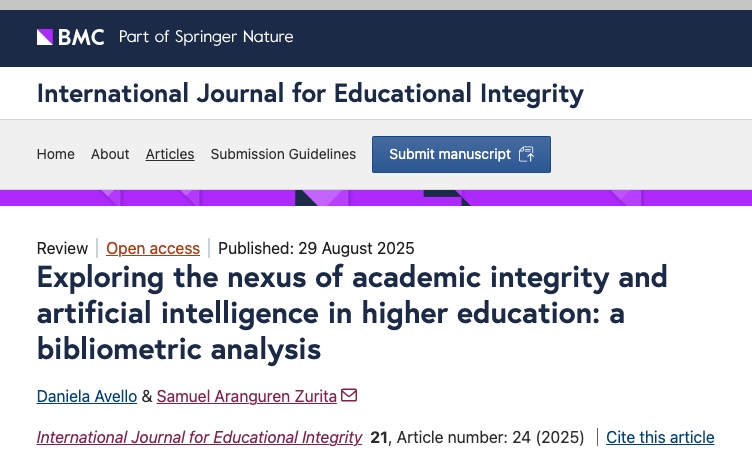
One of the great joys of being a journal editor is getting to share good news when a new article is published. I am going to make more of an effort to do this on my blog because the International Journal for Educational Integrity is a high quality (Q1) journal with lots to offer when it comes to academic integrity. We accept only about 10% of manuscripts submitted to the journal, so having an article published is a great achievment!
Artificial intelligence has created new opportunities in higher education, enhancing teaching and learning methods for both students and educators. However, it has also posed challenges to academic integrity.
Objective
To describe the evolution of scientific production on academic integrity and artificial intelligence in higher education.
Methodology
A bibliometric analysis was carried out using VOSviewer software and the Bibliometrix package in R. A total of 467 documents published between 2017 and 2025, retrieved from the Web of Science database, were analyzed.
Results
The analysis reveals a rapid expansion of the field, with an annual growth rate of 71.97%, concentrated in journals specializing in education, academic ethics, and technology. The field has evolved from a focus on the use of artificial intelligence in dishonest practices to the study of its integration in higher education. Four main lines of research were identified: the impact and adoption of artificial intelligence, implications for students, academic dishonesty, and associated psychological factors.
Conclusions
The field is at an early stage of development but is expanding rapidly, albeit with fragmented evolution, limited collaboration between research teams, and high editorial dispersion. The analysis shows a predominance of descriptive approaches, leaving room for the development of theoretical frameworks.
Originality or value
This study provides an overview and updated of the evolution of research on artificial intelligence and academic integrity, identifying trends, collaborations, and conceptual gaps. It highlights the need to promote theoretical reflection to guide future practice and research on the ethical use of artificial intelligence in higher education.
Sarah Elaine Eaton, PhD, is a Professor and Research Chair in the Werklund School of Education at the University of Calgary, Canada. Opinions are my own and do not represent those of my employer.
Since 2020 I’ve been working with a number of collaborators on projects related to fake degrees, diploma mills, and credential fraud. One of the people I have had the privilege of working with is FBI Special Agent (ret.), Allen Ezell, who is one of the world’s leading experts on fake degrees and accreditation fraud.
We also learned from other contributors to the book that the companies who sell fake credentials don’t stop there. They can also provide contact cheating services (often under the guise of ‘research services’), fake admission letters, fake transcripts, fraud in standardized testing (e.g., sending impersonators to write English language proficiency tests), and much more.
In the introduction for the book, we connect the dots to show how admissions fraud, contract cheating (e.g., term paper mills), scientific and scholarly paper mills, and fake degrees and fraudulent credentials are all connected. We synthesize the key ideas in this infographic:
Throughout the past half-decade, we’ve developed a number of resources related to these topics. I’ve posted about them previously, but I figured it might be helpful if I gathered some of them into a single blog post. They are all freely available as open access resources.
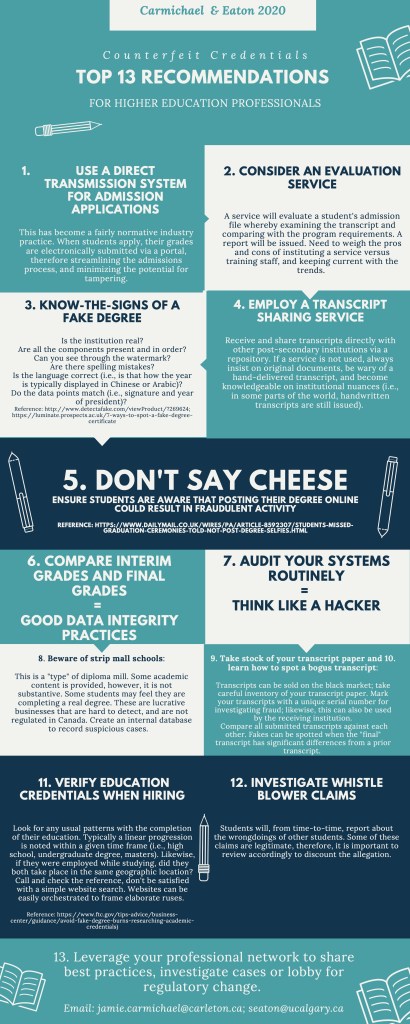
Counterfeit Credentials: 13 Recommendations for Higher Education Professionals
This infographic is intended mainly for registrars, admissions staff, admissions committees and others whose work involves assessing the credentials of applicants for university and college programs.
Scholarships Without Scruples
In this infographic, Jamie Carmichael and I share signs of scholarship scams, which is one from of educational fraud:
When it comes to education fraud, there are many angles to consider. There is certainly a need for more research, awareness, and advocacy on these topics, especially as GenAI can make these types of fraud easier.
Below are some related posts and further resources that I hope you find helpful.
Carmichael, J. J. (2024). Reframing and Broadening Adversarial Stylometry for Academic Integrity. In S. E. Eaton (Ed.), Second Handbook of Academic Integrity (pp. 1467-1485). Springer Nature Switzerland. https://doi.org/10.1007/978-3-031-54144-5_148
Carmichael, J., & Eaton, S. E. (2020). Counterfeit Credentials: Top 13 Recommendations for Higher Education Professionals (Infographic). University of Calgary. http://hdl.handle.net/1880/113042
Clark, A. (2023). Examining the problem of fraudulent English test scores: What can Canadian higher education institutions learn? In S. E. Eaton, J. J. Carmichael, & H. Pethrick (Eds.), Fake Degrees and Fraudulent Credentials in Higher Education (pp. 187-207). Springer International Publishing. https://doi.org/10.1007/978-3-031-21796-8_9
Çelik, Ö., & Razı, S. (2023). Avoiding favouritism in the recruitment practice of Turkish higher education institutions. In S. E. Eaton, J. J. Carmichael, & H. Pethrick (Eds.), Fake Degrees and Fraudulent Credentials in Higher Education (pp. 153-167). Springer International Publishing. https://doi.org/10.1007/978-3-031-21796-8_7
DeCoster, B. (2023). There is no culture? A framework for addressing admissions fraud. In S. E. Eaton, J. J. Carmichael, & H. Pethrick (Eds.), Fake Degrees and Fraudulent Credentials in Higher Education (pp. 209-226). Springer International Publishing. https://doi.org/10.1007/978-3-031-21796-8_10
Duklas, J. (2023). Bridging to tomorrow: A historical and technological review of credential exchange in higher education within Canada. In S. E. Eaton, J. J. Carmichael, & H. Pethrick (Eds.), Fake Degrees and Fraudulent Credentials in Higher Education (pp. 95-113). Springer International Publishing. https://doi.org/10.1007/978-3-031-21796-8_4
Eaton, S. E., & Carmichael, J. (2020). Scholarships without scruples (Infographic). University of Calgary: http://hdl.handle.net/1880/113044
Eaton, S. E., Carmichael, J., & Pethrick, H. (Eds.). (2023). Fake degrees and credential fraud in higher education. Springer. https://doi.org/10.1007/978-3-031-21796-8
Ezell, A. (2023). Yesterday, today, and tomorrow: A tour of Axact, the “World’s Largest Diploma Mill”. In S. E. Eaton, J. J. Carmichael, & H. Pethrick (Eds.), Fake Degrees and Fraudulent Credentials in Higher Education (pp. 49-94). Springer International Publishing. https://doi.org/10.1007/978-3-031-21796-8_3
Hextrum, K. (2023). Fair play, fraud, or fixed? Athletic credentials in U.S. higher education. In S. E. Eaton, J. J. Carmichael, & H. Pethrick (Eds.), Fake Degrees and Fraudulent Credentials in Higher Education (pp. 115-132). Springer International Publishing. https://doi.org/10.1007/978-3-031-21796-8_5
Orim, S.-M., & Glendinning, I. (2023). Corruption in admissions, recruitment, qualifications and credentials: From research into quality assurance. In S. E. Eaton, J. J. Carmichael, & H. Pethrick (Eds.), Fake Degrees and Fraudulent Credentials in Higher Education (pp. 133-151). Springer International Publishing. https://doi.org/10.1007/978-3-031-21796-8_6
Sabbaghan, S., & Fazel, I. (2023). None of the above: Integrity concerns of standardized English proficiency tests. In S. E. Eaton, J. J. Carmichael, & H. Pethrick (Eds.), Fake Degrees and Fraudulent Credentials in Higher Education (pp. 169-185). Springer International Publishing. https://doi.org/10.1007/978-3-031-21796-8_8
This blog has had over 3.7 million views thanks to readers like you. If you enjoyed this post, please ‘Like’ it using the button below or share it on social media. Thanks!
Sarah Elaine Eaton, PhD, is a Professor and Research Chair in the Werklund School of Education at the University of Calgary, Canada. Opinions are my own and do not represent those of my employer.
Starting the year with a brief reflection inspired by the OECD Social and Emotional Skills for Better Lives report:
How can we, as educators, create systems and circumstances to help students thrive? How do we create opportunities for them? If there are doors that have been closed to them, how do we open those doors?
Or better yet, how do we break down the walls that hold up those doors in the first place?
These are some big questions I am contemplating for this year. How about you?
This blog has had over 3 million views thanks to readers like you. If you enjoyed this post, please “like” it or share it on social media. Thanks!
Sarah Elaine Eaton, PhD, is a Professor and Research Chair in the Werklund School of Education at the University of Calgary, Canada. Opinions are my own and do not represent those of my employer.
As I prepare for the 2024-2025 Werklund Distinguished Research Lecture, I’ve been reflecting about how important it is to make scholarly work accessible to all. Open access (OA) is more than just a publishing model—it is a philosophy that challenges traditional barriers to knowledge dissemination and embodies the true spirit of academic scholarship.
Breaking Down Barriers to Knowledge
Historically (at least in my lived historical experience in higher education), academic research has been locked behind expensive paywalls, creating a significant divide that extends far beyond academic institutions. This exclusionary model particularly impacts researchers and knowledge seekers who find themselves on the margins of academic privilege. Researchers in middle and low-income countries (LMICs) often struggle to access scholarly and scientific literature and independent scholars and community practitioners face substantial financial barriers to staying current in their fields. Students and educators with limited institutional resources find themselves cut off from the latest scholarly insights, and curious members of the public are shut out from understanding complex academic work that could potentially transform their understanding of the world.
The Ethical Imperative of Sharing
Research is fundamentally about advancing human understanding, and restricting access undermines this core mission. Open access is commitment to knowledge as a public good, enabling a more dynamic and inclusive approach to scholarly communication. By removing economic and institutional barriers, we create opportunities for faster dissemination of critical findings, increased global collaboration, and unprecedented transparency in research methodologies. This approach allows for more rapid scientific and social progress, breaking down the traditional silos that have long constrained academic discourse.
Amplifying Research Impact
Contrary to traditional concerns, open access actually enhances the visibility and influence of scholarly work. Publications that are freely available receive more citations and reach broader audiences. This expanded reach afforded through OA creates opportunities for interdisciplinary and transdisciplinary connections that might otherwise remain unexplored, allowing research to transcend the narrow confines of specialized academic journals and engage with a more diverse intellectual ecosystem.
Personal Commitment and Broader Vision
As I prepare for this lecture, I am reflecting deeply about my commitment to open access (OA). One of my goals is to create a more equitable, informed, and connected world. This isn’t only about making documents freely downloadable, but also about cultivating a more inclusive intellectual landscape where knowledge can flow freely, unencumbered by economic or institutional constraints.
Practical Pathways to Open Access
For researchers considering this path, the journey involves strategic choices and institutional engagement. I am grateful for the privilege of working at the University of Calgary where researchers can self-archive their works into our institutional digital repository, PRISM.
Our university supports infrastructures that recognize and reward open access scholarship. Not everyone has this privilege.
Navigating Copyright and Publisher Agreements
Having said all this, I also recognize that it is important to abide by existing copyright agreements with publishers. Academic publishing involves complex legal and contractual relationships. Each publication typically comes with specific copyright terms that must be honoured (both ethically and legally), which may limit immediate or unrestricted sharing.
Because of this, I won’t be able to share all my work with a Creative Commons licence— not if a publisher holds the copyright. It does mean that I will look for creative and ethical ways to maximize access while maintaining professional integrity and contractual obligations.
Concluding reflections
Open access is not just about free downloads—it’s about free thinking, free exploration, and our commitment to knowledge being a universal right, not a privileged access. The longer I work in higher education, the more I am thinking about the future of knowledge, teaching, learning, and creating opportunities for others to thrive. This is really what is driving me right now — creating opportunities for others to thrive. Making as much of my work freely available as open access resources is one way I can do this.
As we get closer to the lecture, I’ll be making more and more of my work available as free open access downloads. I’ll keep you updated as we get closer to the lecture.
This blog has had over 3 million views thanks to readers like you. If you enjoyed this post, please “like” it or share it on social media. Thanks!
Sarah Elaine Eaton, PhD, is a Professor and Research Chair in the Werklund School of Education at the University of Calgary, Canada. Opinions are my own and do not represent those of my employer.
A question I am often asked is: Is it considered self-plagiarism to publish an article or some other output from one’s thesis?
I will start with a disclaimer: The contents of this post may not represent the views of my employer, an editor, or a publisher. There is no singular or universally accepted definition of self-plagiarism (or even plagiarism, for that matter). This post is based on my expertise as a scholar of plagiarism and academic misconduct. I have written about self-plagiarism in this peer-reviewed article and I dedicate an entire chapter to the topic my book, Plagiarism in Higher Education: Tackling Tough Topics in Academic Integrity.
In this post, I use the word ‘thesis’ to include any kind of student final summative written work including dissertations or other forms of final projects. A thesis can refer to undergraduate (often honours) work or graduate work, which is also called post-graduate work in some countries. In this post, I am talking specifically about student academic work that is supervised by a professor and receives approval and validation through formal evaluation such as a written appraisal of the work, an examination, and/or an oral defence.
In this post I am talking more about a thesis with a traditional format (e.g., five or six chapters) than about a manuscript-based thesis (also called ‘thesis by publication’ or ‘PhD by publication’). The queries I get about self-plagiarism are almost always about theses that follow a historically dominant structure with chapters, which is the kind of thesis that remains prevalent in the humanities and social sciences.
With these details covered, let’s get to the good stuff. Firstly, it is both expected and encouraged that students will publish from their thesis. After the oral defence or final thesis evaluation, a student’s work can be further refined and developed in order for it to be ready for publication. In many cases, student work may require substantive revisions (or even a complete overhaul) before it is suitable for publication in a journal or a book. It is foolhardy to assume that just because a student thesis has passed that it is automatically suitable for publication elsewhere. In some cases, there is still a lot of work to be done.
Here are the few things to think about after the thesis has been approved by the university authorities:
Archiving the Thesis in a Digital Repository
Our friendly institutional librarians at the University of Calgary have clarified for me on a previous occasion that theses are considered ‘unpublished’. Adding a thesis to a digital repository means it is archived, but not published. Learning that distinction was helpful for me.
Request an embargo on the release of the thesis into the public domain
Students can ask for an embargo on the release of the thesis until the results are published (e.g., journal article, book chapter or any other format). There seems to be a distressing but growing predatory practice around graduate student theses (or the data therein) being misappropriated, repackaged, and published under someone else’s name. I have heard of two such instances recently and, anecdotally, it seems this practice is growing internationally, though I have no data to substantiate this assertion.
This recommendation stems not from protecting oneself from self-plagiarism, but rather from predatory bad actors who have the intention of harvesting your work before you yourself have published it.
An embargo on a thesis should be requested for a reasonable and finite period of time, with the goal of making the research publicly accessible at some point within a couple of years of graduation, unless there is a compelling reason to extend the embargo longer than that.
Advice About How to Avoid Allegations of Self-plagiarism
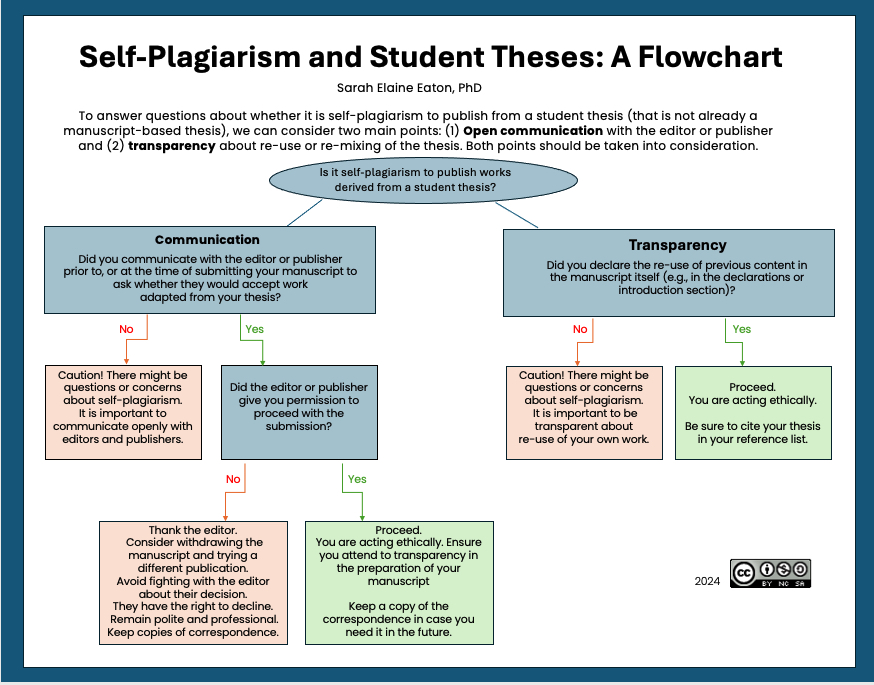
To avoid questions about academic or research misconduct, and specifically self-plagiarism, that can emerge when a student publish works derived from their thesis, there are two points to consider: communication and transparency. Both points should be taken into consideration.
Communication: Correspond with the Editor Prior to Submission
I recommend that students/graduates correspond with the journal editors prior to, orat the time of manuscript submission, in writing, to ensure full transparency. State clearly that the manuscript is drawn from the thesis and parts of it may be replicated exactly (e.g., methods section). Other parts of the manuscript may be derived (and/or significantly revised) from the thesis and if that is the case, offer some details, but avoid going overboard. Ask directly if such a submission would be considered by the journal / publisher. There is no harm is being clear and transparent with journal editors in this regard.
If the journal editor says no, then consider withdrawing the manuscript and trying a different publication. It is important to recognize that editors have the authority to make such judgements, so don’t be rude or try to convince the editor that their decision is wrong. Maintain a polite and professional tone at all times. Thank them for considering your request and move on.
If the editor says yes, then you are ready to proceed. Ensure you are attending to the matter of transparency during the preparation of your manuscript.
If you communicate with an editor orally (e.g., a face-to-face conversation or a video call), follow up in writing to document the conversation. Ask for confirmation that you have understood the agreement correctly.
I recommend keeping a record of your written correspondence in case you ever need it again in the future.
Transparency: Declare the re-use of previous content in the manuscript itself
As you prepare your manuscript for submission, ensure you are being transparent about the re-use of content derived from your thesis. This can be done in a couple of ways:
Explicit transparency statement: Add a declaration to the article/chapter/knowledge output stating that it is derived from your thesis. This way, you are declaring there may be some duplication helps to mitigate concerns about self-plagiarizing. You do not need be excessive with your statement. You can keep it short and simple. Here is some sample text that you are welcome to use, re-use, or adapt (as in, I am openly giving anyone permission to use or adapt this statement):
“This work is derived from my doctoral dissertation. Portions of the text resemble or may replicate the original text from my unpublished PhD thesis and have been reproduced as such with the permission of the editors”.
Note that if you use this statement verbatim, it may (ironically) be picked up by text-matching software used by publishers (i.e., flagged for possible plagiarism). I won’t take responsibility for that, so use some judgement in how you prepare your transparency statement.
Attribution: Self-citation is a contested issue in academic publication and it is prudent to avoid over-citing oneself. There are some circumstances in which self-citation is appropriate and this is one of them. When you are deriving work from your thesis, it is appropriate to cite your thesis in the list of references of your publication.
Be careful and attentive when it comes to attribution in publications derived from your thesis. You still need to cite any original works that your thesis drew from. I once saw a manuscript derived from a student thesis and the only work listed in the references was the student thesis! This is disrespectful to the authors of any original works the student thesis was drawn from, so be sure to give credit where it is due. Ensure you give attribution to the authors whose work informed your thesis and any subsequent publications.
This does not mean that you need to replicate the entire bibliography from your thesis in subsequent publications, unless, of course, you are specifically citing every single source in the publication. Instead, be meticulous and mindful to ensure that the specific sources that inform subsequent publications are cited appropriately. Details matter, and if you are going to publish from your thesis, it is worth it to focus on producing the highest quality publication possible.
Finally, assuming that you have a good relationship with your supervisor, I recommend that you keep them informed. In some cases, co-publication with the supervisor may be appropriate, but not in all cases. Co-publishing with one’s supervisor is a topic for another blog post, so I won’t delve deep into those complexities here. Suffice to say that staying in touch with your supervisor about the publication of your work may be beneficial to you, depending on the circumstances.
The bottom line is that concerns about self-plagiarism might be solved with open communication and transparency.
Bibliography and Further Reading
Eaton, S. E., & Crossman, K. (2018). Self-plagiarism research literature in the social sciences: A scoping review. Interchange: A Quarterly Review of Education, 49(3), 285-311. https://rdcu.be/YR5u
Roig, M. (2005). Re-using text from one’s own previously published papers: An exploratory study of potential self-plagiarism. Psychological Reports, 2005(97), 43-49. https://doi.org/10.2466/pr0.97.1.43-49
Roig, M. (2008). The debate on self-plagiarism: Inquisitional science or high standards of scholarship? Journal of Cognitive & Behavioral Psychotherapies, 8(2), 245-258.
Roig, M. (2024). On Recycling Our Own Work in the Digital Age. In S. E. Eaton (Ed.), Second Handbook of Academic Integrity (pp. 361-380). Springer Nature Switzerland. https://doi.org/10.1007/978-3-031-54144-5_15
This blog has had over 3.7 million views thanks to readers like you. If you enjoyed this post, please “like” it or share it on social media. Thanks!
Sarah Elaine Eaton, PhD, is a faculty member in the Werklund School of Education at the University of Calgary, Canada. Opinions are my own and do not represent those of my employer.
Sarah Elaine Eaton, PhD, Editor-in-Chief, International Journal for Educational Integrity


 Posted by Sarah Elaine Eaton, Ph.D.




You must be logged in to post a comment.