Generative AI (GenAI) is transforming teaching, learning, and assessment in higher education.
Learn to integrate GenAI effectively while maintaining academic integrity and enhancing student agency.
Dr. Sarah Eaton shares innovative strategies that promote critical thinking and original scholarship. Explore how GenAI reshapes academic practices and discover proactive approaches to leverage its potential.
This session equips educators, administrators, and policymakers to lead purposefully in a dynamic academic landscape.
Speaker bio
Sarah Elaine Eaton is a Professor and research chair at the Werklund School of Education at the University of Calgary (Canada). She is an award-winning educator, researcher, and leader. She leads transdisciplinary research teams focused on the ethical implications of advanced technology use in educational contexts. Dr. Eaton also holds a concurrent appointment as an Honorary Associate Professor, Deakin University, Australia.
More Details
Date: January 29, 2025
Time: 12:00 – 13:00 Mountain time
This talk is free and open to the public, but there are only 20 seats available to join us in person! We can also accommodate folks online.
This blog has had over 3.7 million views thanks to readers like you. If you enjoyed this post, please “like” it or share it on social media. Thanks!
Sarah Elaine Eaton, PhD, is a Professor and Research Chair in the Werklund School of Education at the University of Calgary, Canada. Opinions are my own and do not represent those of my employer.
Here are three things you can do to prioritize human rights and dignity when it comes to policies and procedures to address allegations of academic or research misconduct:
Use a human-rights-by-design approach to developing, revising, and implementing policies by conducting a comprehensive review of existing academic integrity policies. Update policies to explicitly incorporate human rights principles, ensuring they address fair process, privacy, equitable treatment, and respect for human dignity. It is essential to involve individuals from representative groups in this process.
Provide ongoing training, education, and support to faculty, staff, and students about human rights principles and how they apply to misconduct investigations and case management. Create orientation programs that explain expectations for ethical conduct while respecting diverse cultural perspectives. Offer workshops and resources, peer mentoring programs, and support services.
Focus on continuous improvement and quality assurance of ethics and integrity practices by gathering feedback from students, faculty, staff and relevant stakeholders. Regularly review misconduct case management processes and data to ensure equitable treatment across different demographics.
Implementing human rights principles into misconduct investigations and case management helps to create more effective and sustainable learning environments. This approach prioritizes people over punishment, dignity over draconianism, and compassion over callousness.
This blog has had over 3 million views thanks to readers like you. If you enjoyed this post, please “like” it or share it on social media. Thanks!
Sarah Elaine Eaton, PhD, is a Professor and Research Chair in the Werklund School of Education at the University of Calgary, Canada. Opinions are my own and do not represent those of my employer.
Many people in the academic integrity world are already familiar with contract cheating websites, those that deal in the business of buying and selling exams, bespoke term papers, theses, and exam questions and answers.
But this business isn’t limited to the millions of K-12, high school and post-secondary students. The exam fraud business is alive and well for professional accreditation exams for folks who either want to bypass a formal university degree or to supplement existing credentials.
For example, in the IT industry credentials are often the golden key to new opportunities. Certifications and accreditations (allegedly) validate technical skills, offering (so-called) proof that a candidate has the expertise needed for a professional role.
Taking into account supply and demand, with job candidates being in high supply and well-paying jobs being in high demand, certification and accreditation fraud is alive and well in the IT industry, as well as other industries. This is a trend employers cannot afford to ignore.
Exposing the Fraud: How Buying and Selling of Certification Exam Questions Works
Certification fraud occurs when individuals falsify credentials, purchase counterfeit certifications, or misuse legitimate certifications obtained by others. But there’s this sneaky grey area that exists when a person actually sits a professional exam themselves, but they’ve prepared by buying the exam questions and/or the answers from an online vendor.
I won’t name specific companies that do this in this post, because I’m not in the habit of advertising for these fraudsters, but I want to show you how they work, so here are some screenshots:
Screenshot #1: Home page
At the top of this website, the company claims that 94% of the exam questions that they sold were “almost the same” and that 97% of customers passed the exam using their materials. (Who knows what happened to the other 3%…?) Finally, 98% of customers found the “study guides” effective and helpful.
There’s that phrase that we commonly see on contract cheating websites, “study guide”. For the uninitiated, this is a euphemism for “exam questions”.
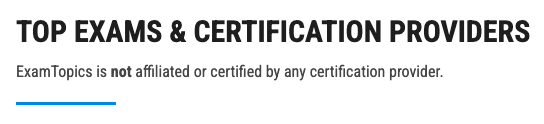
Screenshot #2: Saying it like it is: Not affiliated with any certification provider
In this screenshot the company states plainly that they are not affiliated or certified by any certification provider. Reading between the lines, the message is ‘caveat emptor’ or ‘buyer beware’. They are telling you upfront that they are in the business of selling exam questions and make no guarantees about their products.
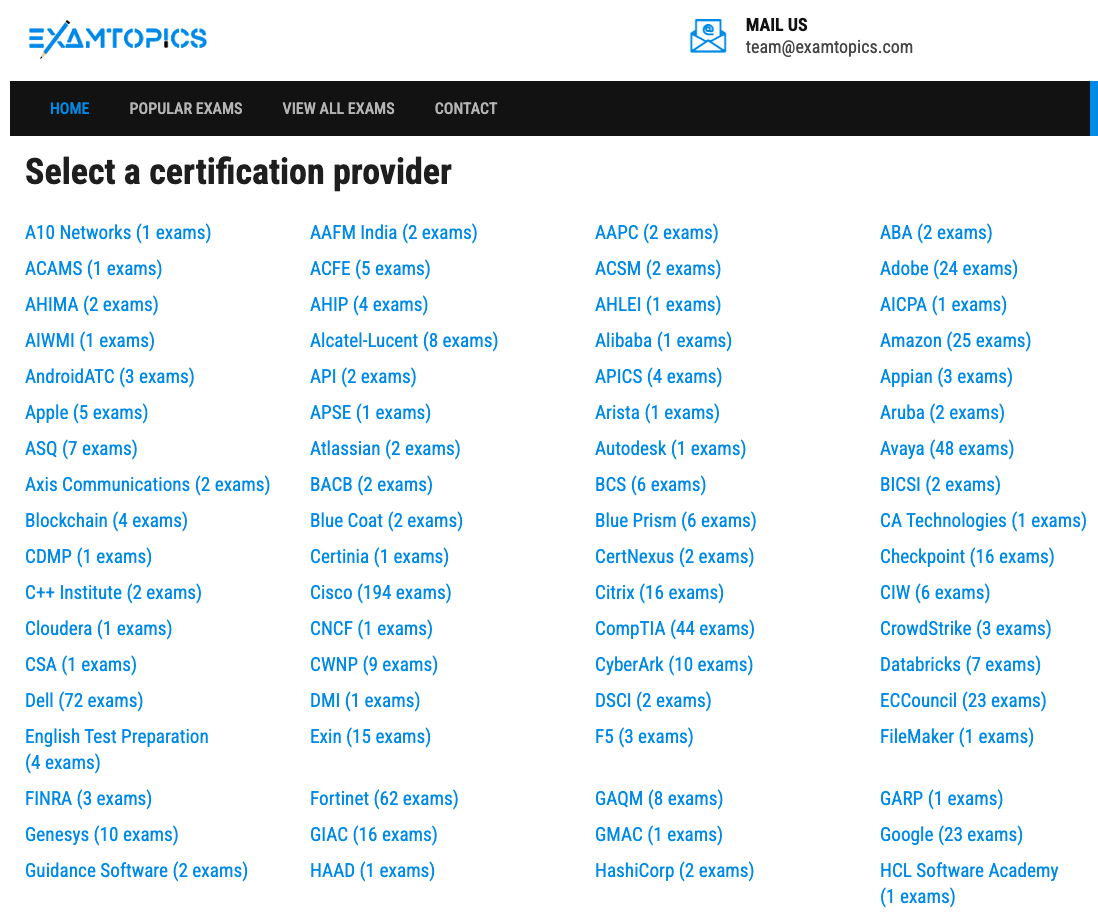
Screenshot #3: Samples of accreditation exam questions for sale
Look at all the options: You can buy exam questions for certifications offered by DELL, English language proficiency exams, Citrix, Adobe, and Amazon, and Google just to name a few.
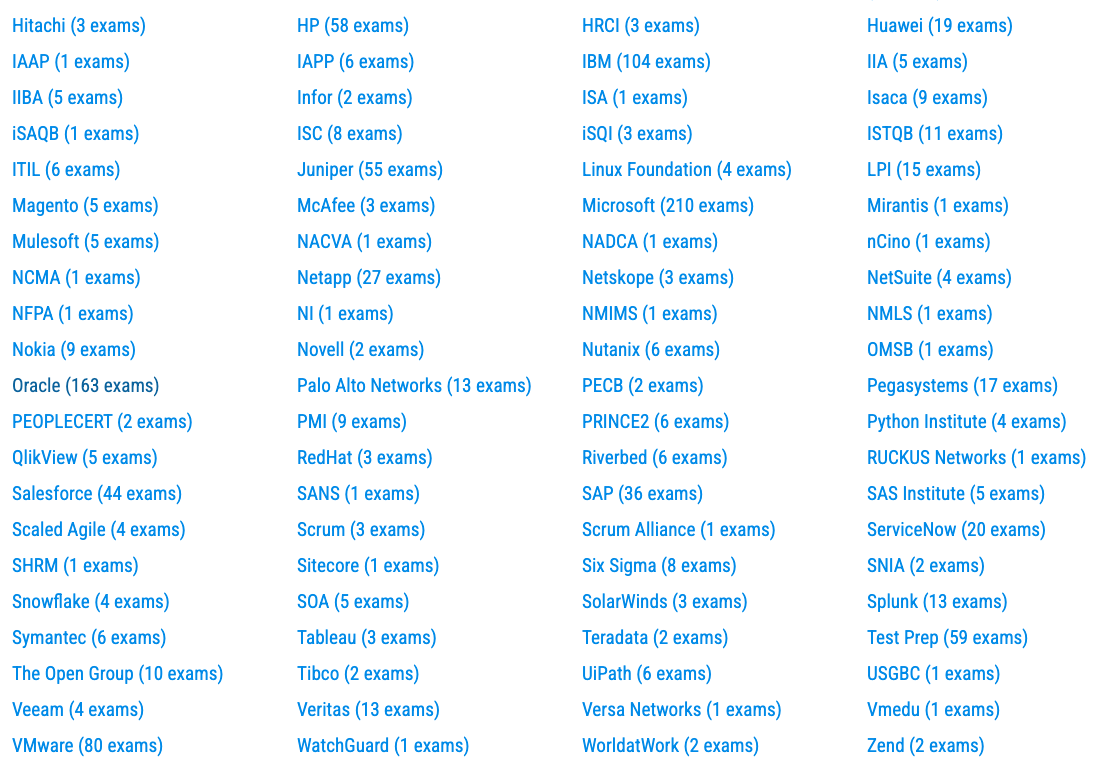
Screenshot #4: More samples of certification provider exam questions for sale.
But wait! There’s more! You can buy exam questions for certifications offers by Oracle, IBM, SAP, and others.
Businesses that buy and sell exam certification questions engage in fraudulent practices undermine trust in the certification system and create significant risks for employers.
Consequences for Employers
Hiring someone with counterfeit credentials can have dire consequences. Unqualified employees may lack the technical skills to handle complex tasks, leading to project delays, costly errors, or even security breaches. Beyond the financial impact, fraudulent certifications can erode team morale, as employees with genuine qualifications may feel undervalued when working alongside those who faked their way in.
What Employers and Hiring Managers can Do
Employers, and especially hiring managers and those working in HR, must take proactive steps to safeguard their hiring processes. Some of you may be asking if this kind of practice is actually illegal. I’m not a lawyer, but what I can say is that although contact cheating for students is illegal in countries like Australia, the UK, and Ireland, if you’re not a student, then you might get to live a proverbial grey zone. To the best of my knowledge, it is not actually illegal to buy and sell questions for professional certification exams in most countries of the world.
So, what can employers do? First, trust but verify! Verifying certifications directly with issuing organizations is one step. Many certification bodies offer easy online verification tools to confirm a candidate’s credentials. Additionally, employers should stay informed about recognized accreditation standards and avoid unverified institutions.
Having said this, verification of credentials and certification won’t help if someone has bought exam questions online and then taken the test themselves. Their results could be ‘verifiable’ in a sense, because there’s an assumption that a person who has passed an exam had the knowledge to do so. But when someone buys their exam questions before sitting the test, it means that they have prepared for an exam and may not necessarily have internalized the knowledge or skills that should match the certification they receive from passing an exam. An exam is one measure of knowledge, but it isn’t the only one.
Having prospective employees demonstrate their skills and respond to technical questions that could only be answered if the person has the knowledge to back up their documentation can also help. One possibility is to give an interviewee a real-world scenario that could happen at your organization. Ask them how they would go about problem-solving it. If they struggle or stumble, it could be a sign that they lack the necessary skills for the job. (It could also be a sign that they’re just nervous or that interviewing isn’t their strength. So let me also make a plug here for having an inclusive and equitable interviewing process.)
Investing in robust, inclusive, and equitable hiring practices not only protects an organization from the pitfalls of fraud but also helps to create a culture of accountability and excellence. By placing a premium on authentic certifications combined with demonstrable knowledge and skills and inclusive hiring practices, employers signal their commitment to integrity and ensure they are building a team of qualified professionals.
Bottom line: If you’re hiring someone who says they have an IT certification based on taking exams, it’s worth it to find out if they actually have the knowledge and skills to do the job.
And this is just one example of one site. Rest assured that it is not the only one out there. Exam cheating companies like this one don’t exist in isolation. They’re in the game to make money, and lots of it.
In an industry where skills and knowledge drive success, vigilance against certification and accreditation fraud is not optional—it is a driver of success.
Future Outlook
Fraud and corruption are alive and well education and industry. There is a growing community of sleuths, scholars, and activists who are ready to sniff out fraud and expose it and naïveté about these matters is quickly going out of fashion.
There may have been a time when it was acceptable—or even fashionable—to clutch your pearls, proclaim moral outrage, or just refuse to accept that educational and professional fraud are more commonplace than you might have previously thought. GenAI is here to stay, and so are companies whose business is educational, accreditation, scientific, and professional fraud. These companies are profitable because they have customers willing to pay for their goods and services.
Vigilance, sleuthing, and exposing fraud are very much on trend as we move ahead into the new year. And if you’re a hiring manager, taking steps to protect the integrity of your operations is definitely part of the job in 2025 and beyond.
Eaton, S. E., & Carmichael, J. (2022). The Ecosystem of Commercial Academic Fraud. In. Calgary, Canada: University of Calgary. https://dx.doi.org/10.11575/PRISM/40330
Eaton, S. E., Carmichael, J., & Pethrick, H. (Eds.). (2023). Fake degrees and credential fraud in higher education. Springer. https://doi.org/10.1007/978-3-031-21796-8
This blog has had over 3 million views thanks to readers like you. If you enjoyed this post, please “like” it or share it on social media. Thanks!
Sarah Elaine Eaton, PhD, is a Professor and Research Chair in the Werklund School of Education at the University of Calgary, Canada. Opinions are my own and do not represent those of my employer.
Earlier this semester, I accepted a new leadership role in the Werklund School of Education as the Academic Coordinator of the Master of Education (MEd) graduate topic in Inclusive Education. (We are accepting applications the 2025-2026 academic year, in case you’ve been thinking about doing an MEd. It is a fully online four-course topic.)
This got me thinking about academic integrity through an inclusive lens. My interest in the connection between social justice, equity, inclusion, and accessibility goes back a few years. In 2022, I partnered with a Werklund graduate student in educational psychology, Rachel Pagaling, and Dr. Brenda McDermott, Senior Manager, Student Accessibility Services to write up a brief open access report on Academic Integrity Considerations for Accessibility, Equity and Inclusion.
We know that academic integrity is a cornerstone of both K-12 and higher education. We want to ensure that learning, assessment, and credentials uphold the highest ethical standards. However, as educators, we can — and should — consider how the principles of inclusive education can strengthen and complement our approach to academic integrity.
Inclusive education means ensuring that all students, regardless of their background, abilities, or learning needs, have equitable access to educational opportunities and can meaningfully participate. Thomas and May sum it up nicely when they say that being inclusive means “proactively making higher education accessible, relevant and engaging to all students” (p. 5). Of course, the same thinking could be extended to K-12 education, too. Applying these inclusive principles to academic integrity means recognizing that diverse learners may express and demonstrate their knowledge in different ways.
Inclusion is not only about students with physical disabilities, developmental disabilities, or neurodivergence, but rather it is about creating conditions where all students can thrive. Associate Professor Joanna Tai and colleagues have a great article on Assessment for Inclusion that helps us think about how to design equitable and rigorous.
The point here is that by fostering an inclusive academic culture, we empower all students to bring their best selves to school and learn with integrity.
Beyond accessibility and cultural responsiveness, inclusive academic integrity also means actively addressing systemic barriers and implicit biases. If certain groups of students consistently struggle with academic integrity issues, it may reveal deeper inequities that need to be examined and addressed. In other words, we can look at the barriers to success, rather than the limitations of our students, as being the problem. As Juuso Nieminen and I have pointed out, even accommodations policies have an underlying assumption that students who need accommodations are out to cheat the system.
If you’re interested in reading more about disability justice to inform your thinking, I highly recommend Doron Dorfman’s article on the fear of the disability con and Jay Dolman’s work on academic ableism.
The benefits of this holistic, inclusive approach to academic integrity are numerous. When students feel respected, supported, and able to succeed, they are more engaged and motivated. This, in turn, leads to better learning outcomes. Moreover, graduates who have internalized inclusive academic integrity will be better equipped to uphold ethical standards in their future careers and communities.
As educators, we have a responsibility to nurture academic integrity in ways that are inclusive, accessible, culturally responsive, and empowering for diverse learners. By applying the principles of inclusive education, we can transform academic integrity from a rigid set of rules into a collaborative, values-driven endeavor that brings out the best in our students and ourselves.
References
Davis, M. (2022). Examining and improving inclusive practice in institutional academic integrity policies, procedures, teaching and support. International Journal for Educational Integrity, 18(1), 14. https://doi.org/10.1007/s40979-022-00108-x
Dolmage, J. T. (2017). Academic Ableism: Disability and Higher Education. University of Michigan Press.
Dorfman, D. (2019). Fear of the disability con: Perceptions of fraud and special rights discourse. Law & society review, 53(4), 1051-1091. https://doi.org/10.1111/lasr.12437
Elkhoury, E. (2024). An Equitable Approach to Academic Integrity Through Alternative Assessment. In S. E. Eaton (Ed.), Second Handbook of Academic Integrity (pp. 1261-1272). Springer Nature Switzerland. https://doi.org/10.1007/978-3-031-54144-5_135
Nieminen, J. H., & Eaton, S. E. (2023). Are assessment accommodations cheating? A critical policy analysis. Assessment & Evaluation in Higher Education, 1-16. https://doi.org/10.1080/02602938.2023.2259632
Pagaling, R., Eaton, S. E., & McDermott, B. (2022, April 4). Academic Integrity: Considerations for Accessibility, Equity, and Inclusion. http://hdl.handle.net/1880/114519
Tai, J., Ajjawi, R., Bearman, M., Boud, D., Dawson, P., & Jorre de St Jorre, T. (Eds.). (2022). Assessment for inclusion: rethinking contemporary strategies in assessment design. Routledge. https://doi.org/10.1080/07294360.2022.2057451
This blog has had over 3 million views thanks to readers like you. If you enjoyed this post, please “like” it or share it on social media. Thanks!
Sarah Elaine Eaton, PhD, is a Professor and Research Chair in the Werklund School of Education at the University of Calgary, Canada. Opinions are my own and do not represent those of my employer.
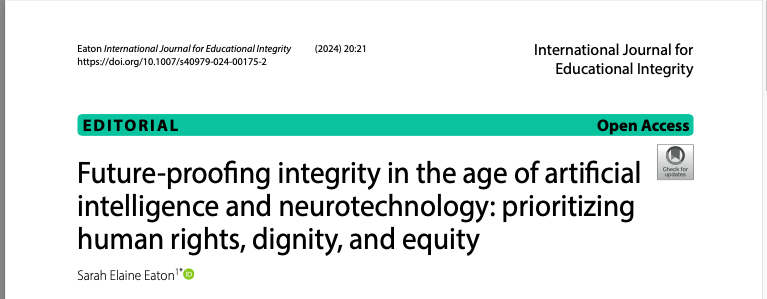
Future-proofing integrity in the age of artificial intelligence and neurotechnology: prioritizing human rights, dignity, and equity
Abstract
In this article I argue for the prioritisation of human rights when developing and implementing misconduct policies. Existing approaches may be perpetuate inequities, particularly for individuals from marginalised groups. A human-rights-by-design approach, which centres human rights in policy development, revision, and implementation, ensuring that every individual is treated with dignity and respect.
Recommendations for implementing a human-rights approach to misconduct investigations and case management are offered, covering areas such as procedural fairness, privacy, equity, and the right to education. Additional topics covered are the need to limit surveillance technologies, and the need to recognize that not all use of artificial intelligence tools automatically constitutes misconduct. I disentangle
the differences between equity and equality and explain how both are important when considering ethics and integrity. A central argument of this paper is that a human-rights-by-design approach to integrity does not diminish standards but rather strengthens educational systems by cultivating ethical awareness and respect for personhood. I conclude with a call to action with a seven-point plan for institutions to adopt a human-rights-based approach to ethics and integrity. In the age of artificial intelligence and neurotechnology, insisting on human rights and dignity when we investigate and address misconduct allegations is an ethical imperative that has never been more important.
As I reflect on the current state of academic and research integrity, I am struck by a glaring omission in our discussions: the connection between misconduct and human rights. We often treat these as separate entities, failing to recognize the profound impact that misconduct investigations and policies can have on the fundamental rights of individuals. This oversight is particularly concerning in the age of artificial intelligence (AI) and neurotechnology, where the potential for harm is magnified.
Take, for example, the case of a professor in Canada who physically assaulted international students accused of plagiarism. This horrifying example demonstrates how the pursuit of academic integrity can be twisted into a justification for degrading and inhumane treatment, violating the very principles of dignity and respect that should guide our actions. While this is an extreme case, it highlights the need for a fundamental shift in our approach.
In this editorial, I offer a call to action to move beyond simply adhering to legal requirements and embrace a ‘human-rights-by-design’ approach that embeds human rights principles into our policies and practices. This means ensuring procedural fairness throughout investigations, safeguarding the privacy of individuals, and recognizing the right to be presumed innocent until there is proof to the contrary. It also requires us to acknowledge the diverse backgrounds and circumstances of our students and staff, striving for equitable treatment that addresses systemic inequalities and provides the support needed for everyone to succeed.
In the face of rapidly evolving technologies like AI, we must be especially vigilant in upholding human rights. The temptation to rely on unproven AI detection tools or to rush to judgement based on suspicion rather than evidence is strong, but it is a path that leads us away from justice and fairness. We cannot allow fear or expediency to erode our commitment to human dignity.
By centring human rights in our approach to integrity, we can create educational and research environments that are not only ethically sound but also truly just and equitable. This is not about lowering standards; it is about building a culture of integrity that upholds the inherent worth of every individual.
Sarah Elaine Eaton, PhD, is a Professor and Research Chair in the Werklund School of Education at the University of Calgary, Canada. Opinions are my own and do not represent those of my employer.


 Posted by Sarah Elaine Eaton, Ph.D.


 Learning, Teaching and Leadership
You must be logged in to post a comment.