Just 26.3% of the European Union’s artificial intelligence (AI) professionals are women, according to a report from LinkedIn.
In my work with of the Women for Ethical AI (W4EAI) UNESCO platform, we had similar findings in our gender outlook study.
There are no easy solutions to this gap, but for those working in this area, some five concrete things you can do to promote gender inclusion (and equity in general) are:
Invite women into leadership roles, strategic planing for artificial intelligence and advanced technology.
Ensure that policies explicitly include women, girls, and other equity-deserving groups.
Invite women (and in particular, early career women and those who are precariously employed) to share and showcase their expertise and knowledge (and compensate them for their contributions).
Create formal sponsorship programs for women and girls who want to develop their knowledge and cp-competencies related to AI, with ongoing opportunities for learning and skill development.
There are a myriad of ethical complexities when it comes to artificial intelligence and gender is only one of them. Acknowledging inequalities and then working to support equity, fairness, and justice will remain ongoing work in the years to come.
United Nations Educational Scientific and Cultural Organization (UNESCO). (2024). UNESCO Women for Ethical AI: Outlook study on artificial intelligence and gender. https://unesdoc.unesco.org/ark:/48223/pf0000391719
This blog has had over 3.7 million views thanks to readers like you. If you enjoyed this post, please ‘Like’ it using the button below or share it on social media. Thanks!
Sarah Elaine Eaton, PhD, is a Professor and Research Chair in the Werklund School of Education at the University of Calgary, Canada. Opinions are my own and do not represent those of my employer.
Generative AI (GenAI) is transforming teaching, learning, and assessment in higher education.
Learn to integrate GenAI effectively while maintaining academic integrity and enhancing student agency.
Dr. Sarah Eaton shares innovative strategies that promote critical thinking and original scholarship. Explore how GenAI reshapes academic practices and discover proactive approaches to leverage its potential.
This session equips educators, administrators, and policymakers to lead purposefully in a dynamic academic landscape.
Speaker bio
Sarah Elaine Eaton is a Professor and research chair at the Werklund School of Education at the University of Calgary (Canada). She is an award-winning educator, researcher, and leader. She leads transdisciplinary research teams focused on the ethical implications of advanced technology use in educational contexts. Dr. Eaton also holds a concurrent appointment as an Honorary Associate Professor, Deakin University, Australia.
More Details
Date: January 29, 2025
Time: 12:00 – 13:00 Mountain time
This talk is free and open to the public, but there are only 20 seats available to join us in person! We can also accommodate folks online.
This blog has had over 3.7 million views thanks to readers like you. If you enjoyed this post, please “like” it or share it on social media. Thanks!
Sarah Elaine Eaton, PhD, is a Professor and Research Chair in the Werklund School of Education at the University of Calgary, Canada. Opinions are my own and do not represent those of my employer.
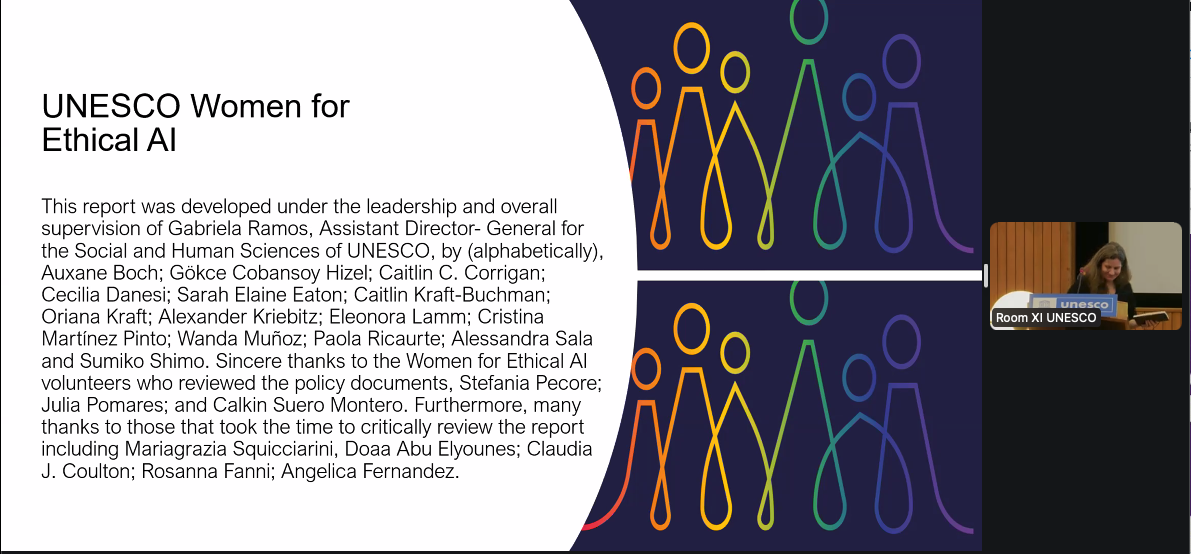
Over the past few months I have had the tremendous opportunity to work with an incredible group of women under the direction of Assistant Director-General (ADG) for Social and Human Sciences of UNESCO. Our collective produced this report that was launched today at a special conference in Paris:
UNESCO Women for Ethical AI: outlook study on artificial intelligence and gender
This blog has had over 3 million views thanks to readers like you. If you enjoyed this post, please “like” it or share it on social media. Thanks!
Sarah Elaine Eaton, PhD, is a Professor and Research Chair in the Werklund School of Education at the University of Calgary, Canada. Opinions are my own and do not represent those of my employer.
It’s the start of a new school year here in North America. We are into the second week of classes and already I am hearing from administrators in both K-12 and higher education institutions who are frustrated with educators who have turned to ChatGPT and other publicly-available Gen AI apps to help them assess student learning.
Although customized AI apps designed specifically to assist with the assessment of student learning already exist, many educators do not yet have access to such tools. Instead, I am hearing about educators turning to large language models (LLMs) like ChatGPT to help them provide formative or summative assessment of students’ work. There are some good reasons not to avoid using ChatGPT or other LLMs to assess student learning.
I expect that not everyone will agree with these points, please take them with the spirit in which they are intended, which to provide guidance on ethical ways to teach, learn, and assess students’ work.
8 Tips on Why Educators Should Avoid Using AI Apps to Help with Assessment of Student Learning
Intellectual Property
In Canada at least, a student’s work is their intellectual property. Unless you have permission to use it outside of class, then avoid doing so. The bottom line here is that student’s intellectual work is not yours to share to a large-language model (LLM) or any other third party application, with out their knowledge and consent.
Privacy
A student’s personal data, including their name, ID number and other details should never be uploaded to an external app without consent. One reason for this blog post is to respond to stories I am hearing about educators uploading entire student essays or assignments, including the cover page with all the identifying information, to a third-party GenAI app.
Data security
Content uploaded to an AI tool may be added to its database and used to train the tool. Uploading student assignments to GenAI apps for feedback poses several data security risks. These include potential breaches of data storage systems, privacy violations through sharing sensitive student information, and intellectual property concerns. Inadequate access controls or encryption could allow unauthorized access to student work.
AI model vulnerabilities might enable data extraction, while unintended leakage could occur through the AI app’s responses. If the educator’s account is compromised, it could expose all of the uploaded assignments. The app’s policies may permit third-party data sharing, and long-term data persistence in backups or training sets could extend the risk timeline. Also, there may be legal and regulatory issues around sharing student data, especially for minors, without proper consent.
Bias
AI apps are known to be biased. Feedback generated by an AI app can be biased, unfair, and even racist. To learn more check out this article published in Nature. AI models can perpetuate existing biases present in their training data, which may not represent diverse student populations adequately. Apps might favour certain writing styles (e.g., standard American English), cultural references, or modes of expression, disadvantaging students from different backgrounds.
Furthermore, the AI’s feedback could be inconsistent across similar submissions or fail to account for individual student progress and needs. Additionally, the app may not fully grasp nuanced or creative approaches, leading to standardized feedback that discourages unique thinking.
Lack of context
An AI app does not know your student like you do. Although GenAI tools can offer quick assessments and feedback, they often lack the nuanced understanding of a student’s unique context, learning style, and emotional or physical well-being. Overreliance on AI-generated feedback might lead to generic responses, diminishing the personal connection and meaningful interaction that educators provide, which are vital for effective learning.
Impersonal
AI apps can provide generic feedback, but as an educator, you can personalize feedback to help the student grow. AI apps can provide generic feedback but may not help to scaffold a student’s learning. Personalized feedback is crucial, as it fosters individual student growth, enhances understanding, and encourages engagement with the material. Tailoring feedback to specific strengths and weaknesses helps students recognize their progress and areas needing improvement. In turn, this helps to build their confidence and motivation.
Academic Integrity
Educators model ethical behaviour, this includes transparent and fair assessment. If you are using tech tools to assess student learning, it is important to be transparent about it. In this post, I write more about how and why deceptive and covert assessment tactics are unacceptable.
Your Employee Responsibilities
If your job description includes assessing student work , you may be violating your employment contract if you offload assessment to an AI app.
Concluding Thoughts
Unless your employer has explicitly given you permission to use AI apps for assessing student work then, at least for now, consider providing feedback and assessment in the ways expected by your employer. If we do not want students to use AI apps to take shortcuts, then it is up to us as educators to model the behavior we expect from students.
I understand that educators have excessive and exhausting workloads. I appreciate that we have more items on our To Do Lists than is reasonable. I totally get it that we may look for shortcuts and ways to reduce our workload. The reality is that although Gen AI may have the capability to help with certain tasks, not all employers have endorsed their use in same way.
Not all institutions or schools have artificial intelligence policies or guideline, so when in doubt, ask your supervisor if you are not sure about the expectations. Again, there is a parallel here with student conduct. If we expect students to avoid using AI apps unless we make it explicit that it is OK, then the same goes for educators. Avoid using unauthorized tech tools for assessment without the boss knowing about it.
I am not suggesting that Gen AI apps don’t have the capability to assist with AI, but I am suggesting that many educational institutions have not yet approved the use of such apps for use in the workplace. Trust me, when there are Gen AI apps to help with the heaviest aspects of our workload as educators, I’ll be at the front of the line to use them. In the meantime, there’s a balance to be struck between what AI can do and what one’s employer may permit us to use AI for. It’s important to know the difference — and to protect your livelihood.
This blog has had over 3.6 million views thanks to readers like you. If you enjoyed this post, please “like” it or share it on social media. Thanks!
Sarah Elaine Eaton, PhD, is a faculty member in the Werklund School of Education at the University of Calgary, Canada. Opinions are my own and do not represent those of my employer.
Sarah Elaine Eaton, PhD, Editor-in-Chief, International Journal for Educational Integrity
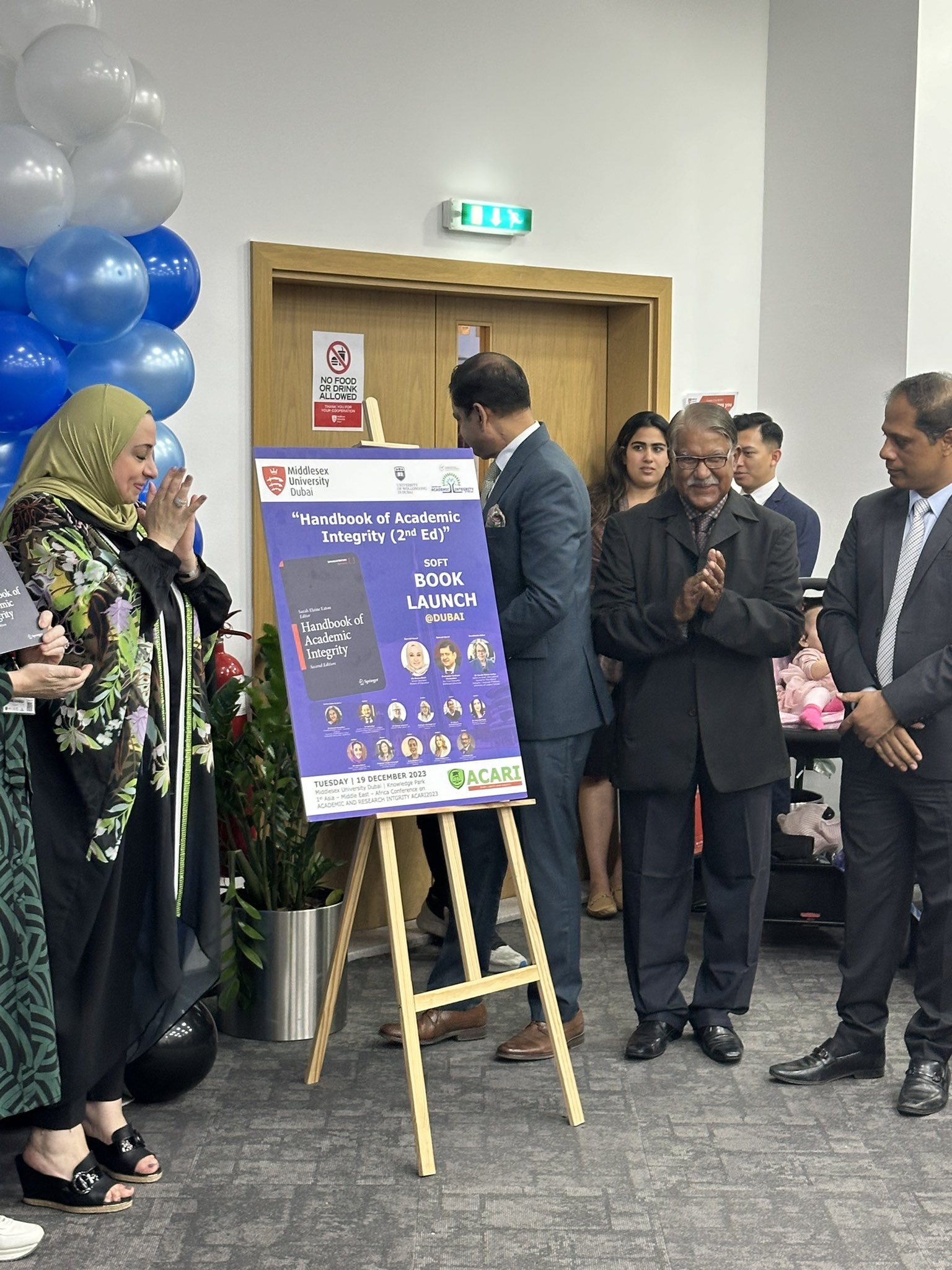
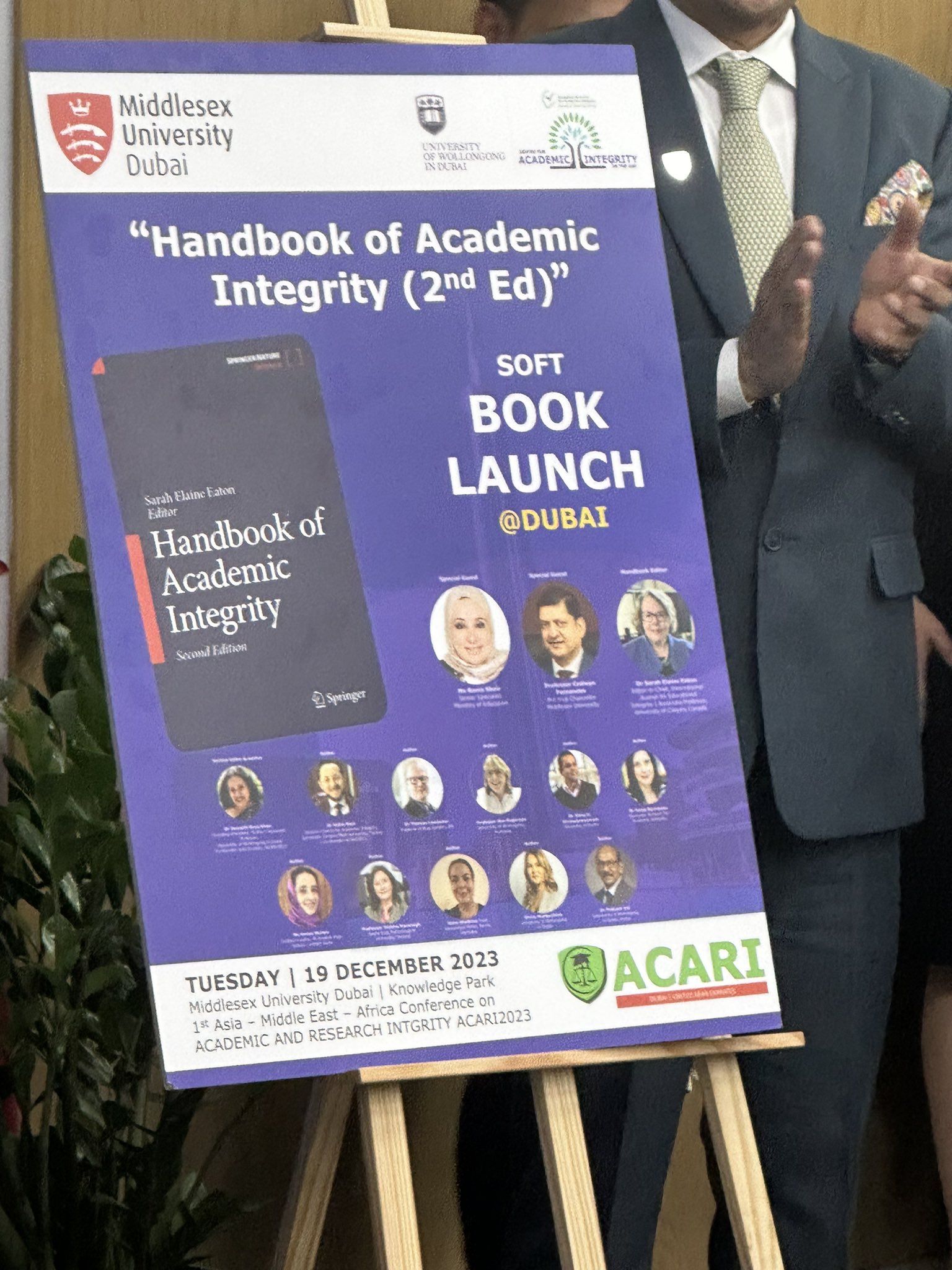
The handbook is now in its final stages of production, and the standalone second edition will be released in hard copy in January, 2024. To celebrate, Dr. Zeenath Reza Khan, who serves as one of the handbook’s section editors and contributors, and was a co-chair of the 1st Asia -Middle East – Africa Conference on Academic and Research Integrity (ACARI) 2023, 17-19 December led the organization of the soft launch for the handbook during the conference.
The launch was held during the closing ceremony of the conference on the final day in an auditorium at the prestigious Middlesex University Dubai, was both festive and scholarly, as it brought together educators, researchers, and advocates for academic integrity. In addition to conference delegates, a number of esteemed dignitaries attended including, His Excellency, Jamal Hossain, Consul General of Bangladesh to UAE; Dr. Mohammad Ali Reza Khan, Award-winning Expert Wildlife Specialist, Dubai Municipality, along with Professor Cedwyn Fernandes, Pro Vice Chancellor of Middlesex University and Director of Middlesex University Dubai. Special thanks to Ms. Rania Sheir, Senior Specialist, Entrepreneurship and Innovation, Ministry of Education, UAE, who not only attended the launch, but also posted about it on LinkedIn.
The Handbook, meticulously curated by leading experts in the field, is a compendium of insights, strategies, and best practices aimed at upholding the ethical practices in academia and research. It covers a diverse range of topics, from plagiarism to artificial intelligence, to the promotion of ethical behaviour in academic research, and much more. The multidimensional approach of the Handbook of Academic Integrity ensures that it caters to the needs of educators, administrators, and students alike.
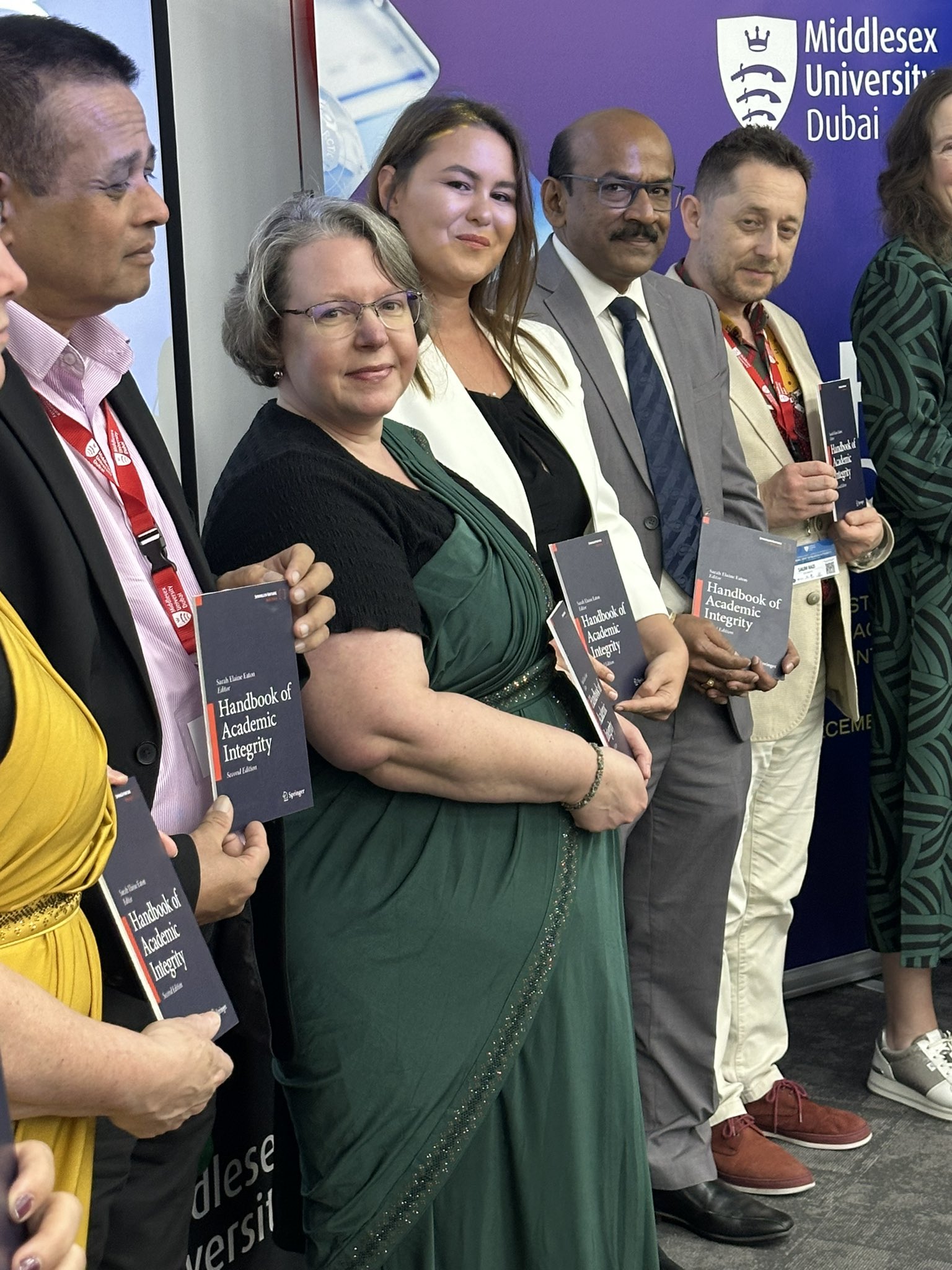
A number of contributing authors were in attendance, including:
Dr. Zeenath generously gifted two colleagues and me with authentic saris that we wore during the closing ceremony and the launch. As you can see from the photo below, I was given one in dark green and I just love it! I had an opportunity to say a few words about the book and its importance in the field, and to thank the organizers and authors. Each contributor was gifted a symbolic souvenir cut-out of the front cover of the handbook and following the formalities, we signed the back of one another’s covers.
The book launch culminated in a celebratory atmosphere, with attendees leaving inspired. The Handbook of Academic Integrity (2nd ed.), now poised to be a cornerstone in the field, builds on the first edition and stands as a testament to the collective commitment to nurturing a culture of integrity throughout every level of education and research.
This blog has had over 3 million views thanks to readers like you. If you enjoyed this post, please “like” it or share it on social media. Thanks!
Sarah Elaine Eaton, PhD, is a faculty member in the Werklund School of Education at the University of Calgary, Canada. Opinions are my own and do not represent those of my employer.




 Posted by Sarah Elaine Eaton, Ph.D.







You must be logged in to post a comment.