Just 26.3% of the European Union’s artificial intelligence (AI) professionals are women, according to a report from LinkedIn.
In my work with of the Women for Ethical AI (W4EAI) UNESCO platform, we had similar findings in our gender outlook study.
There are no easy solutions to this gap, but for those working in this area, some five concrete things you can do to promote gender inclusion (and equity in general) are:
Invite women into leadership roles, strategic planing for artificial intelligence and advanced technology.
Ensure that policies explicitly include women, girls, and other equity-deserving groups.
Invite women (and in particular, early career women and those who are precariously employed) to share and showcase their expertise and knowledge (and compensate them for their contributions).
Create formal sponsorship programs for women and girls who want to develop their knowledge and cp-competencies related to AI, with ongoing opportunities for learning and skill development.
There are a myriad of ethical complexities when it comes to artificial intelligence and gender is only one of them. Acknowledging inequalities and then working to support equity, fairness, and justice will remain ongoing work in the years to come.
United Nations Educational Scientific and Cultural Organization (UNESCO). (2024). UNESCO Women for Ethical AI: Outlook study on artificial intelligence and gender. https://unesdoc.unesco.org/ark:/48223/pf0000391719
This blog has had over 3.7 million views thanks to readers like you. If you enjoyed this post, please ‘Like’ it using the button below or share it on social media. Thanks!
Sarah Elaine Eaton, PhD, is a Professor and Research Chair in the Werklund School of Education at the University of Calgary, Canada. Opinions are my own and do not represent those of my employer.
Generative AI (GenAI) is transforming teaching, learning, and assessment in higher education.
Learn to integrate GenAI effectively while maintaining academic integrity and enhancing student agency.
Dr. Sarah Eaton shares innovative strategies that promote critical thinking and original scholarship. Explore how GenAI reshapes academic practices and discover proactive approaches to leverage its potential.
This session equips educators, administrators, and policymakers to lead purposefully in a dynamic academic landscape.
Speaker bio
Sarah Elaine Eaton is a Professor and research chair at the Werklund School of Education at the University of Calgary (Canada). She is an award-winning educator, researcher, and leader. She leads transdisciplinary research teams focused on the ethical implications of advanced technology use in educational contexts. Dr. Eaton also holds a concurrent appointment as an Honorary Associate Professor, Deakin University, Australia.
More Details
Date: January 29, 2025
Time: 12:00 – 13:00 Mountain time
This talk is free and open to the public, but there are only 20 seats available to join us in person! We can also accommodate folks online.
This blog has had over 3.7 million views thanks to readers like you. If you enjoyed this post, please “like” it or share it on social media. Thanks!
Sarah Elaine Eaton, PhD, is a Professor and Research Chair in the Werklund School of Education at the University of Calgary, Canada. Opinions are my own and do not represent those of my employer.
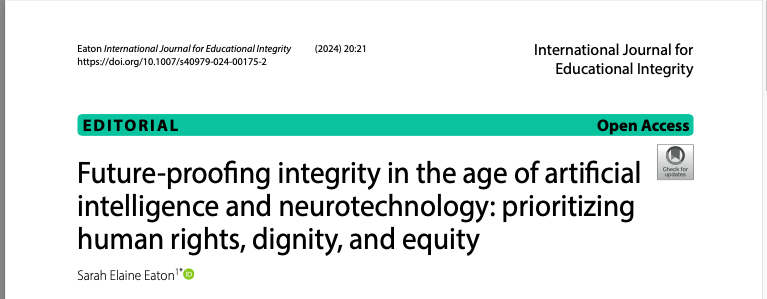
Future-proofing integrity in the age of artificial intelligence and neurotechnology: prioritizing human rights, dignity, and equity
Abstract
In this article I argue for the prioritisation of human rights when developing and implementing misconduct policies. Existing approaches may be perpetuate inequities, particularly for individuals from marginalised groups. A human-rights-by-design approach, which centres human rights in policy development, revision, and implementation, ensuring that every individual is treated with dignity and respect.
Recommendations for implementing a human-rights approach to misconduct investigations and case management are offered, covering areas such as procedural fairness, privacy, equity, and the right to education. Additional topics covered are the need to limit surveillance technologies, and the need to recognize that not all use of artificial intelligence tools automatically constitutes misconduct. I disentangle
the differences between equity and equality and explain how both are important when considering ethics and integrity. A central argument of this paper is that a human-rights-by-design approach to integrity does not diminish standards but rather strengthens educational systems by cultivating ethical awareness and respect for personhood. I conclude with a call to action with a seven-point plan for institutions to adopt a human-rights-based approach to ethics and integrity. In the age of artificial intelligence and neurotechnology, insisting on human rights and dignity when we investigate and address misconduct allegations is an ethical imperative that has never been more important.
As I reflect on the current state of academic and research integrity, I am struck by a glaring omission in our discussions: the connection between misconduct and human rights. We often treat these as separate entities, failing to recognize the profound impact that misconduct investigations and policies can have on the fundamental rights of individuals. This oversight is particularly concerning in the age of artificial intelligence (AI) and neurotechnology, where the potential for harm is magnified.
Take, for example, the case of a professor in Canada who physically assaulted international students accused of plagiarism. This horrifying example demonstrates how the pursuit of academic integrity can be twisted into a justification for degrading and inhumane treatment, violating the very principles of dignity and respect that should guide our actions. While this is an extreme case, it highlights the need for a fundamental shift in our approach.
In this editorial, I offer a call to action to move beyond simply adhering to legal requirements and embrace a ‘human-rights-by-design’ approach that embeds human rights principles into our policies and practices. This means ensuring procedural fairness throughout investigations, safeguarding the privacy of individuals, and recognizing the right to be presumed innocent until there is proof to the contrary. It also requires us to acknowledge the diverse backgrounds and circumstances of our students and staff, striving for equitable treatment that addresses systemic inequalities and provides the support needed for everyone to succeed.
In the face of rapidly evolving technologies like AI, we must be especially vigilant in upholding human rights. The temptation to rely on unproven AI detection tools or to rush to judgement based on suspicion rather than evidence is strong, but it is a path that leads us away from justice and fairness. We cannot allow fear or expediency to erode our commitment to human dignity.
By centring human rights in our approach to integrity, we can create educational and research environments that are not only ethically sound but also truly just and equitable. This is not about lowering standards; it is about building a culture of integrity that upholds the inherent worth of every individual.
Sarah Elaine Eaton, PhD, is a Professor and Research Chair in the Werklund School of Education at the University of Calgary, Canada. Opinions are my own and do not represent those of my employer.
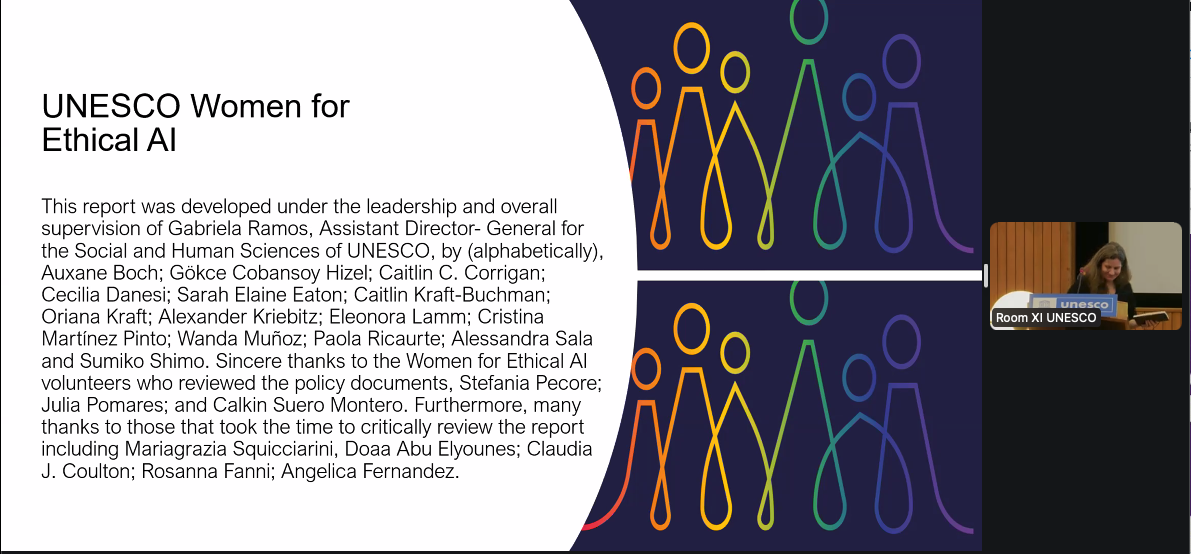
Over the past few months I have had the tremendous opportunity to work with an incredible group of women under the direction of Assistant Director-General (ADG) for Social and Human Sciences of UNESCO. Our collective produced this report that was launched today at a special conference in Paris:
UNESCO Women for Ethical AI: outlook study on artificial intelligence and gender
This blog has had over 3 million views thanks to readers like you. If you enjoyed this post, please “like” it or share it on social media. Thanks!
Sarah Elaine Eaton, PhD, is a Professor and Research Chair in the Werklund School of Education at the University of Calgary, Canada. Opinions are my own and do not represent those of my employer.
Next week is Academic Integrity Week at the Univeristy of Calgary. This year, I have the honour of moderating a fireside chat with one of my very own Werklund School of Education Doctor of Education (EdD) students, Colleen Fleming.
Join us for a thought-provoking discussion during Academic Integrity Week 2024!
Discover the crucial link between academic integrity and inclusion in higher education with our distinguished speaker, Colleen Fleming, EdD student, Werklund School of Education.
Moderated by Dr. Sarah Elaine Eaton, this conversation will explore:
Defining academic integrity in an inclusive context
Challenges in maintaining integrity across diverse student populations
Practical strategies for educators to promote both integrity and inclusion
Don’t miss this opportunity to gain insights from Colleen’s extensive experience as a K-12 practitioner and her cutting-edge doctoral research. Engage in a live Q&A session and contribute to this important conversation.
A bit about Colleen…
Colleen Fleming (she/her/hers) is a K-12 practitioner at a designated special education school in Calgary. She has a keen interest in developing a culture of integrity among learners through the promotion of equity, diversity, and inclusion. As a Doctor of Education student at Werklund, her research involves proactively educating students about academic integrity in preparation for higher education.
Event details
Date: October 16, 2024
Time: 12:00 – 1:00 p.m.
Location: University of Calgary, Taylor Family Digital Library, Gallery Hall
This blog has had over 3 million views thanks to readers like you. If you enjoyed this post, please “like” it or share it on social media. Thanks!
Sarah Elaine Eaton, PhD, is a Professor and Research Chair in the Werklund School of Education at the University of Calgary, Canada. Opinions are my own and do not represent those of my employer.




 Posted by Sarah Elaine Eaton, Ph.D.





 Learning, Teaching and Leadership
You must be logged in to post a comment.