Gemini Live: Breaking Educational Barriers with AI

April 19, 2025

Gemini Live is Google’s new conversational AI assistant that responds to voice commands in real-time. Unlike text-based interactions, Gemini Live allows for natural, flowing conversations. This voice-first approach opens new possibilities for accessibility in educational settings. It was released last month, and I just got around to trying it today. Here’s how it went:

I was impressed by the tool’s interactivity and speed. In this test I scanned a laptop sticker with the hashtag #UHaveIntegrity, which is from our academic integrity campaign at the University of Calgary. The app correctly identified it and gave me a brief description.

I did a few subsequent tests with other items afterwards. It did not always have 100% accuracy, but with additional prompting, it corrected errors and provided updated information.

I can think of a variety of uses for this kind of app for teaching and learning. In particular, I am excited about the possibilities to enhance accessibility, inclusion, and equity.

Breaking Down Barriers with Voice Interaction

The voice interface of Gemini Live can remove some barriers for students. Students with mobility limitations, visual impairments, or reading difficulties can participate in learning activities through speech. This creates a more level playing field in the classroom.

Imagine a scenario where a teacher uses Gemini Live to help a student with dyslexia engage with research projects. The student could ask questions verbally and receive information without struggling with text. This hypothetical case illustrates how voice interaction might lead to increased confidence and class participation.

Multilingual Support for Diverse Classrooms

Language barriers often create obstacles in education. Gemini Live supports multiple languages and can translate between them. This feature helps:

  • Non-native English speakers follow lessons in their first language
  • International students integrate into new learning environments
  • Teachers communicate with students from different linguistic backgrounds
  • Parents who speak other languages stay involved in their children’s education

Learning Accommodations Made Simple

Every student learns differently. Gemini Live can adapt content to different learning needs. Here are some examples:

  1. It can explain complex concepts in simpler terms for students who need additional support
  2. It provides alternative explanations when students don’t understand a topic the first time
  3. It offers audio descriptions of visual content for visually impaired students
  4. It can generate study materials in different formats to match learning preferences

Real-Time Assistance in the Classroom

Teachers often struggle to provide individual attention to every student in a classroom. Gemini Live can serve as an additional resource that students can turn to when they need help. This can reduce wait times and frustration.

As a hypothetical example, a high school math teacher could implement Gemini Live as a ‘homework helper’ station in the classroom. Students who get stuck on problems could ask Gemini Live for guidance without waiting for the teacher to become available. This approach would allow more students to receive timely support while waiting for personalized attention from their teacher.

Digital Equity Through Voice Access

Not all students have equal access to technology or equal ability to use traditional interfaces. Voice technology lowers the technical barriers to using digital tools. Students without keyboards, mice, or touchscreens can still access information and complete assignments through voice commands.

Practical Implementation Tips

In thinking about how we could use use Gemini Live and similar tools for accessibility and inclusion, here are some ideas:

  • Create specific prompts that students can use to get help with different subjects
  • Set up dedicated stations where students can interact with Gemini Live
  • Teach students how to ask effective questions
  • Combine Gemini Live with other AI tools for a comprehensive accessibility solution

Challenges and Considerations

It is important for teachers to be aware that the tool is not perfect (at least as it currently stands). Although Gemini Live offers benefits, it currently has certain limitations.

  • Voice recognition may struggle with some speech patterns or accents
  • Private conversations require appropriate spaces to avoid classroom disruption
  • Students need guidance on when AI assistance is appropriate and when it isn’t
  • Technology should supplement, not replace, human teaching and interaction

Looking Forward

As AI assistants like Gemini Live continue to evolve, they will provide even more tools for inclusive education. The most successful classrooms will be those that thoughtfully blend technology with human instruction.

By incorporating Gemini Live into teaching practices, educators can create learning environments that accommodate more students. The goal isn’t just to make education accessible but to ensure every student feels valued and included in the learning process. When we remove barriers to education, we unlock potential — and that’s one of the most fun parts of being an educator.

–——–-

Share this post: Gemini Live: Breaking Educational Barriers with AI – https://drsaraheaton.com/2025/04/19/gemini-live-breaking-educational-barriers-with-ai/

This blog has had over 3.7 million views thanks to readers like you. If you enjoyed this post, please ‘Like’ it using the button below or share it on social media. Thanks!

Sarah Elaine Eaton, PhD, is a Professor and Research Chair in the Werklund School of Education at the University of Calgary, Canada. Opinions are my own and do not represent those of my employer. 


Neuralink’s Clinical Trials in Canada

January 11, 2025

Last month CBC’s Geoff Leo did a great article on called, ‘No consequences’, for violating human rights in privately funded research in Canada. This was a bit of an eye opener, even for me.

He writes that, “Roughly 85 per cent of clinical trials in Canada are privately funded” and that research undergoes very little scrutiny by anyone.

One of the cases Geoff wrote about involved a research study that ran from 2014-2016 involving Indigenous children in Saskatchewan, aged 12-15, who were research subjects in a study that monitored their brainwaves. Student participants were recruited with the help of a Canadian school board.

The study was led by James Hardt, who runs something called the Biocybernaut Institute, a privately run business. According to Leo, James Hardt claims that “brainwave training can make participants smarter, happier and enable them to overcome trauma. He said it can also allow them to levitate, walk on water and visit angels.”

Geoff Leo digs deep into some of the ethical issues and I recommend reading his article.

So, that was last month. This month, I happened to notice that according to Elon Musk’s Neuralink website, Musk’s product has now been approved by Health Canada to recruit research participants. There’s a bright purple banner at the top of the Neuralink home page showing a Canadian flag that says, “We’ve received approval from Health Canada to begin recruitment for our first clinical trial in Canada”.

A screenshot of the Neuralink.com home page. On the bottom right is a blurred photo of a man wearing a ball cap, who appears to be in a wheelchair and using tubes as medical assistance. There is white text on the right-hand side. At the top is a purple banner with white text and a small Canadian flag.

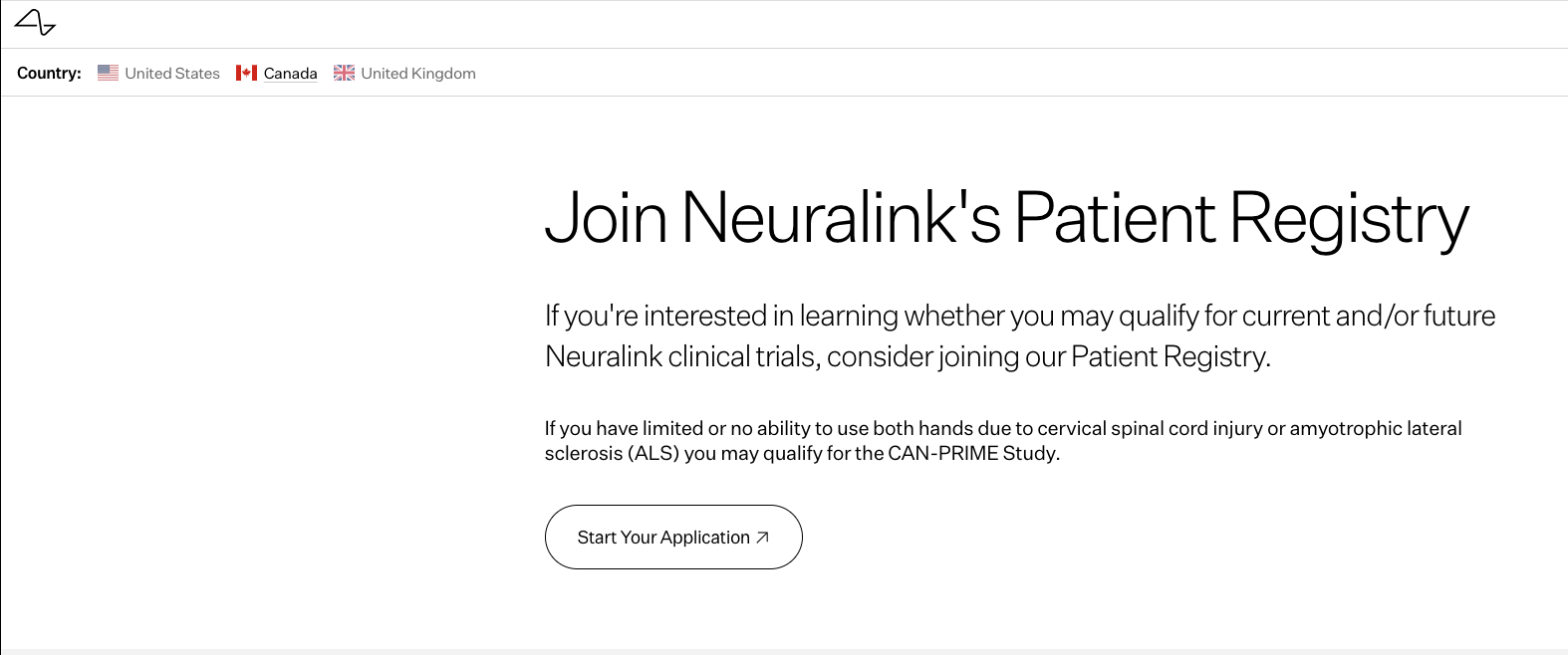
When you click on the link, you get to another page that shows the flags for the US, Canada, and the UK, where clinical trials are either underway or planned, it seems.

A screenshot of a webpage from the Neuralink web site. It has a white background with black text. In the upper left-hand corner there are three small flags, one each for the USA, Canada, and the UK.

The Canadian version is called CAN-PRIME. There’s a YouTube video promo/recruitment video for patients interested in joining, “this revolutionary journey”.

According to the website, “This study involves placing a small, cosmetically invisible implant in a part of the brain that plans movements. The device is designed to interpret a person’s neural activity, so they can operate a computer or smartphone by simply intending to move – no wires or physical movement are required.”

A screenshot from the Neuralink web page. The background is grey with black text.

So, just to connect the dots here… ten years ago in Canada there was a study involving neurotechnology that “exploited the hell out of” Indigenous kids, according to Janice Parente who leads the Human Research Standards Organization

Now we have Elon Musk’s company actively recruiting people from across Canada, the US, and the UK, for research that would involve implanting experimental technology into people’s brains without, it seems, much research ethics oversight at all.

What could possibly go wrong?

Reference

Leo, G. (2024, December 2). ‘No consequences’ for violating human rights in privately funded research in Canada, says ethics expert. https://www.cbc.ca/news/canada/saskatchewan/ethics-research-canada-privately-funded-1.7393063

________________________

Share this post: Neuralink’s Clinical Trials in Canada – https://drsaraheaton.com/2025/01/11/neuralinks-clinical-trials-in-canada/

This blog has had over 3.7 million views thanks to readers like you. If you enjoyed this post, please ‘Like’ it using the button below or share it on social media. Thanks!

Sarah Elaine Eaton, PhD, is a Professor and Research Chair in the Werklund School of Education at the University of Calgary, Canada. Opinions are my own and do not represent those of my employer. 


A Reflection to Start 2025

January 1, 2025
An infographic with black text set on a background with blue at the top that transitions into green at the bottom.

Starting the year with a brief reflection inspired by the OECD Social and Emotional Skills for Better Lives report:

How can we, as educators, create systems and circumstances to help students thrive? How do we create opportunities for them? If there are doors that have been closed to them, how do we open those doors?

Or better yet, how do we break down the walls that hold up those doors in the first place?

These are some big questions I am contemplating for this year. How about you?

________________________

Share this post: A Reflection to Start 2025 https://drsaraheaton.com/2025/01/01/a-reflection-to-start-2025/

This blog has had over 3 million views thanks to readers like you. If you enjoyed this post, please “like” it or share it on social media. Thanks!

Sarah Elaine Eaton, PhD, is a Professor and Research Chair in the Werklund School of Education at the University of Calgary, Canada. Opinions are my own and do not represent those of my employer. 


Inclusive Academic Integrity: A Holistic Approach to Ethical Learning for Everyone

November 15, 2024

Earlier this semester, I accepted a new leadership role in the Werklund School of Education as the Academic Coordinator of the Master of Education (MEd) graduate topic in Inclusive Education. (We are accepting applications the 2025-2026 academic year, in case you’ve been thinking about doing an MEd. It is a fully online four-course topic.)

This got me thinking about academic integrity through an inclusive lens. My interest in the connection between social justice, equity, inclusion, and accessibility goes back a few years. In 2022, I partnered with a Werklund graduate student in educational psychology, Rachel Pagaling, and Dr. Brenda McDermott, Senior Manager, Student Accessibility Services to write up a brief open access report on Academic Integrity Considerations for Accessibility, Equity and Inclusion.

A lot more work has been done in this area since we wrote that report. Professor Mary Davis has been a particular champion of this topic. Her 2022 open access article, Examining and improving inclusive practice in institutional academic integrity policies, procedures, teaching and support, is worth checking out. There is also an entire section of the Second Handbook of Academic Integrity (2024) dedicated to equity, diversity, inclusion, accessibility, and decolonization. 

We know that academic integrity is a cornerstone of both K-12 and higher education. We want to ensure that learning, assessment, and credentials uphold the highest ethical standards. However, as educators, we can — and should — consider how the principles of inclusive education can strengthen and complement our approach to academic integrity.

Inclusive education means ensuring that all students, regardless of their background, abilities, or learning needs, have equitable access to educational opportunities and can meaningfully participate. Thomas and May sum it up nicely when they say that being inclusive means “proactively making higher education accessible, relevant and engaging to all students” (p. 5).  Of course, the same thinking could be extended to K-12 education, too. Applying these inclusive principles to academic integrity means recognizing that diverse learners may express and demonstrate their knowledge in different ways. 

Inclusion is not only about students with physical disabilities, developmental disabilities, or neurodivergence, but rather it is about creating conditions where all students can thrive. Associate Professor Joanna Tai and colleagues have a great article on Assessment for Inclusion that helps us think about how to design equitable and rigorous.

In addition, Dr. Eliana Elkhoury has a great chapter on how to create, An Equitable Approach to Academic Integrity Through Alternative Assessment.

The point here is that by fostering an inclusive academic culture, we empower all students to bring their best selves to school and learn with integrity.

Beyond accessibility and cultural responsiveness, inclusive academic integrity also means actively addressing systemic barriers and implicit biases. If certain groups of students consistently struggle with academic integrity issues, it may reveal deeper inequities that need to be examined and addressed. In other words, we can look at the barriers to success, rather than the limitations of our students, as being the problem. As Juuso Nieminen and I have pointed out, even accommodations policies have an underlying assumption that students who need accommodations are out to cheat the system. 

If you’re interested in reading more about disability justice to inform your thinking, I highly recommend Doron Dorfman’s article on the fear of the disability con and Jay Dolman’s work on academic ableism.

The benefits of this holistic, inclusive approach to academic integrity are numerous. When students feel respected, supported, and able to succeed, they are more engaged and motivated. This, in turn, leads to better learning outcomes. Moreover, graduates who have internalized inclusive academic integrity will be better equipped to uphold ethical standards in their future careers and communities.

As educators, we have a responsibility to nurture academic integrity in ways that are inclusive, accessible, culturally responsive, and empowering for diverse learners. By applying the principles of inclusive education, we can transform academic integrity from a rigid set of rules into a collaborative, values-driven endeavor that brings out the best in our students and ourselves.

References

Davis, M. (2022). Examining and improving inclusive practice in institutional academic integrity policies, procedures, teaching and support. International Journal for Educational Integrity, 18(1), 14. https://doi.org/10.1007/s40979-022-00108-x 

Dolmage, J. T. (2017). Academic Ableism: Disability and Higher Education. University of Michigan Press. 

Dorfman, D. (2019). Fear of the disability con: Perceptions of fraud and special rights discourse. Law & society review, 53(4), 1051-1091. https://doi.org/10.1111/lasr.12437 

Elkhoury, E. (2024). An Equitable Approach to Academic Integrity Through Alternative Assessment. In S. E. Eaton (Ed.), Second Handbook of Academic Integrity (pp. 1261-1272). Springer Nature Switzerland. https://doi.org/10.1007/978-3-031-54144-5_135 

Nieminen, J. H., & Eaton, S. E. (2023). Are assessment accommodations cheating? A critical policy analysis. Assessment & Evaluation in Higher Education, 1-16. https://doi.org/10.1080/02602938.2023.2259632 

Pagaling, R., Eaton, S. E., & McDermott, B. (2022, April 4). Academic Integrity: Considerations for Accessibility, Equity, and Inclusion. http://hdl.handle.net/1880/114519

Thomas, L., & May, H. (2010). Inclusive learning and teaching in Higher Education. Higher Education Academy. https://www.advance-he.ac.uk/knowledge-hub/inclusive-learning-and-teaching-higher-education

Tai, J., Ajjawi, R., Bearman, M., Boud, D., Dawson, P., & Jorre de St Jorre, T. (Eds.). (2022). Assessment for inclusion: rethinking contemporary strategies in assessment design. Routledge. https://doi.org/10.1080/07294360.2022.2057451 

________________________

Share this post: Inclusive Academic Integrity: A Holistic Approach to Ethical Learning for Everyone – https://drsaraheaton.com/2024/11/12/inclusive-academic-integrity-a-holistic-approach-to-ethical-learning-for-everyone/

This blog has had over 3 million views thanks to readers like you. If you enjoyed this post, please “like” it or share it on social media. Thanks!

Sarah Elaine Eaton, PhD, is a Professor and Research Chair in the Werklund School of Education at the University of Calgary, Canada. Opinions are my own and do not represent those of my employer.


Future-proofing integrity in the age of artificial intelligence and neurotechnology: Prioritizing human rights, dignity, and equity

November 13, 2024

Once a year I write an editorial for the International Journal for Educational Integrity. I take a big idea, ground it in literature written by some of the best in the world and then call for ways to improve our field even more. In 2023 I wrote about Postplagiarism and in 2022, I focused on equity, diversity, inclusion, accessibility and decolonization as new priorities for academic integrity. Here is this year’s editorial:

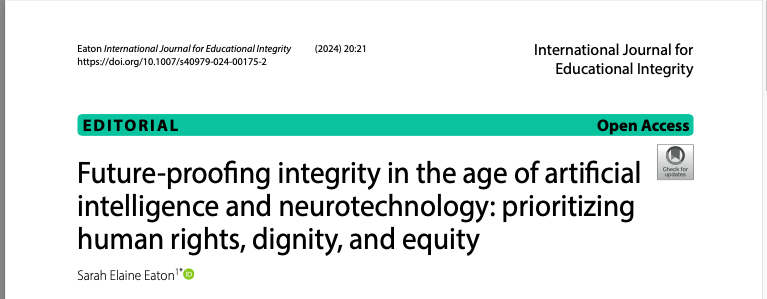
Future-proofing integrity in the age of artificial intelligence and neurotechnology: prioritizing human rights, dignity, and equity

A screenshot of an article title page. There is black text on a white background with a green banner at the top.
Here is a link to the original: https://edintegrity.biomedcentral.com/articles/10.1007/s40979-024-00175-2

Abstract

In this article I argue for the prioritisation of human rights when developing and implementing misconduct policies. Existing approaches may be perpetuate inequities, particularly for individuals from marginalised groups. A human-rights-by-design approach, which centres human rights in policy development, revision, and implementation, ensuring that every individual is treated with dignity and respect.

Recommendations for implementing a human-rights approach to misconduct investigations and case management are offered, covering areas such as procedural fairness, privacy, equity, and the right to education. Additional topics covered are the need to limit surveillance technologies, and the need to recognize that not all use of artificial intelligence tools automatically constitutes misconduct. I disentangle

the differences between equity and equality and explain how both are important when considering ethics and integrity. A central argument of this paper is that a human-rights-by-design approach to integrity does not diminish standards but rather strengthens educational systems by cultivating ethical awareness and respect for personhood. I conclude with a call to action with a seven-point plan for institutions to adopt a human-rights-based approach to ethics and integrity. In the age of artificial intelligence and neurotechnology, insisting on human rights and dignity when we investigate and address misconduct allegations is an ethical imperative that has never been more important.

Keywords Academic misconduct, Academic dishonesty, Plagiarism, Policy, Human rights, Restorative justice, Artificial intelligence, Neurotechnology, Higher education, Education

Commentary

As I reflect on the current state of academic and research integrity, I am struck by a glaring omission in our discussions: the connection between misconduct and human rights. We often treat these as separate entities, failing to recognize the profound impact that misconduct investigations and policies can have on the fundamental rights of individuals. This oversight is particularly concerning in the age of artificial intelligence (AI) and neurotechnology, where the potential for harm is magnified.

Take, for example, the case of a professor in Canada who physically assaulted international students accused of plagiarism. This horrifying example demonstrates how the pursuit of academic integrity can be twisted into a justification for degrading and inhumane treatment, violating the very principles of dignity and respect that should guide our actions. While this is an extreme case, it highlights the need for a fundamental shift in our approach.

In this editorial, I offer a call to action to move beyond simply adhering to legal requirements and embrace a ‘human-rights-by-design’ approach that embeds human rights principles into our policies and practices. This means ensuring procedural fairness throughout investigations, safeguarding the privacy of individuals, and recognizing the right to be presumed innocent until there is proof to the contrary. It also requires us to acknowledge the diverse backgrounds and circumstances of our students and staff, striving for equitable treatment that addresses systemic inequalities and provides the support needed for everyone to succeed.

In the face of rapidly evolving technologies like AI, we must be especially vigilant in upholding human rights. The temptation to rely on unproven AI detection tools or to rush to judgement based on suspicion rather than evidence is strong, but it is a path that leads us away from justice and fairness. We cannot allow fear or expediency to erode our commitment to human dignity.

By centring human rights in our approach to integrity, we can create educational and research environments that are not only ethically sound but also truly just and equitable. This is not about lowering standards; it is about building a culture of integrity that upholds the inherent worth of every individual.

________________________

Share this post: Future-proofing integrity in the age of artificial intelligence and neurotechnology: Prioritizing human rights, dignity, and equity – https://drsaraheaton.com/2024/11/13/future-proofing-integrity-in-the-age-of-artificial-intelligence-and-neurotechnology-prioritizing-human-rights-dignity-and-equity/
This blog has had over 3 million views thanks to readers like you. If you enjoyed this post, please “like” it or share it on social media. Thanks!

Sarah Elaine Eaton, PhD, is a Professor and Research Chair in the Werklund School of Education at the University of Calgary, Canada. Opinions are my own and do not represent those of my employer.