Starting the year with a brief reflection inspired by the OECD Social and Emotional Skills for Better Lives report:
How can we, as educators, create systems and circumstances to help students thrive? How do we create opportunities for them? If there are doors that have been closed to them, how do we open those doors?
Or better yet, how do we break down the walls that hold up those doors in the first place?
These are some big questions I am contemplating for this year. How about you?
This blog has had over 3 million views thanks to readers like you. If you enjoyed this post, please “like” it or share it on social media. Thanks!
Sarah Elaine Eaton, PhD, is a Professor and Research Chair in the Werklund School of Education at the University of Calgary, Canada. Opinions are my own and do not represent those of my employer.
Many people in the academic integrity world are already familiar with contract cheating websites, those that deal in the business of buying and selling exams, bespoke term papers, theses, and exam questions and answers.
But this business isn’t limited to the millions of K-12, high school and post-secondary students. The exam fraud business is alive and well for professional accreditation exams for folks who either want to bypass a formal university degree or to supplement existing credentials.
For example, in the IT industry credentials are often the golden key to new opportunities. Certifications and accreditations (allegedly) validate technical skills, offering (so-called) proof that a candidate has the expertise needed for a professional role.
Taking into account supply and demand, with job candidates being in high supply and well-paying jobs being in high demand, certification and accreditation fraud is alive and well in the IT industry, as well as other industries. This is a trend employers cannot afford to ignore.
Exposing the Fraud: How Buying and Selling of Certification Exam Questions Works
Certification fraud occurs when individuals falsify credentials, purchase counterfeit certifications, or misuse legitimate certifications obtained by others. But there’s this sneaky grey area that exists when a person actually sits a professional exam themselves, but they’ve prepared by buying the exam questions and/or the answers from an online vendor.
I won’t name specific companies that do this in this post, because I’m not in the habit of advertising for these fraudsters, but I want to show you how they work, so here are some screenshots:
Screenshot #1: Home page
At the top of this website, the company claims that 94% of the exam questions that they sold were “almost the same” and that 97% of customers passed the exam using their materials. (Who knows what happened to the other 3%…?) Finally, 98% of customers found the “study guides” effective and helpful.
There’s that phrase that we commonly see on contract cheating websites, “study guide”. For the uninitiated, this is a euphemism for “exam questions”.
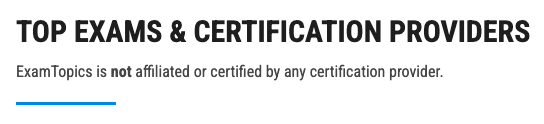
Screenshot #2: Saying it like it is: Not affiliated with any certification provider
In this screenshot the company states plainly that they are not affiliated or certified by any certification provider. Reading between the lines, the message is ‘caveat emptor’ or ‘buyer beware’. They are telling you upfront that they are in the business of selling exam questions and make no guarantees about their products.
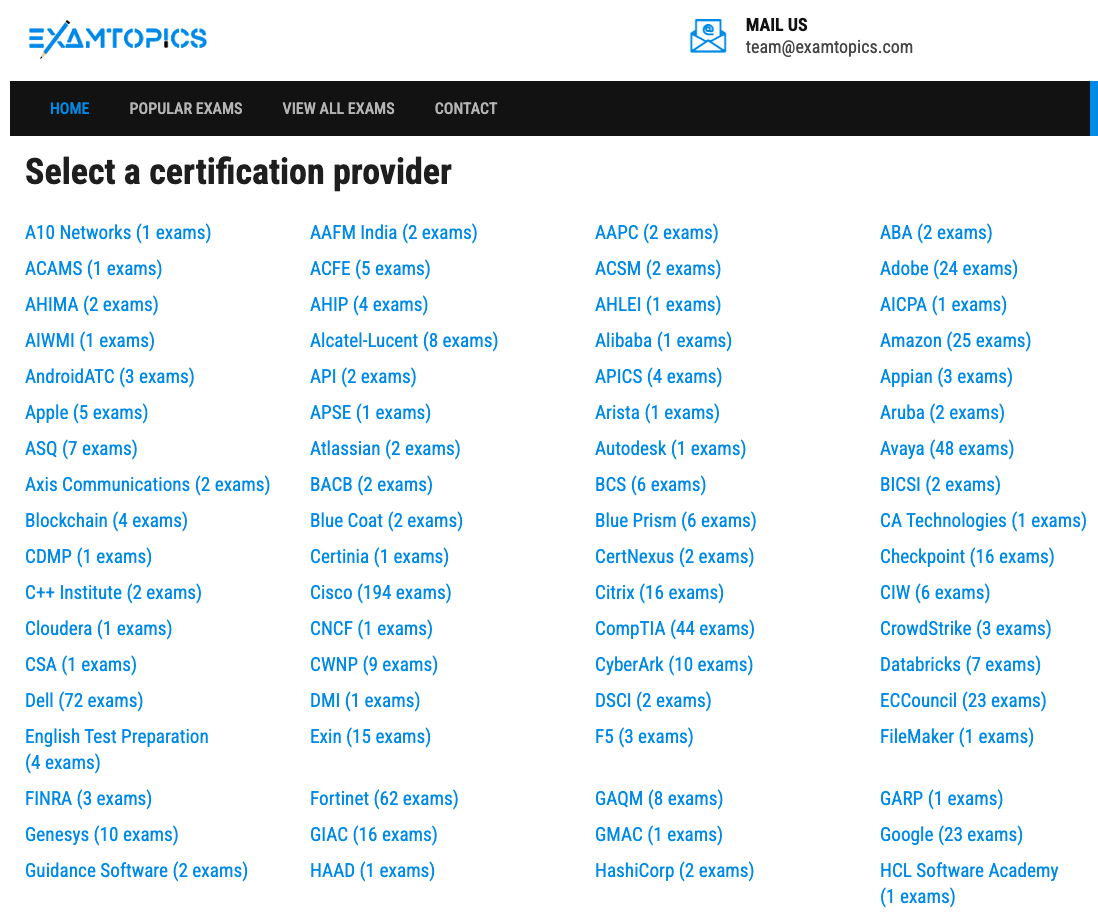
Screenshot #3: Samples of accreditation exam questions for sale
Look at all the options: You can buy exam questions for certifications offered by DELL, English language proficiency exams, Citrix, Adobe, and Amazon, and Google just to name a few.
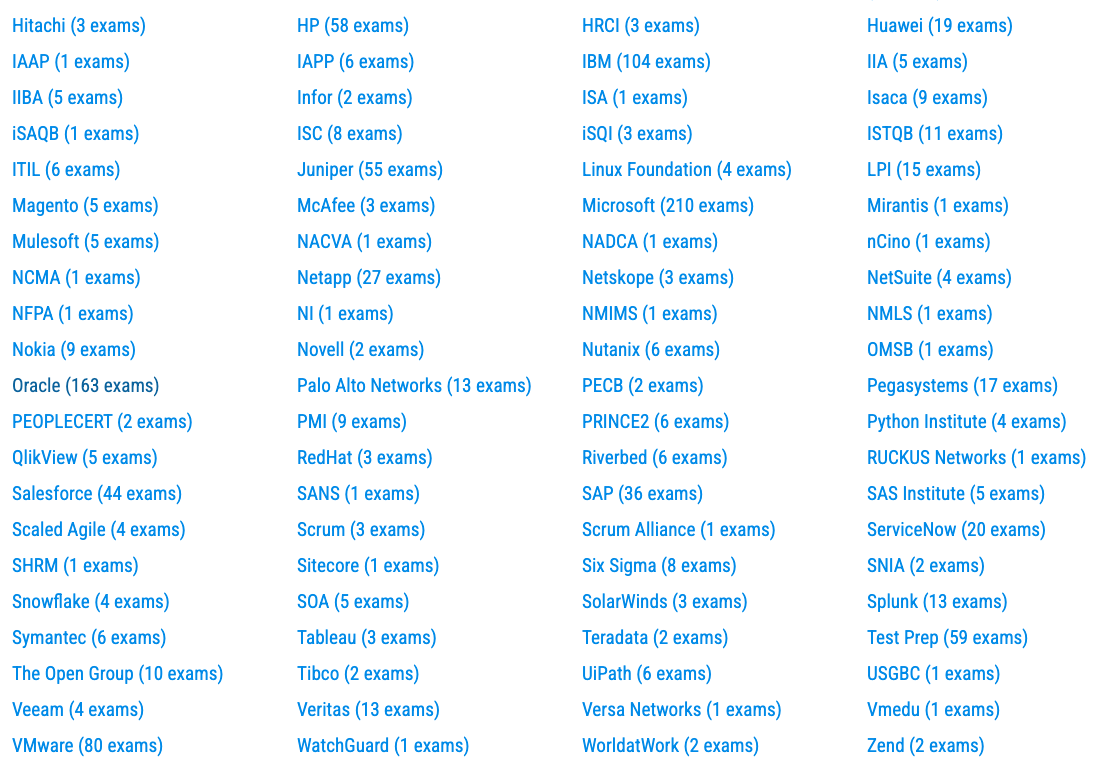
Screenshot #4: More samples of certification provider exam questions for sale.
But wait! There’s more! You can buy exam questions for certifications offers by Oracle, IBM, SAP, and others.
Businesses that buy and sell exam certification questions engage in fraudulent practices undermine trust in the certification system and create significant risks for employers.
Consequences for Employers
Hiring someone with counterfeit credentials can have dire consequences. Unqualified employees may lack the technical skills to handle complex tasks, leading to project delays, costly errors, or even security breaches. Beyond the financial impact, fraudulent certifications can erode team morale, as employees with genuine qualifications may feel undervalued when working alongside those who faked their way in.
What Employers and Hiring Managers can Do
Employers, and especially hiring managers and those working in HR, must take proactive steps to safeguard their hiring processes. Some of you may be asking if this kind of practice is actually illegal. I’m not a lawyer, but what I can say is that although contact cheating for students is illegal in countries like Australia, the UK, and Ireland, if you’re not a student, then you might get to live a proverbial grey zone. To the best of my knowledge, it is not actually illegal to buy and sell questions for professional certification exams in most countries of the world.
So, what can employers do? First, trust but verify! Verifying certifications directly with issuing organizations is one step. Many certification bodies offer easy online verification tools to confirm a candidate’s credentials. Additionally, employers should stay informed about recognized accreditation standards and avoid unverified institutions.
Having said this, verification of credentials and certification won’t help if someone has bought exam questions online and then taken the test themselves. Their results could be ‘verifiable’ in a sense, because there’s an assumption that a person who has passed an exam had the knowledge to do so. But when someone buys their exam questions before sitting the test, it means that they have prepared for an exam and may not necessarily have internalized the knowledge or skills that should match the certification they receive from passing an exam. An exam is one measure of knowledge, but it isn’t the only one.
Having prospective employees demonstrate their skills and respond to technical questions that could only be answered if the person has the knowledge to back up their documentation can also help. One possibility is to give an interviewee a real-world scenario that could happen at your organization. Ask them how they would go about problem-solving it. If they struggle or stumble, it could be a sign that they lack the necessary skills for the job. (It could also be a sign that they’re just nervous or that interviewing isn’t their strength. So let me also make a plug here for having an inclusive and equitable interviewing process.)
Investing in robust, inclusive, and equitable hiring practices not only protects an organization from the pitfalls of fraud but also helps to create a culture of accountability and excellence. By placing a premium on authentic certifications combined with demonstrable knowledge and skills and inclusive hiring practices, employers signal their commitment to integrity and ensure they are building a team of qualified professionals.
Bottom line: If you’re hiring someone who says they have an IT certification based on taking exams, it’s worth it to find out if they actually have the knowledge and skills to do the job.
And this is just one example of one site. Rest assured that it is not the only one out there. Exam cheating companies like this one don’t exist in isolation. They’re in the game to make money, and lots of it.
In an industry where skills and knowledge drive success, vigilance against certification and accreditation fraud is not optional—it is a driver of success.
Future Outlook
Fraud and corruption are alive and well education and industry. There is a growing community of sleuths, scholars, and activists who are ready to sniff out fraud and expose it and naïveté about these matters is quickly going out of fashion.
There may have been a time when it was acceptable—or even fashionable—to clutch your pearls, proclaim moral outrage, or just refuse to accept that educational and professional fraud are more commonplace than you might have previously thought. GenAI is here to stay, and so are companies whose business is educational, accreditation, scientific, and professional fraud. These companies are profitable because they have customers willing to pay for their goods and services.
Vigilance, sleuthing, and exposing fraud are very much on trend as we move ahead into the new year. And if you’re a hiring manager, taking steps to protect the integrity of your operations is definitely part of the job in 2025 and beyond.
Eaton, S. E., & Carmichael, J. (2022). The Ecosystem of Commercial Academic Fraud. In. Calgary, Canada: University of Calgary. https://dx.doi.org/10.11575/PRISM/40330
Eaton, S. E., Carmichael, J., & Pethrick, H. (Eds.). (2023). Fake degrees and credential fraud in higher education. Springer. https://doi.org/10.1007/978-3-031-21796-8
This blog has had over 3 million views thanks to readers like you. If you enjoyed this post, please “like” it or share it on social media. Thanks!
Sarah Elaine Eaton, PhD, is a Professor and Research Chair in the Werklund School of Education at the University of Calgary, Canada. Opinions are my own and do not represent those of my employer.
As I prepare for the 2024-2025 Werklund Distinguished Research Lecture, I’ve been reflecting about how important it is to make scholarly work accessible to all. Open access (OA) is more than just a publishing model—it is a philosophy that challenges traditional barriers to knowledge dissemination and embodies the true spirit of academic scholarship.
Breaking Down Barriers to Knowledge
Historically (at least in my lived historical experience in higher education), academic research has been locked behind expensive paywalls, creating a significant divide that extends far beyond academic institutions. This exclusionary model particularly impacts researchers and knowledge seekers who find themselves on the margins of academic privilege. Researchers in middle and low-income countries (LMICs) often struggle to access scholarly and scientific literature and independent scholars and community practitioners face substantial financial barriers to staying current in their fields. Students and educators with limited institutional resources find themselves cut off from the latest scholarly insights, and curious members of the public are shut out from understanding complex academic work that could potentially transform their understanding of the world.
The Ethical Imperative of Sharing
Research is fundamentally about advancing human understanding, and restricting access undermines this core mission. Open access is commitment to knowledge as a public good, enabling a more dynamic and inclusive approach to scholarly communication. By removing economic and institutional barriers, we create opportunities for faster dissemination of critical findings, increased global collaboration, and unprecedented transparency in research methodologies. This approach allows for more rapid scientific and social progress, breaking down the traditional silos that have long constrained academic discourse.
Amplifying Research Impact
Contrary to traditional concerns, open access actually enhances the visibility and influence of scholarly work. Publications that are freely available receive more citations and reach broader audiences. This expanded reach afforded through OA creates opportunities for interdisciplinary and transdisciplinary connections that might otherwise remain unexplored, allowing research to transcend the narrow confines of specialized academic journals and engage with a more diverse intellectual ecosystem.
Personal Commitment and Broader Vision
As I prepare for this lecture, I am reflecting deeply about my commitment to open access (OA). One of my goals is to create a more equitable, informed, and connected world. This isn’t only about making documents freely downloadable, but also about cultivating a more inclusive intellectual landscape where knowledge can flow freely, unencumbered by economic or institutional constraints.
Practical Pathways to Open Access
For researchers considering this path, the journey involves strategic choices and institutional engagement. I am grateful for the privilege of working at the University of Calgary where researchers can self-archive their works into our institutional digital repository, PRISM.
Our university supports infrastructures that recognize and reward open access scholarship. Not everyone has this privilege.
Navigating Copyright and Publisher Agreements
Having said all this, I also recognize that it is important to abide by existing copyright agreements with publishers. Academic publishing involves complex legal and contractual relationships. Each publication typically comes with specific copyright terms that must be honoured (both ethically and legally), which may limit immediate or unrestricted sharing.
Because of this, I won’t be able to share all my work with a Creative Commons licence— not if a publisher holds the copyright. It does mean that I will look for creative and ethical ways to maximize access while maintaining professional integrity and contractual obligations.
Concluding reflections
Open access is not just about free downloads—it’s about free thinking, free exploration, and our commitment to knowledge being a universal right, not a privileged access. The longer I work in higher education, the more I am thinking about the future of knowledge, teaching, learning, and creating opportunities for others to thrive. This is really what is driving me right now — creating opportunities for others to thrive. Making as much of my work freely available as open access resources is one way I can do this.
As we get closer to the lecture, I’ll be making more and more of my work available as free open access downloads. I’ll keep you updated as we get closer to the lecture.
This blog has had over 3 million views thanks to readers like you. If you enjoyed this post, please “like” it or share it on social media. Thanks!
Sarah Elaine Eaton, PhD, is a Professor and Research Chair in the Werklund School of Education at the University of Calgary, Canada. Opinions are my own and do not represent those of my employer.
Although my role at the University of Calgary’s Office of Equity, Diversity, and Inclusion (OEDI) wrapped up some months ago, there’s an experience that I have been reflecting on that I wanted to share.
While I was working at the OEDI I ran into a colleague at an event. I’d known this person for many years and as we were chatting, they asked, “How does it feel to be a white woman working in an office of equity, diversity, and inclusion? I mean, don’t you feel like you’re taking up space for someone who is more deserving?”
The question was asked with genuine curiosity, and without any judgement or blame that I could ascertain. This person had been engaged in equity work themselves and was genuinely puzzled and curious about why I had taken up a director role in the office.
The question has lingered in my mind and heart for a long time and quite frankly, it’s taken me ages to process, which is why I am just getting around to writing about it now. It is a complex and values-laded question that I have grappled with for what seems like an eon. Although I understand the sentiment behind it, the question itself it oversimplifies the nature of equity, diversity, inclusion, and accessibility (EDIA) work and makes some problematic assumptions.
First, it’s important to recognize that equity work isn’t solely the responsibility of people from marginalized groups. Creating truly inclusive environments requires engagement and effort from people of all backgrounds. I bring my own lived experiences that include both discrimination and privilege. As a woman, I have lived experience of gender-based discrimination. As a white person, I recognize my racial privilege. Being human means that we are infinitely complex and reducing a person down to either a victim of discrimination or a purveyor of privilege is not only reductionist, it can be harmful. In my case, I engage in ongoing reflection that allows me to relate to some challenges faced by marginalized groups, while maintaining awareness of my own privilege.
I am acutely aware of the immense privilege I hold. I continually educate myself, amplify diverse voices, and strive to use my privilege to advocate for systemic changes. I see my role not as speaking for underrepresented groups, but as working to dismantle oppressive structures that perpetuate harm. This includes challenging others to examine their biases and pushing for institutional reforms, and doing so in a way that does not antagonize them, which is quite an art.
The notion that I might be ‘taking up space’ assumes there’s a fixed number of EDIA positions that should be reserved for people of colour. Representation absolutely matters, and EDI work requires a variety of skills, experiences, and perspectives. What matters most, in my humble opinion (and sure to be challenged by some who reads this post, I’m sure…) is a deep commitment to justice, a willingness to continually learn and grow, and the ability to effect change within organizations. These qualities aren’t exclusive to any one demographic.
Moreover, the idea that someone else might be inherently ‘more deserving’ based solely on their identity is problematic. It reduces people to singular aspects of their identity and ignores the complexity of lived experiences. I am about to make another contentious claim here, but here goes… A person of colour is not automatically an expert in all facets of EDIA work simply by virtue of their race, just as being white doesn’t preclude someone from developing expertise in this field.
It is critical — essential — to remember that many forms of marginalization are invisible. Disabilities, neurodivergence, chronic illnesses, socioeconomic background, and LGBTQ2S+* identities are just a few examples of characteristics that may not be immediately apparent. This underscores the importance of resisting the temptation to judge someone’s qualifications or experiences based solely on what we can see or what we think we know about them.
By making assumptions about who ‘deserves’ to be in EDI spaces based on visible characteristics, we risk excluding valuable perspectives, lived experience, and qualifications, while simultaneously reinforcing harmful stereotypes.
Inclusivity means creating environments where all individuals feel empowered to bring their full selves to the work, including aspects of their identity that may not be visible to others.
A key component of my EDI work is the practice of ‘radical acceptance’. This concept goes beyond mere tolerance or surface-level inclusion. Radical acceptance means embracing the full humanity of every individual, including all their complexities, contradictions, and lived experiences. It requires us to set aside our preconceptions and biases, and to approach each person with genuine openness and empathy. In the context of EDIA work, radical acceptance means creating spaces where people feel truly seen, heard, and valued for who they are, not just for how they fit into predefined categories or expectations. Being angry is easy; practising radical acceptance is exhausting, but ultimately more useful than anger.
Being an equity advocate means acknowledging that every person’s journey is unique and valid, even if it doesn’t align with our own experiences or understanding.
Even though I am no longer serving in a formal role related to EDI, I continue to focus on equity, diversity, inclusion, accessibility, and social justice in my work. This includes focusing on dignity, acceptance, and belonging. I strive to approach every interaction with openness and humility, recognizing that each person I encounter may have experiences and insights that I can learn from, regardless of their outward appearance. It also means making a conscious effort to resist the temptation that I might think that I know everything about a person.
There is wisdom to the old adage that “there is more to a person than meets the eye.” What I can say is that every human being is worthy of dignity. This mindset is crucial for creating genuinely inclusive spaces and avoiding the pitfalls of tokenism or superficial diversity.
People whose advocacy focuses on EDIA roles have a special responsibility to practice rigorous self-reflection, actively seek out diverse perspectives, and ensure we keep our privilege and biases in check. We must be humble enough to know when to step back and elevate other voices. I have watched people who believe their position is superior or their experience is more valid lash out at others who are just as deserving of understanding, kindness, and respect. This kind of lateral violence is both jarring and heartbreaking to watch… and even worse when a person has been “cancelled” by a group of loud, virtue-signalling individuals. In some cases, the accusers fail to recognize that in their efforts to be activists and uphold what they believe to be right and true, they may have forgotten that a foundation of equity work is human dignity for all, not just for some.
Those who proclaim to value social justice have a responsibility to be extra cautious before “cancelling” someone.
Practicing radical acceptance has profound implications for how we approach diversity and inclusion. Instead of focusing solely on visible markers of diversity or trying to fill quotas, we work to create environments where every individual feels empowered to bring their whole self to the table. This includes embracing diverse thought processes, communication styles, and ways of problem-solving that might challenge our own assumptions about what ‘professional’ or ‘effective’ looks like.
I work hard to embody this principle of radical acceptance in my interactions. But this is not a linear practice or something that one learns and then does correctly every day. Some days I screw up. Practicing radical acceptance is a constant process of self-reflection, learning, and growth. It means being willing to have my own assumptions challenged and to continually expand my understanding of what diversity and inclusion truly mean. It also means extending grace and forgiveness in moments of conflict with others whose views and lived experiences may lead them to say things or act in ways that I do not understand. What I know for sure is that I will never know the entirety of another person… and they will never know my entirety.
Living and working with others, with an appreciation of who they are, as they are, is part of the daily practice of radical acceptance.
Equity work — as well as integrity work — isn’t about virtue signaling or moral grandstanding. It’s about dismantling oppressive systems and creating genuine, lasting change. That requires participation and commitment from people of all backgrounds, working in solidarity toward a more just and equitable world. I’m driven by a genuine passion for creating more equitable and inclusive environments. I often say that the word ‘integrity’ comes from a Latin word meaning ‘to make whole’. I have said it before and I will say it again (and again… and again…): There can be no integrity without equity.
This blog has had over 3 million views thanks to readers like you. If you enjoyed this post, please “like” it or share it on social media. Thanks!
Sarah Elaine Eaton, PhD, is a Professor and Research Chair in the Werklund School of Education at the University of Calgary, Canada. Opinions are my own and do not represent those of my employer.
It’s the start of a new school year here in North America. We are into the second week of classes and already I am hearing from administrators in both K-12 and higher education institutions who are frustrated with educators who have turned to ChatGPT and other publicly-available Gen AI apps to help them assess student learning.
Although customized AI apps designed specifically to assist with the assessment of student learning already exist, many educators do not yet have access to such tools. Instead, I am hearing about educators turning to large language models (LLMs) like ChatGPT to help them provide formative or summative assessment of students’ work. There are some good reasons not to avoid using ChatGPT or other LLMs to assess student learning.
I expect that not everyone will agree with these points, please take them with the spirit in which they are intended, which to provide guidance on ethical ways to teach, learn, and assess students’ work.
8 Tips on Why Educators Should Avoid Using AI Apps to Help with Assessment of Student Learning
Intellectual Property
In Canada at least, a student’s work is their intellectual property. Unless you have permission to use it outside of class, then avoid doing so. The bottom line here is that student’s intellectual work is not yours to share to a large-language model (LLM) or any other third party application, with out their knowledge and consent.
Privacy
A student’s personal data, including their name, ID number and other details should never be uploaded to an external app without consent. One reason for this blog post is to respond to stories I am hearing about educators uploading entire student essays or assignments, including the cover page with all the identifying information, to a third-party GenAI app.
Data security
Content uploaded to an AI tool may be added to its database and used to train the tool. Uploading student assignments to GenAI apps for feedback poses several data security risks. These include potential breaches of data storage systems, privacy violations through sharing sensitive student information, and intellectual property concerns. Inadequate access controls or encryption could allow unauthorized access to student work.
AI model vulnerabilities might enable data extraction, while unintended leakage could occur through the AI app’s responses. If the educator’s account is compromised, it could expose all of the uploaded assignments. The app’s policies may permit third-party data sharing, and long-term data persistence in backups or training sets could extend the risk timeline. Also, there may be legal and regulatory issues around sharing student data, especially for minors, without proper consent.
Bias
AI apps are known to be biased. Feedback generated by an AI app can be biased, unfair, and even racist. To learn more check out this article published in Nature. AI models can perpetuate existing biases present in their training data, which may not represent diverse student populations adequately. Apps might favour certain writing styles (e.g., standard American English), cultural references, or modes of expression, disadvantaging students from different backgrounds.
Furthermore, the AI’s feedback could be inconsistent across similar submissions or fail to account for individual student progress and needs. Additionally, the app may not fully grasp nuanced or creative approaches, leading to standardized feedback that discourages unique thinking.
Lack of context
An AI app does not know your student like you do. Although GenAI tools can offer quick assessments and feedback, they often lack the nuanced understanding of a student’s unique context, learning style, and emotional or physical well-being. Overreliance on AI-generated feedback might lead to generic responses, diminishing the personal connection and meaningful interaction that educators provide, which are vital for effective learning.
Impersonal
AI apps can provide generic feedback, but as an educator, you can personalize feedback to help the student grow. AI apps can provide generic feedback but may not help to scaffold a student’s learning. Personalized feedback is crucial, as it fosters individual student growth, enhances understanding, and encourages engagement with the material. Tailoring feedback to specific strengths and weaknesses helps students recognize their progress and areas needing improvement. In turn, this helps to build their confidence and motivation.
Academic Integrity
Educators model ethical behaviour, this includes transparent and fair assessment. If you are using tech tools to assess student learning, it is important to be transparent about it. In this post, I write more about how and why deceptive and covert assessment tactics are unacceptable.
Your Employee Responsibilities
If your job description includes assessing student work , you may be violating your employment contract if you offload assessment to an AI app.
Concluding Thoughts
Unless your employer has explicitly given you permission to use AI apps for assessing student work then, at least for now, consider providing feedback and assessment in the ways expected by your employer. If we do not want students to use AI apps to take shortcuts, then it is up to us as educators to model the behavior we expect from students.
I understand that educators have excessive and exhausting workloads. I appreciate that we have more items on our To Do Lists than is reasonable. I totally get it that we may look for shortcuts and ways to reduce our workload. The reality is that although Gen AI may have the capability to help with certain tasks, not all employers have endorsed their use in same way.
Not all institutions or schools have artificial intelligence policies or guideline, so when in doubt, ask your supervisor if you are not sure about the expectations. Again, there is a parallel here with student conduct. If we expect students to avoid using AI apps unless we make it explicit that it is OK, then the same goes for educators. Avoid using unauthorized tech tools for assessment without the boss knowing about it.
I am not suggesting that Gen AI apps don’t have the capability to assist with AI, but I am suggesting that many educational institutions have not yet approved the use of such apps for use in the workplace. Trust me, when there are Gen AI apps to help with the heaviest aspects of our workload as educators, I’ll be at the front of the line to use them. In the meantime, there’s a balance to be struck between what AI can do and what one’s employer may permit us to use AI for. It’s important to know the difference — and to protect your livelihood.
This blog has had over 3.6 million views thanks to readers like you. If you enjoyed this post, please “like” it or share it on social media. Thanks!
Sarah Elaine Eaton, PhD, is a faculty member in the Werklund School of Education at the University of Calgary, Canada. Opinions are my own and do not represent those of my employer.
Sarah Elaine Eaton, PhD, Editor-in-Chief, International Journal for Educational Integrity


 Posted by Sarah Elaine Eaton, Ph.D.


 Learning, Teaching and Leadership
You must be logged in to post a comment.