Three tips for future-proofing academic and research integrity this year

January 2, 2025

In my 2024 annual editorial for the International Journal for Educational Integrity, was entitled, ’Future-proofing integrity in the age of artificial intelligence and neurotechnology: prioritizing human rights, dignity, and equity

Here are three things you can do to prioritize human rights and dignity when it comes to policies and procedures to address allegations of academic or research misconduct:

Use a human-rights-by-design approach to developing, revising, and implementing policies by conducting a comprehensive review of existing academic integrity policies. Update policies to explicitly incorporate human rights principles, ensuring they address fair process, privacy, equitable treatment, and respect for human dignity. It is essential to involve individuals from representative groups in this process.

Provide ongoing training, education, and support to faculty, staff, and students about human rights principles and how they apply to misconduct investigations and case management. Create orientation programs that explain expectations for ethical conduct while respecting diverse cultural perspectives. Offer workshops and resources, peer mentoring programs, and support services.

Focus on continuous improvement and quality assurance of ethics and integrity practices by gathering feedback from students, faculty, staff and relevant stakeholders. Regularly review misconduct case management processes and data to ensure equitable treatment across different demographics.

Implementing human rights principles into misconduct investigations and case management helps to create more effective and sustainable learning environments. This approach prioritizes people over punishment, dignity over draconianism, and compassion over callousness.

Read the full article here: https://edintegrity.biomedcentral.com/articles/10.1007/s40979-024-00175-2 

Related post:

Future-proofing integrity in the age of artificial intelligence and neurotechnology: Prioritizing human rights, dignity, and equity

________________________

Share this post: Three tips for future-proofing academic and research integrity this year – https://drsaraheaton.com/2025/01/02/three-tips-for-future-proofing-academic-and-research-integrity-this-year/

This blog has had over 3 million views thanks to readers like you. If you enjoyed this post, please “like” it or share it on social media. Thanks!

Sarah Elaine Eaton, PhD, is a Professor and Research Chair in the Werklund School of Education at the University of Calgary, Canada. Opinions are my own and do not represent those of my employer. 


A Reflection to Start 2025

January 1, 2025
An infographic with black text set on a background with blue at the top that transitions into green at the bottom.

Starting the year with a brief reflection inspired by the OECD Social and Emotional Skills for Better Lives report:

How can we, as educators, create systems and circumstances to help students thrive? How do we create opportunities for them? If there are doors that have been closed to them, how do we open those doors?

Or better yet, how do we break down the walls that hold up those doors in the first place?

These are some big questions I am contemplating for this year. How about you?

________________________

Share this post: A Reflection to Start 2025 https://drsaraheaton.com/2025/01/01/a-reflection-to-start-2025/

This blog has had over 3 million views thanks to readers like you. If you enjoyed this post, please “like” it or share it on social media. Thanks!

Sarah Elaine Eaton, PhD, is a Professor and Research Chair in the Werklund School of Education at the University of Calgary, Canada. Opinions are my own and do not represent those of my employer. 


The ethics of outsourcing: Contract cheating in the health professions

February 15, 2019

This morning I had the pleasure of providing a continuing education session to the Orthopaedic Surgeons at their City Wide (Grand) Rounds. The session was offered live at the Foothills campus and participants from various hospitals around the city joined by video conference.

2019 02 15 Ortho CWR Poster[1]Learning Objectives:

  • Define and explain what contract cheating is
  • Explain how the global contract cheating industry works
  • Understand the impact of contract cheating among medical and health program students

Here’s a copy of the title slide:
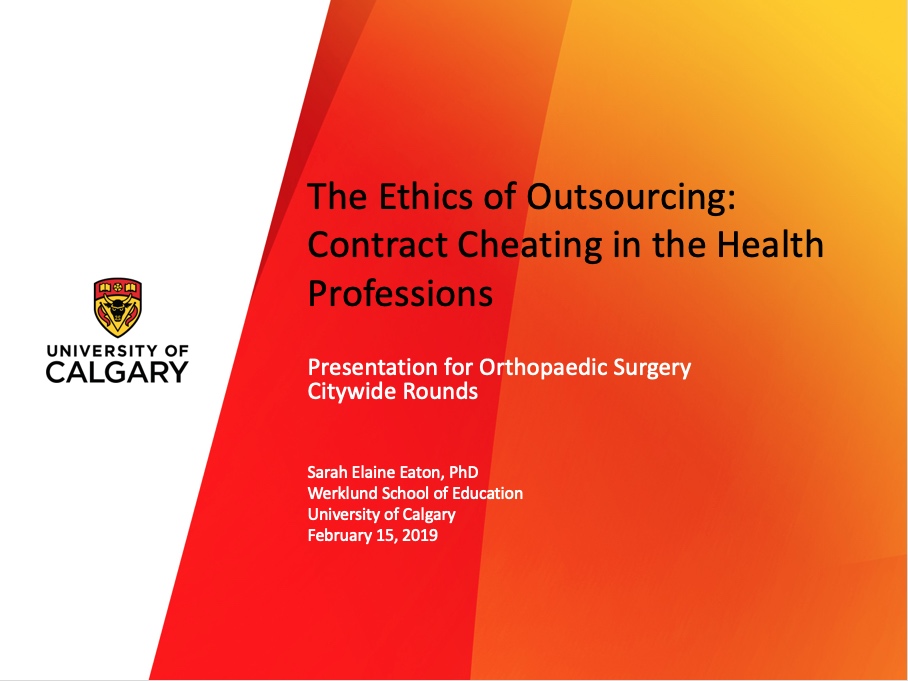
Title slide - Orthopaedic surgery rounds

References:

Bagshaw, E. (2016, May 26). University of Sydney’s medical school in second cheating controversy. Sydney Morning Herald. Retrieved from https://www.smh.com.au/education/university-of-sydneys-medical-school-in-second-cheating-controversy-20160525-gp3g3h.html

Bretag, T. (2017). Tertiary Education Quality and Standards Agency, Good Practice Note: Addressing contract cheating to safeguard academic integrity  Retrieved from https://www.teqsa.gov.au/latest-news/publications/good-practice-note-addressing-contract-cheating-safeguard-academic

Clarke, R., & Lancaster, T. (2006). Eliminating the successor to plagiarism: Identifying the usage of contract cheating sites. Paper presented at the Second International Plagiarism Conference, Gateshead, UK.

Curtis, G. J., & Clare, J. (2017). How Prevalent is contract cheating and to what extent are students repeat offenders? Journal of Academic Ethics, 15(2), 115-124. doi:10.1007/s10805-017-9278-x

Eaton, S. E. (2018). Contract cheating: A Canadian perspective.  Retrieved from http://blogs.biomedcentral.com/bmcblog/2018/07/24/contract-cheating-a-canadian-perspective/

Eaton, S. E., & Edino, R. I. (2018). Strengthening the research agenda of educational integrity in Canada: A review of the research literature and call to action. Journal of Educational Integrity, 14(1). Retrieved from https://edintegrity.biomedcentral.com/articles/10.1007/s40979-018-0028-7 doi:https://doi.org/10.1007/s40979-018-0028-7

Hosney, M. I., & Fatima, S. (2014). Attitude of students towards cheating and plagiarism: University case study. Journal of Applied Sciences, 14(8), 748-757. doi:10.3923/jas.2014.748.757

International Center for Academic Integrity. (2016). Institutional toolkit to combat contract cheating  Retrieved from http://integrity.fiu.edu/pdfs/Contract%20Cheating.pdf

Lancaster, T. (2018). US in first place for essays orders (not surprising), with the UK and Canada in equal second place [Tweet].   Retrieved from https://twitter.com/DrLancaster/status/1029014675198013440

Lancaster, T., & Clarke, R. (2008). The phenomena of contract cheating. In T. S. Roberts (Ed.), Student plagiarism in an online world: Problems and solutions (pp. 144-158). Hershey, PA: Idea Group Inc.

Lancaster, T., & Clarke, R. (2015). Examining contract cheating, essay mill use and academic misconduct by students on health courses.  Retrieved from https://www.researchgate.net/publication/323425525_Examining_Contract_Cheating_Essay_Mill_Use_and_Academic_Misconduct_by_Students_on_Health_Courses

Newton, P. M., & Lang, C. (2016). Custom essay writers, freelancers, and other paid third parties. In T. Bretag (Ed.), Handbook of Academic Integrity (pp. 249-271). Singapore: Springer Singapore.

O’BRien, N., & Smith, A. (2015, June 6). Cheating scandal: Sydney university to review medical study unit. Sydney Morning Herald. Retrieved from https://www.smh.com.au/education/cheating-scandal-sydney-university-to-review-medical-study-unit-20150606-ghi5d2.html

Plagiarism.org. (2017). How big of a problem in contract cheating?   Retrieved from http://www.plagiarism.org/blog/2017/12/12/how-big-of-a-problem-is-contract-cheating

Quality Assurance Agency for Higher Education (UK) (QAA). (2017). Contracting to cheat in higher education: How to address contract cheating, the use of third-party services and essay mills  Retrieved from http://www.qaa.ac.uk/en/Publications/Documents/Contracting-to-cheat-in-higher-education.pdf

Rogerson, A. M. (2017). Detecting contract cheating in essay and report submissions: process, patterns, clues and conversations. International Journal for Educational Integrity, 13(1), 10. doi:10.1007/s40979-017-0021-6

Tonkin, A. L. (2015). “Lifting the carpet” on cheating in medical school exams. BMJ: British Medical Journal, 351(August), 22-29.

Turnitin. (2013). Paying for plagiarism (webinar). Retrieved from http://go.turnitin.com/webcast/paying-for-plagiarism

University of Alberta. (n.d.). Student Conduct and Accountability: Proving Misconduct.   Retrieved from https://www.ualberta.ca/provost/dean-of-students/student-conduct-and-accountability/proving-misconduct

Walker, M., & Townley, C. (2012). Contract cheating: A new challenge for academic honesty? Journal of Academic Ethics, 10(1), 27–44. https://doi.org/10.1007/s10805-012-9150-y

If you would like  a copy of this talk, please e-mail me at seaton (at) ucalgary (dot) ca

______________________________________________________

Share or Tweet this: The ethics of outsourcing: Contract cheating in the health professions https://wp.me/pNAh3-2mw

This blog has had over 2 million views thanks to readers like you. If you enjoyed this post, please “like” it or share it on social media. Thanks!

Sarah Elaine Eaton is a faculty member in the Werklund School of Education, University of Calgary, Canada.

Opinions are my own and do not represent those of the Werklund School of Education or the University of Calgary.


How to use Scribd to publish your own documents online: A free, downloadable, step-by-step guide

September 2, 2013

With a new school year about to start, a great online tool for teachers and students to know about is Scribd. This online service lets you publish all kinds of documents, including:

  • Resources (like the guide I am sharing with you in this post)
  • Slide presentations
  • Digitally created books
  • Basically any document you can save in Word or .pdf format.

Here’s a preview, step-by-step, “how to” guide for you:

View this document on Scribd

To download a free copy, click on the download icon next to the word “Scribd” at the bottom of the frame. (It looks like an arrow pointing downwards.)

__________________________________

If you enjoyed this post, please “like” it or share it on social media. Thanks!

Share or Tweet this: How to use Scribd to publish your own documents online: A free, downloadable, step-by-step guide  http://wp.me/pNAh3-1Em

Update – January 2018 – This blog has had over 1.8 million views thanks to readers like you. If you enjoyed this post, please “like” it or share it on social media. Thanks!

Sarah Elaine Eaton is a faculty member in the Werklund School of Education, University of Calgary, Canada.


De-grouping to be a more effective leader

August 2, 2013

LinkedIn logoYou are probably familiar with the term “re-grouping”. It means taking a breath and a step back from a situation in order to re-assess the current state of it.

Lately, I have been “de-grouping”, mostly on LinkedIn. For a number of years, I have been a member of the maximum number of groups allowed, which is 50. I signed up for groups related to topics I was interested in professionally including leadership, literacy, languages, marketing, education and other topics. I tried to read discussion posts and contribute. I thought it was a good way to keep my pulse on sectors and industries that I felt were important to my career.

What I found was quite the opposite. Instead of staying on top of news and trends, I was inundated with messages, many of which did not help me learn, grow or provide many insights.

On the flip side, I was also unable to contribute much of value to many of the discussions.

I have pared down my membership to 10 LinkedIn groups. Here are the three criteria I used to decide which groups to stay in:

  1.  I personally know some or all of the members. I’ve seen the whites of their eyes and I can easily remember their smile.
  2. I learn something from the discussions.
  3. I can contribute something of value to the discussions from time to time.

For me, cutting back on the number of groups I am a member of on LinkedIn has helped free up time and energy for other activities such as tending to my clients, teaching students and preparing upcoming presentations and workshops for the fall. All in all, being more selective about how I spend my time and energy online has helped me to cultivate my professional and leadership skills overall. I’m still online… just more selectively than ever before.

I have increased energy as I am using laser-focus to determine which activities bring value to my profession and where I can also make a meaningful contribution.

Related post: How to delete LinkedIn contacts who spam you (and why you should) http://wp.me/pNAh3-1CO

 __________________________

If you enjoyed this post, please “like” it or share it on social media. Thanks!

Share or Tweet this: De-grouping to be a more effective leader http://wp.me/pNAh3-1De

Update – January 2018 – This blog has had over 1.8 million views thanks to readers like you. If you enjoyed this post, please “like” it or share it on social media. Thanks!

Sarah Elaine Eaton is a faculty member in the Werklund School of Education, University of Calgary, Canada.