“What should we be assessing exactly?” This was a question one of our research participants asked when we interviewed them as part of our project on artificial intelligence and academic integrity, sponsored by a University of Calgary Teaching Grant.
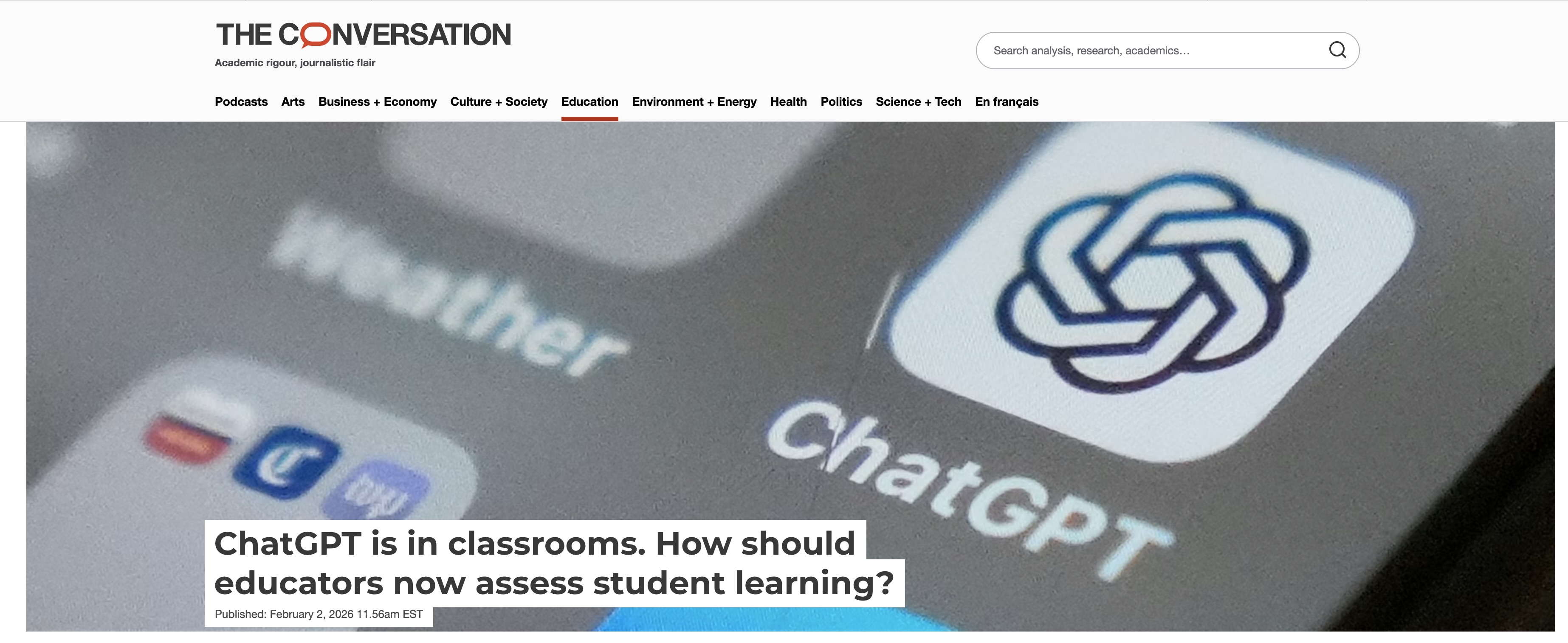
In an article published in The Conversation, we provide highlights of the results from our interviews with 28 educators across Canada, as well as our analysis of 15 years of research that looked at how AI affects education. (Spoiler alert: AI is a double-edged sword for educators and there are no easy answers.)
Screenshot from The Conversation.
We emphasize that, “in a post-plagiarism context, we consider that humans and AI co-writing and co-creating does not automatically equate to plagiarism.” Check out the full article in The Conversation.
You can check out the scholarly paper that we published in Assessment and Evaluation in Higher Education that goes into more detail about the methods and findings of our interviews.
I’d like to give a shoutout to all the project team members who worked with us on various aspects of this research: Robert (Bob) Brennan (Schulich School of Engineering, University of Calgary), Jason Weins (Faculty of Arts, University of Calgary), Brenda McDermott (Student Accessibility Services, University of Calgary), Rahul Kumar (Faculty of Education, Brock University), Beatriz Moya (Instituto de Éticas Aplicadas, Pontificia Universidad Católica de Chile) and the student research assistants who helped along the way (who have now all successfully graduated and moved on to the next phase of their careers): Jonathan Lesage, Helen Pethrick, and Mawuli Tay.
Sarah Elaine Eaton, PhD, is a Professor and Research Chair in the Werklund School of Education at the University of Calgary, Canada. Opinions are my own and do not represent those of my employer.
This week I did an invited presentation for the European Network for Academic Integrity (ENAI) Integrity for All Working Group.
As part of my presentation, I shared this bibliography of resources that I’ve worked on over the past several years on academic integrity as it relates to equity, diversity, inclusion, accessibility, and decolonization. These topics have become increasingly important to me over the past half decade and it is more important now than it ever has been to elevate the importance of these topics, along with human rights and social justice, when addressing matters of student conduct.
This bibliography contains a list of academic integrity articles, presentations, and resources that focus on these topics.
I’ve done my best to prepare this list according to APA 7 conventions, but please forgive any errors.
I aim to make as much of my content open access. If there is anything on this list that you cannot access, please contact me directly and I’ll see what I can do.
Sarah Elaine Eaton, PhD, is a Professor and Research Chair in the Werklund School of Education at the University of Calgary, Canada. Opinions are my own and do not represent those of my employer.
As a new academic year begins here in the northern hemisphere, I’m worried. I am worried that equity-deserving students, including racialized and linguistic-minority students, disabled and neurodivergent students, and others from equity-deserving groups will fall through the cracks again this year.
Conversations about academic integrity often centre around detection and discipline.
How many students will be accused of — and investigated for — academic cheating this year when what they actually needed was learning support? Or language support? Or just a clearer understanding of what academic integrity is and how to uphold it?
It doesn’t have to be this way.
Academic integrity is also about creating a learning environment grounded in fairness and opportunity for every student. Social justice, equity, inclusion, diversity, and accessibility shape how students experience integrity in real ways:
Equity reminds us that students enter the classroom with different levels of preparation and support.
Inclusion ensures every student can participate in learning and assessment.
Accessibility removes barriers that make it harder for some students to meet expectations.
A social justice lens helps us see patterns in who is reported or penalized for breaches of integrity and why.
Here are some actions educators can take in the first month of classes to support student success:
Review course materials to ensure instructions and policies about integrity are written in plain, accessible language.
Dedicate class time to talking with students about what integrity looks like in your course and why it matters.
Share examples of proper citation and collaboration that are relevant to your discipline.
Make time for questions about assessments so students understand what is expected and where to find help.
Connect students early to campus supports such as writing centres, student services, and accessibility services.
This is just a start.
My point is this: Do not assume that students should just know what academic integrity means. Take the time to explain your expectations and policies. In order for students to follow the rules, they need to know what the rules are.
Academic integrity is not only about avoiding plagiarism or cheating. It is also about fostering trust and fairness so that all students have a fair chance to learn and succeed. The choices we make in the first few weeks of the term set the tone for the entire year.
What steps are you taking at the start of this new school year to build a more inclusive and equitable approach to academic integrity?
Sarah Elaine Eaton, PhD, is a Professor and Research Chair in the Werklund School of Education at the University of Calgary, Canada. Opinions are my own and do not represent those of my employer.
Since 2020 I’ve been working with a number of collaborators on projects related to fake degrees, diploma mills, and credential fraud. One of the people I have had the privilege of working with is FBI Special Agent (ret.), Allen Ezell, who is one of the world’s leading experts on fake degrees and accreditation fraud.
We also learned from other contributors to the book that the companies who sell fake credentials don’t stop there. They can also provide contact cheating services (often under the guise of ‘research services’), fake admission letters, fake transcripts, fraud in standardized testing (e.g., sending impersonators to write English language proficiency tests), and much more.
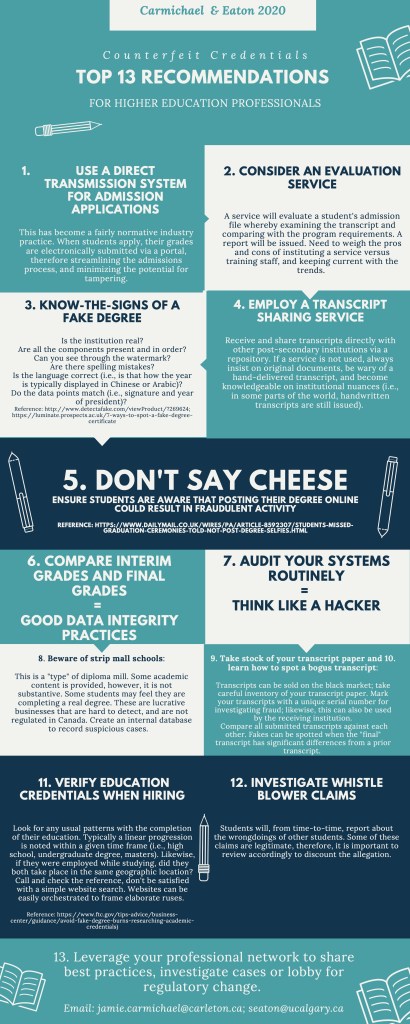
In the introduction for the book, we connect the dots to show how admissions fraud, contract cheating (e.g., term paper mills), scientific and scholarly paper mills, and fake degrees and fraudulent credentials are all connected. We synthesize the key ideas in this infographic:
Throughout the past half-decade, we’ve developed a number of resources related to these topics. I’ve posted about them previously, but I figured it might be helpful if I gathered some of them into a single blog post. They are all freely available as open access resources.
Counterfeit Credentials: 13 Recommendations for Higher Education Professionals
This infographic is intended mainly for registrars, admissions staff, admissions committees and others whose work involves assessing the credentials of applicants for university and college programs.
Scholarships Without Scruples
In this infographic, Jamie Carmichael and I share signs of scholarship scams, which is one from of educational fraud:
When it comes to education fraud, there are many angles to consider. There is certainly a need for more research, awareness, and advocacy on these topics, especially as GenAI can make these types of fraud easier.
Below are some related posts and further resources that I hope you find helpful.
Carmichael, J. J. (2024). Reframing and Broadening Adversarial Stylometry for Academic Integrity. In S. E. Eaton (Ed.), Second Handbook of Academic Integrity (pp. 1467-1485). Springer Nature Switzerland. https://doi.org/10.1007/978-3-031-54144-5_148
Carmichael, J., & Eaton, S. E. (2020). Counterfeit Credentials: Top 13 Recommendations for Higher Education Professionals (Infographic). University of Calgary. http://hdl.handle.net/1880/113042
Clark, A. (2023). Examining the problem of fraudulent English test scores: What can Canadian higher education institutions learn? In S. E. Eaton, J. J. Carmichael, & H. Pethrick (Eds.), Fake Degrees and Fraudulent Credentials in Higher Education (pp. 187-207). Springer International Publishing. https://doi.org/10.1007/978-3-031-21796-8_9
Çelik, Ö., & Razı, S. (2023). Avoiding favouritism in the recruitment practice of Turkish higher education institutions. In S. E. Eaton, J. J. Carmichael, & H. Pethrick (Eds.), Fake Degrees and Fraudulent Credentials in Higher Education (pp. 153-167). Springer International Publishing. https://doi.org/10.1007/978-3-031-21796-8_7
DeCoster, B. (2023). There is no culture? A framework for addressing admissions fraud. In S. E. Eaton, J. J. Carmichael, & H. Pethrick (Eds.), Fake Degrees and Fraudulent Credentials in Higher Education (pp. 209-226). Springer International Publishing. https://doi.org/10.1007/978-3-031-21796-8_10
Duklas, J. (2023). Bridging to tomorrow: A historical and technological review of credential exchange in higher education within Canada. In S. E. Eaton, J. J. Carmichael, & H. Pethrick (Eds.), Fake Degrees and Fraudulent Credentials in Higher Education (pp. 95-113). Springer International Publishing. https://doi.org/10.1007/978-3-031-21796-8_4
Eaton, S. E., & Carmichael, J. (2020). Scholarships without scruples (Infographic). University of Calgary: http://hdl.handle.net/1880/113044
Eaton, S. E., Carmichael, J., & Pethrick, H. (Eds.). (2023). Fake degrees and credential fraud in higher education. Springer. https://doi.org/10.1007/978-3-031-21796-8
Ezell, A. (2023). Yesterday, today, and tomorrow: A tour of Axact, the “World’s Largest Diploma Mill”. In S. E. Eaton, J. J. Carmichael, & H. Pethrick (Eds.), Fake Degrees and Fraudulent Credentials in Higher Education (pp. 49-94). Springer International Publishing. https://doi.org/10.1007/978-3-031-21796-8_3
Hextrum, K. (2023). Fair play, fraud, or fixed? Athletic credentials in U.S. higher education. In S. E. Eaton, J. J. Carmichael, & H. Pethrick (Eds.), Fake Degrees and Fraudulent Credentials in Higher Education (pp. 115-132). Springer International Publishing. https://doi.org/10.1007/978-3-031-21796-8_5
Orim, S.-M., & Glendinning, I. (2023). Corruption in admissions, recruitment, qualifications and credentials: From research into quality assurance. In S. E. Eaton, J. J. Carmichael, & H. Pethrick (Eds.), Fake Degrees and Fraudulent Credentials in Higher Education (pp. 133-151). Springer International Publishing. https://doi.org/10.1007/978-3-031-21796-8_6
Sabbaghan, S., & Fazel, I. (2023). None of the above: Integrity concerns of standardized English proficiency tests. In S. E. Eaton, J. J. Carmichael, & H. Pethrick (Eds.), Fake Degrees and Fraudulent Credentials in Higher Education (pp. 169-185). Springer International Publishing. https://doi.org/10.1007/978-3-031-21796-8_8
This blog has had over 3.7 million views thanks to readers like you. If you enjoyed this post, please ‘Like’ it using the button below or share it on social media. Thanks!
Sarah Elaine Eaton, PhD, is a Professor and Research Chair in the Werklund School of Education at the University of Calgary, Canada. Opinions are my own and do not represent those of my employer.
Many people in the academic integrity world are already familiar with contract cheating websites, those that deal in the business of buying and selling exams, bespoke term papers, theses, and exam questions and answers.
But this business isn’t limited to the millions of K-12, high school and post-secondary students. The exam fraud business is alive and well for professional accreditation exams for folks who either want to bypass a formal university degree or to supplement existing credentials.
For example, in the IT industry credentials are often the golden key to new opportunities. Certifications and accreditations (allegedly) validate technical skills, offering (so-called) proof that a candidate has the expertise needed for a professional role.
Taking into account supply and demand, with job candidates being in high supply and well-paying jobs being in high demand, certification and accreditation fraud is alive and well in the IT industry, as well as other industries. This is a trend employers cannot afford to ignore.
Exposing the Fraud: How Buying and Selling of Certification Exam Questions Works
Certification fraud occurs when individuals falsify credentials, purchase counterfeit certifications, or misuse legitimate certifications obtained by others. But there’s this sneaky grey area that exists when a person actually sits a professional exam themselves, but they’ve prepared by buying the exam questions and/or the answers from an online vendor.
I won’t name specific companies that do this in this post, because I’m not in the habit of advertising for these fraudsters, but I want to show you how they work, so here are some screenshots:
Screenshot #1: Home page
At the top of this website, the company claims that 94% of the exam questions that they sold were “almost the same” and that 97% of customers passed the exam using their materials. (Who knows what happened to the other 3%…?) Finally, 98% of customers found the “study guides” effective and helpful.
There’s that phrase that we commonly see on contract cheating websites, “study guide”. For the uninitiated, this is a euphemism for “exam questions”.
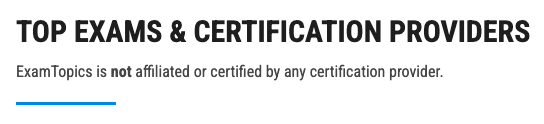
Screenshot #2: Saying it like it is: Not affiliated with any certification provider
In this screenshot the company states plainly that they are not affiliated or certified by any certification provider. Reading between the lines, the message is ‘caveat emptor’ or ‘buyer beware’. They are telling you upfront that they are in the business of selling exam questions and make no guarantees about their products.
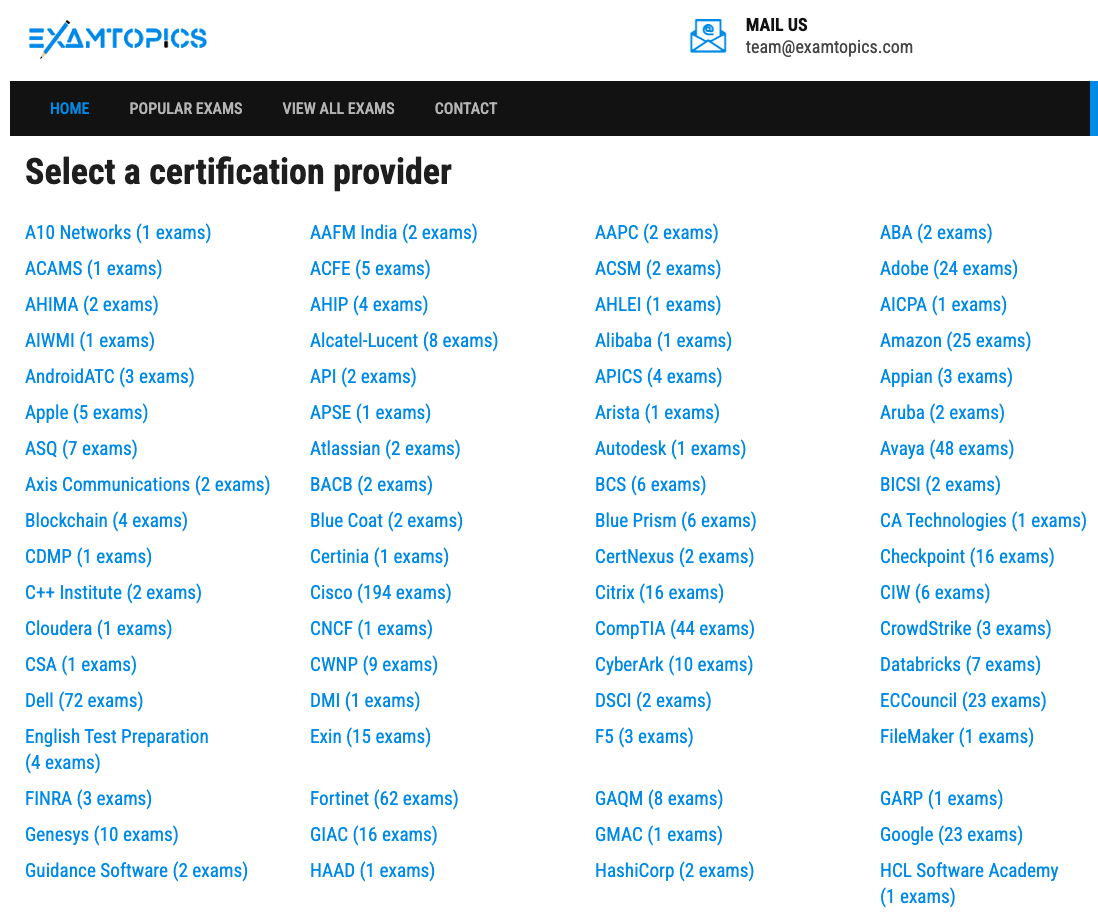
Screenshot #3: Samples of accreditation exam questions for sale
Look at all the options: You can buy exam questions for certifications offered by DELL, English language proficiency exams, Citrix, Adobe, and Amazon, and Google just to name a few.
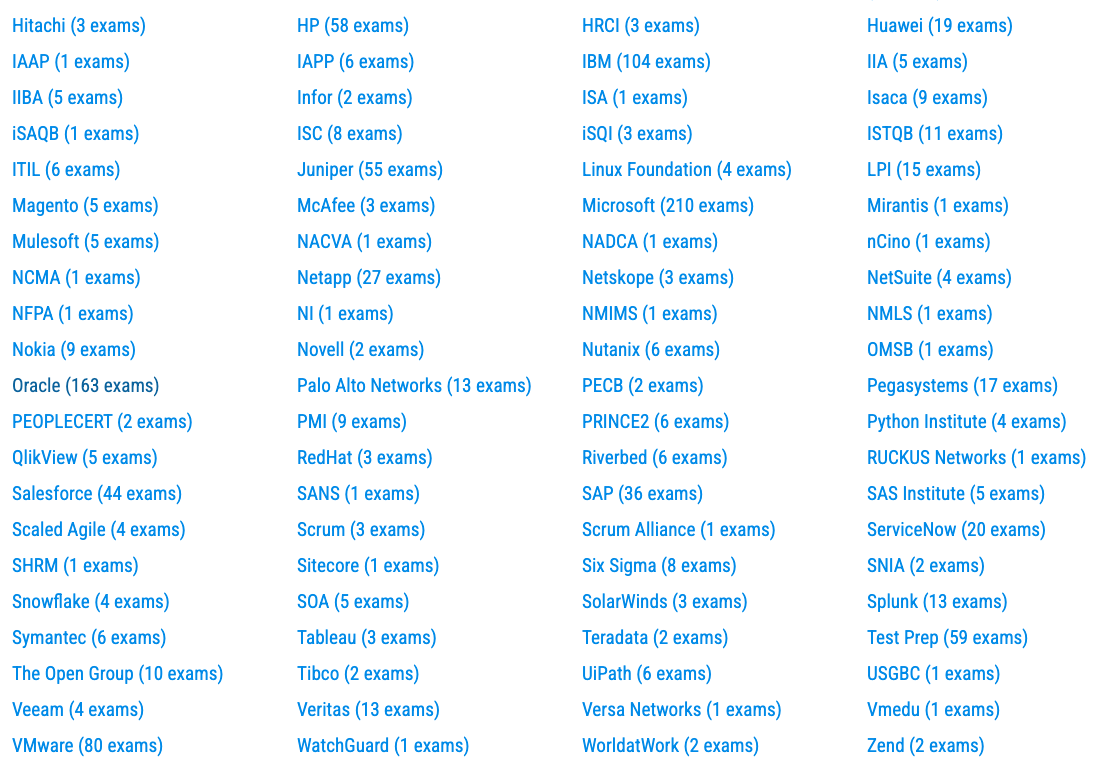
Screenshot #4: More samples of certification provider exam questions for sale.
But wait! There’s more! You can buy exam questions for certifications offers by Oracle, IBM, SAP, and others.
Businesses that buy and sell exam certification questions engage in fraudulent practices undermine trust in the certification system and create significant risks for employers.
Consequences for Employers
Hiring someone with counterfeit credentials can have dire consequences. Unqualified employees may lack the technical skills to handle complex tasks, leading to project delays, costly errors, or even security breaches. Beyond the financial impact, fraudulent certifications can erode team morale, as employees with genuine qualifications may feel undervalued when working alongside those who faked their way in.
What Employers and Hiring Managers can Do
Employers, and especially hiring managers and those working in HR, must take proactive steps to safeguard their hiring processes. Some of you may be asking if this kind of practice is actually illegal. I’m not a lawyer, but what I can say is that although contact cheating for students is illegal in countries like Australia, the UK, and Ireland, if you’re not a student, then you might get to live a proverbial grey zone. To the best of my knowledge, it is not actually illegal to buy and sell questions for professional certification exams in most countries of the world.
So, what can employers do? First, trust but verify! Verifying certifications directly with issuing organizations is one step. Many certification bodies offer easy online verification tools to confirm a candidate’s credentials. Additionally, employers should stay informed about recognized accreditation standards and avoid unverified institutions.
Having said this, verification of credentials and certification won’t help if someone has bought exam questions online and then taken the test themselves. Their results could be ‘verifiable’ in a sense, because there’s an assumption that a person who has passed an exam had the knowledge to do so. But when someone buys their exam questions before sitting the test, it means that they have prepared for an exam and may not necessarily have internalized the knowledge or skills that should match the certification they receive from passing an exam. An exam is one measure of knowledge, but it isn’t the only one.
Having prospective employees demonstrate their skills and respond to technical questions that could only be answered if the person has the knowledge to back up their documentation can also help. One possibility is to give an interviewee a real-world scenario that could happen at your organization. Ask them how they would go about problem-solving it. If they struggle or stumble, it could be a sign that they lack the necessary skills for the job. (It could also be a sign that they’re just nervous or that interviewing isn’t their strength. So let me also make a plug here for having an inclusive and equitable interviewing process.)
Investing in robust, inclusive, and equitable hiring practices not only protects an organization from the pitfalls of fraud but also helps to create a culture of accountability and excellence. By placing a premium on authentic certifications combined with demonstrable knowledge and skills and inclusive hiring practices, employers signal their commitment to integrity and ensure they are building a team of qualified professionals.
Bottom line: If you’re hiring someone who says they have an IT certification based on taking exams, it’s worth it to find out if they actually have the knowledge and skills to do the job.
And this is just one example of one site. Rest assured that it is not the only one out there. Exam cheating companies like this one don’t exist in isolation. They’re in the game to make money, and lots of it.
In an industry where skills and knowledge drive success, vigilance against certification and accreditation fraud is not optional—it is a driver of success.
Future Outlook
Fraud and corruption are alive and well education and industry. There is a growing community of sleuths, scholars, and activists who are ready to sniff out fraud and expose it and naïveté about these matters is quickly going out of fashion.
There may have been a time when it was acceptable—or even fashionable—to clutch your pearls, proclaim moral outrage, or just refuse to accept that educational and professional fraud are more commonplace than you might have previously thought. GenAI is here to stay, and so are companies whose business is educational, accreditation, scientific, and professional fraud. These companies are profitable because they have customers willing to pay for their goods and services.
Vigilance, sleuthing, and exposing fraud are very much on trend as we move ahead into the new year. And if you’re a hiring manager, taking steps to protect the integrity of your operations is definitely part of the job in 2025 and beyond.
Eaton, S. E., & Carmichael, J. (2022). The Ecosystem of Commercial Academic Fraud. In. Calgary, Canada: University of Calgary. https://dx.doi.org/10.11575/PRISM/40330
Eaton, S. E., Carmichael, J., & Pethrick, H. (Eds.). (2023). Fake degrees and credential fraud in higher education. Springer. https://doi.org/10.1007/978-3-031-21796-8
This blog has had over 3 million views thanks to readers like you. If you enjoyed this post, please “like” it or share it on social media. Thanks!
Sarah Elaine Eaton, PhD, is a Professor and Research Chair in the Werklund School of Education at the University of Calgary, Canada. Opinions are my own and do not represent those of my employer.


 Posted by Sarah Elaine Eaton, Ph.D.




 Learning, Teaching and Leadership
You must be logged in to post a comment.