The headline reads, “IELTS exam fraud scandal ‘shocks’ Indonesia“, as reported by Vietnam.vn. The article goes on to offer details about large-scale cheating on English-language proficiency testing, saying that, “Faced with the increasing incidence of fraud, many prestigious universities around the world have adjusted their admission policies, especially regarding IELTS requirements.”
Contract cheating and exam proxies (i.e., impersonators) are at the heart of the scandal, with customers each paying about 47,000,000 Vietnamese Dong (which seems to convert to about $1851 USD or $2650 CAD, according to one online currency exchange website).
The article reports that these cheating incidents have caused schools in Singapore, Australia, and the US to raise the minimum test score for entrance to certain programs. (I am puzzled as to why schools think that raising the minimum score for admissions will prevent cheating on standardized texts used as an entrance requirement? My guess is that it might just drive up the price of fraud…)
Two chapters from our edited book, Fake Degrees and Fraudulent Credentials in Higher Education (Eaton, Carmichael, and Pethrick, 2023) are worth mentioning, as the authors of both chapters raised the alarm about the issue of large-scale global cheating on English language proficiency exams.
Angela Clark (York University), in her chapter, “Examining the Problem of Fraudulent English Test Scores: What Can Canadian Higher Education Institutions Learn?”, argues that “relying on a single language proficiency test score to determine an individual’s readiness is problematic, and also problematic is the lack of related academic research and data to help guide admissions decision-making”. She looks at media reports from the UK, US, and Canada, noting that, “Media reports and a lack of data serve to promote distrust of the language testing process and the test scores that institutions receive.”
Cheating on English language proficiency exams is nothing new and nor is it isolated to any one country.
Both of these chapters are thoroughly researched and well written. If you’re interested in the topic of fraud in English language exams, I recommend checking them out. In the meantime, large-scale cheating on standardized tests and the related problem of admissions fraud should shock exactly no one.
References
Clark, A. (2023). Examining the problem of fraudulent English test scores: What can Canadian higher education institutions learn? In S. E. Eaton, J. J. Carmichael, & H. Pethrick (Eds.), Fake Degrees and Fraudulent Credentials in Higher Education (pp. 187-207). Springer International Publishing. https://doi.org/10.1007/978-3-031-21796-8_9
Sabbaghan, S., & Fazel, I. (2023). None of the above: Integrity concerns of standardized English proficiency tests. In S. E. Eaton, J. J. Carmichael, & H. Pethrick (Eds.), Fake Degrees and Fraudulent Credentials in Higher Education (pp. 169-185). Springer International Publishing. https://doi.org/10.1007/978-3-031-21796-8_8
This blog has had over 3.7 million views thanks to readers like you. If you enjoyed this post, please ‘Like’ it using the button below or share it on social media. Thanks!
Sarah Elaine Eaton, PhD, is a Professor and Research Chair in the Werklund School of Education at the University of Calgary, Canada. Opinions are my own and do not represent those of my employer.
Generative AI (GenAI) is transforming teaching, learning, and assessment in higher education.
Learn to integrate GenAI effectively while maintaining academic integrity and enhancing student agency.
Dr. Sarah Eaton shares innovative strategies that promote critical thinking and original scholarship. Explore how GenAI reshapes academic practices and discover proactive approaches to leverage its potential.
This session equips educators, administrators, and policymakers to lead purposefully in a dynamic academic landscape.
Speaker bio
Sarah Elaine Eaton is a Professor and research chair at the Werklund School of Education at the University of Calgary (Canada). She is an award-winning educator, researcher, and leader. She leads transdisciplinary research teams focused on the ethical implications of advanced technology use in educational contexts. Dr. Eaton also holds a concurrent appointment as an Honorary Associate Professor, Deakin University, Australia.
More Details
Date: January 29, 2025
Time: 12:00 – 13:00 Mountain time
This talk is free and open to the public, but there are only 20 seats available to join us in person! We can also accommodate folks online.
This blog has had over 3.7 million views thanks to readers like you. If you enjoyed this post, please “like” it or share it on social media. Thanks!
Sarah Elaine Eaton, PhD, is a Professor and Research Chair in the Werklund School of Education at the University of Calgary, Canada. Opinions are my own and do not represent those of my employer.
Here are three things you can do to prioritize human rights and dignity when it comes to policies and procedures to address allegations of academic or research misconduct:
Use a human-rights-by-design approach to developing, revising, and implementing policies by conducting a comprehensive review of existing academic integrity policies. Update policies to explicitly incorporate human rights principles, ensuring they address fair process, privacy, equitable treatment, and respect for human dignity. It is essential to involve individuals from representative groups in this process.
Provide ongoing training, education, and support to faculty, staff, and students about human rights principles and how they apply to misconduct investigations and case management. Create orientation programs that explain expectations for ethical conduct while respecting diverse cultural perspectives. Offer workshops and resources, peer mentoring programs, and support services.
Focus on continuous improvement and quality assurance of ethics and integrity practices by gathering feedback from students, faculty, staff and relevant stakeholders. Regularly review misconduct case management processes and data to ensure equitable treatment across different demographics.
Implementing human rights principles into misconduct investigations and case management helps to create more effective and sustainable learning environments. This approach prioritizes people over punishment, dignity over draconianism, and compassion over callousness.
This blog has had over 3 million views thanks to readers like you. If you enjoyed this post, please “like” it or share it on social media. Thanks!
Sarah Elaine Eaton, PhD, is a Professor and Research Chair in the Werklund School of Education at the University of Calgary, Canada. Opinions are my own and do not represent those of my employer.
Starting the year with a brief reflection inspired by the OECD Social and Emotional Skills for Better Lives report:
How can we, as educators, create systems and circumstances to help students thrive? How do we create opportunities for them? If there are doors that have been closed to them, how do we open those doors?
Or better yet, how do we break down the walls that hold up those doors in the first place?
These are some big questions I am contemplating for this year. How about you?
This blog has had over 3 million views thanks to readers like you. If you enjoyed this post, please “like” it or share it on social media. Thanks!
Sarah Elaine Eaton, PhD, is a Professor and Research Chair in the Werklund School of Education at the University of Calgary, Canada. Opinions are my own and do not represent those of my employer.
Many people in the academic integrity world are already familiar with contract cheating websites, those that deal in the business of buying and selling exams, bespoke term papers, theses, and exam questions and answers.
But this business isn’t limited to the millions of K-12, high school and post-secondary students. The exam fraud business is alive and well for professional accreditation exams for folks who either want to bypass a formal university degree or to supplement existing credentials.
For example, in the IT industry credentials are often the golden key to new opportunities. Certifications and accreditations (allegedly) validate technical skills, offering (so-called) proof that a candidate has the expertise needed for a professional role.
Taking into account supply and demand, with job candidates being in high supply and well-paying jobs being in high demand, certification and accreditation fraud is alive and well in the IT industry, as well as other industries. This is a trend employers cannot afford to ignore.
Exposing the Fraud: How Buying and Selling of Certification Exam Questions Works
Certification fraud occurs when individuals falsify credentials, purchase counterfeit certifications, or misuse legitimate certifications obtained by others. But there’s this sneaky grey area that exists when a person actually sits a professional exam themselves, but they’ve prepared by buying the exam questions and/or the answers from an online vendor.
I won’t name specific companies that do this in this post, because I’m not in the habit of advertising for these fraudsters, but I want to show you how they work, so here are some screenshots:
Screenshot #1: Home page
At the top of this website, the company claims that 94% of the exam questions that they sold were “almost the same” and that 97% of customers passed the exam using their materials. (Who knows what happened to the other 3%…?) Finally, 98% of customers found the “study guides” effective and helpful.
There’s that phrase that we commonly see on contract cheating websites, “study guide”. For the uninitiated, this is a euphemism for “exam questions”.
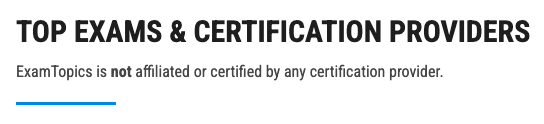
Screenshot #2: Saying it like it is: Not affiliated with any certification provider
In this screenshot the company states plainly that they are not affiliated or certified by any certification provider. Reading between the lines, the message is ‘caveat emptor’ or ‘buyer beware’. They are telling you upfront that they are in the business of selling exam questions and make no guarantees about their products.
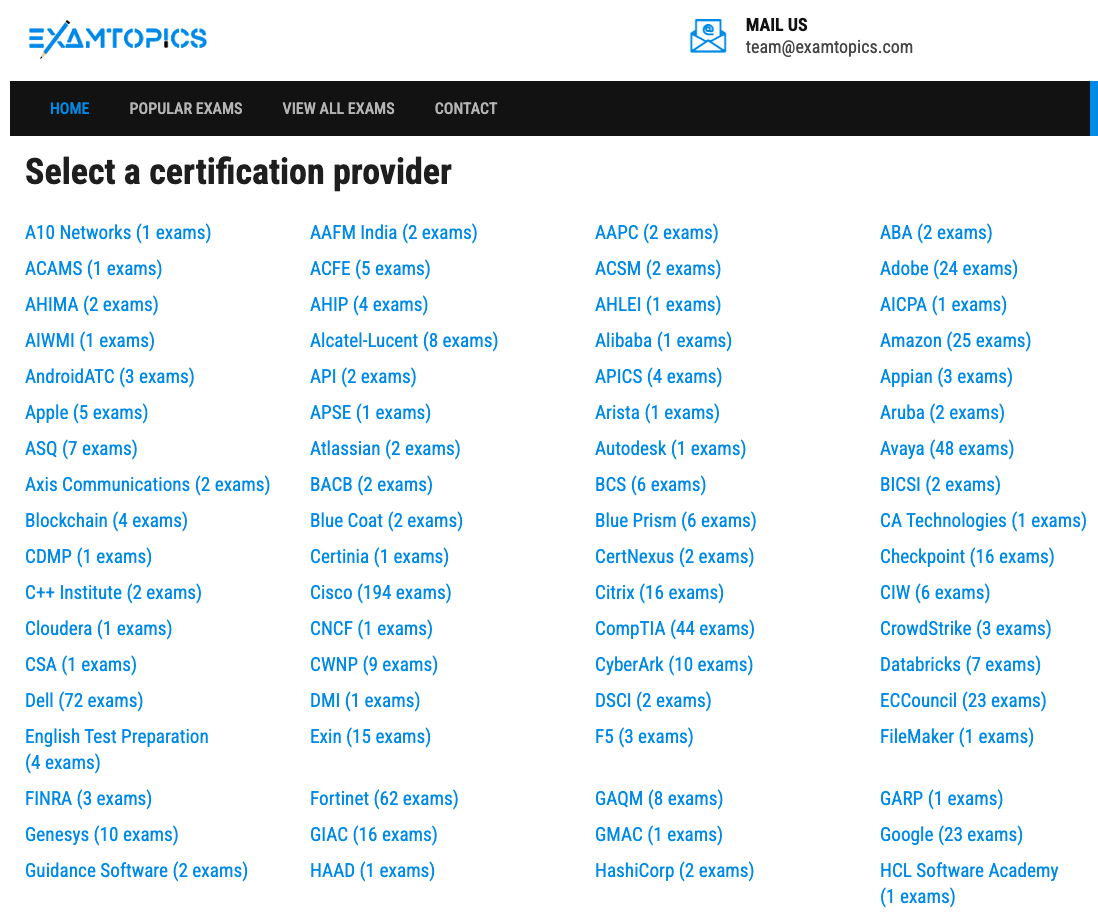
Screenshot #3: Samples of accreditation exam questions for sale
Look at all the options: You can buy exam questions for certifications offered by DELL, English language proficiency exams, Citrix, Adobe, and Amazon, and Google just to name a few.
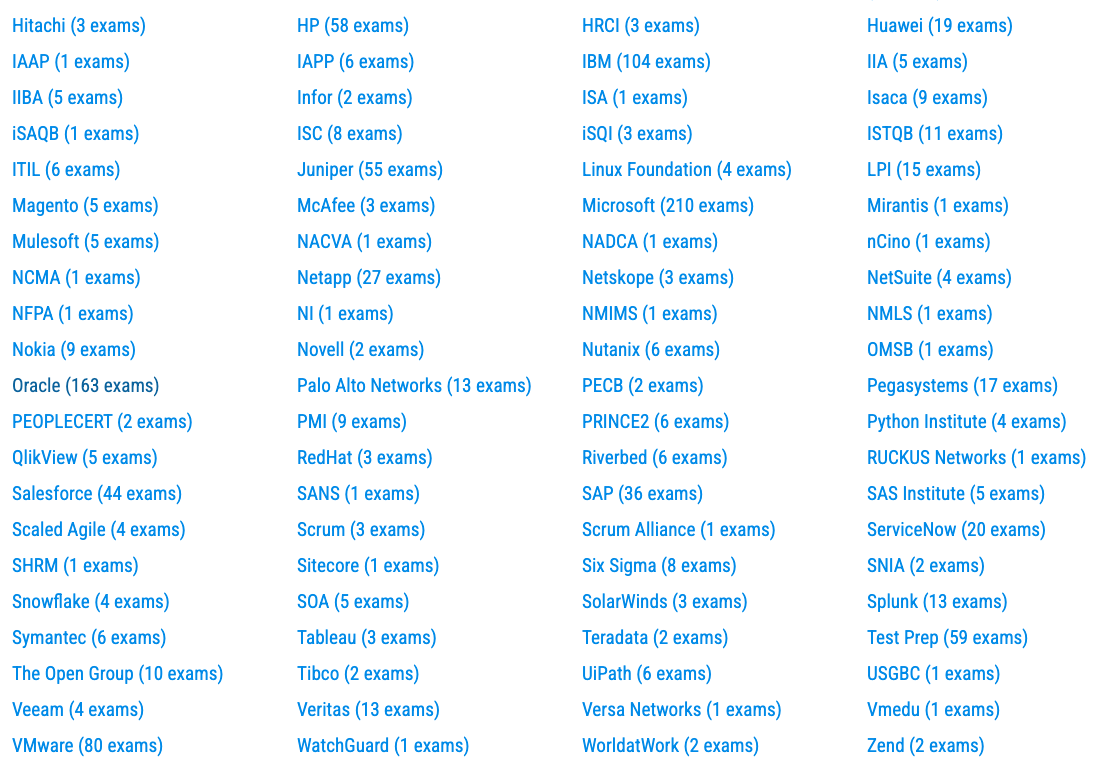
Screenshot #4: More samples of certification provider exam questions for sale.
But wait! There’s more! You can buy exam questions for certifications offers by Oracle, IBM, SAP, and others.
Businesses that buy and sell exam certification questions engage in fraudulent practices undermine trust in the certification system and create significant risks for employers.
Consequences for Employers
Hiring someone with counterfeit credentials can have dire consequences. Unqualified employees may lack the technical skills to handle complex tasks, leading to project delays, costly errors, or even security breaches. Beyond the financial impact, fraudulent certifications can erode team morale, as employees with genuine qualifications may feel undervalued when working alongside those who faked their way in.
What Employers and Hiring Managers can Do
Employers, and especially hiring managers and those working in HR, must take proactive steps to safeguard their hiring processes. Some of you may be asking if this kind of practice is actually illegal. I’m not a lawyer, but what I can say is that although contact cheating for students is illegal in countries like Australia, the UK, and Ireland, if you’re not a student, then you might get to live a proverbial grey zone. To the best of my knowledge, it is not actually illegal to buy and sell questions for professional certification exams in most countries of the world.
So, what can employers do? First, trust but verify! Verifying certifications directly with issuing organizations is one step. Many certification bodies offer easy online verification tools to confirm a candidate’s credentials. Additionally, employers should stay informed about recognized accreditation standards and avoid unverified institutions.
Having said this, verification of credentials and certification won’t help if someone has bought exam questions online and then taken the test themselves. Their results could be ‘verifiable’ in a sense, because there’s an assumption that a person who has passed an exam had the knowledge to do so. But when someone buys their exam questions before sitting the test, it means that they have prepared for an exam and may not necessarily have internalized the knowledge or skills that should match the certification they receive from passing an exam. An exam is one measure of knowledge, but it isn’t the only one.
Having prospective employees demonstrate their skills and respond to technical questions that could only be answered if the person has the knowledge to back up their documentation can also help. One possibility is to give an interviewee a real-world scenario that could happen at your organization. Ask them how they would go about problem-solving it. If they struggle or stumble, it could be a sign that they lack the necessary skills for the job. (It could also be a sign that they’re just nervous or that interviewing isn’t their strength. So let me also make a plug here for having an inclusive and equitable interviewing process.)
Investing in robust, inclusive, and equitable hiring practices not only protects an organization from the pitfalls of fraud but also helps to create a culture of accountability and excellence. By placing a premium on authentic certifications combined with demonstrable knowledge and skills and inclusive hiring practices, employers signal their commitment to integrity and ensure they are building a team of qualified professionals.
Bottom line: If you’re hiring someone who says they have an IT certification based on taking exams, it’s worth it to find out if they actually have the knowledge and skills to do the job.
And this is just one example of one site. Rest assured that it is not the only one out there. Exam cheating companies like this one don’t exist in isolation. They’re in the game to make money, and lots of it.
In an industry where skills and knowledge drive success, vigilance against certification and accreditation fraud is not optional—it is a driver of success.
Future Outlook
Fraud and corruption are alive and well education and industry. There is a growing community of sleuths, scholars, and activists who are ready to sniff out fraud and expose it and naïveté about these matters is quickly going out of fashion.
There may have been a time when it was acceptable—or even fashionable—to clutch your pearls, proclaim moral outrage, or just refuse to accept that educational and professional fraud are more commonplace than you might have previously thought. GenAI is here to stay, and so are companies whose business is educational, accreditation, scientific, and professional fraud. These companies are profitable because they have customers willing to pay for their goods and services.
Vigilance, sleuthing, and exposing fraud are very much on trend as we move ahead into the new year. And if you’re a hiring manager, taking steps to protect the integrity of your operations is definitely part of the job in 2025 and beyond.
Eaton, S. E., & Carmichael, J. (2022). The Ecosystem of Commercial Academic Fraud. In. Calgary, Canada: University of Calgary. https://dx.doi.org/10.11575/PRISM/40330
Eaton, S. E., Carmichael, J., & Pethrick, H. (Eds.). (2023). Fake degrees and credential fraud in higher education. Springer. https://doi.org/10.1007/978-3-031-21796-8
This blog has had over 3 million views thanks to readers like you. If you enjoyed this post, please “like” it or share it on social media. Thanks!
Sarah Elaine Eaton, PhD, is a Professor and Research Chair in the Werklund School of Education at the University of Calgary, Canada. Opinions are my own and do not represent those of my employer.


 Posted by Sarah Elaine Eaton, Ph.D.



 Learning, Teaching and Leadership
You must be logged in to post a comment.